
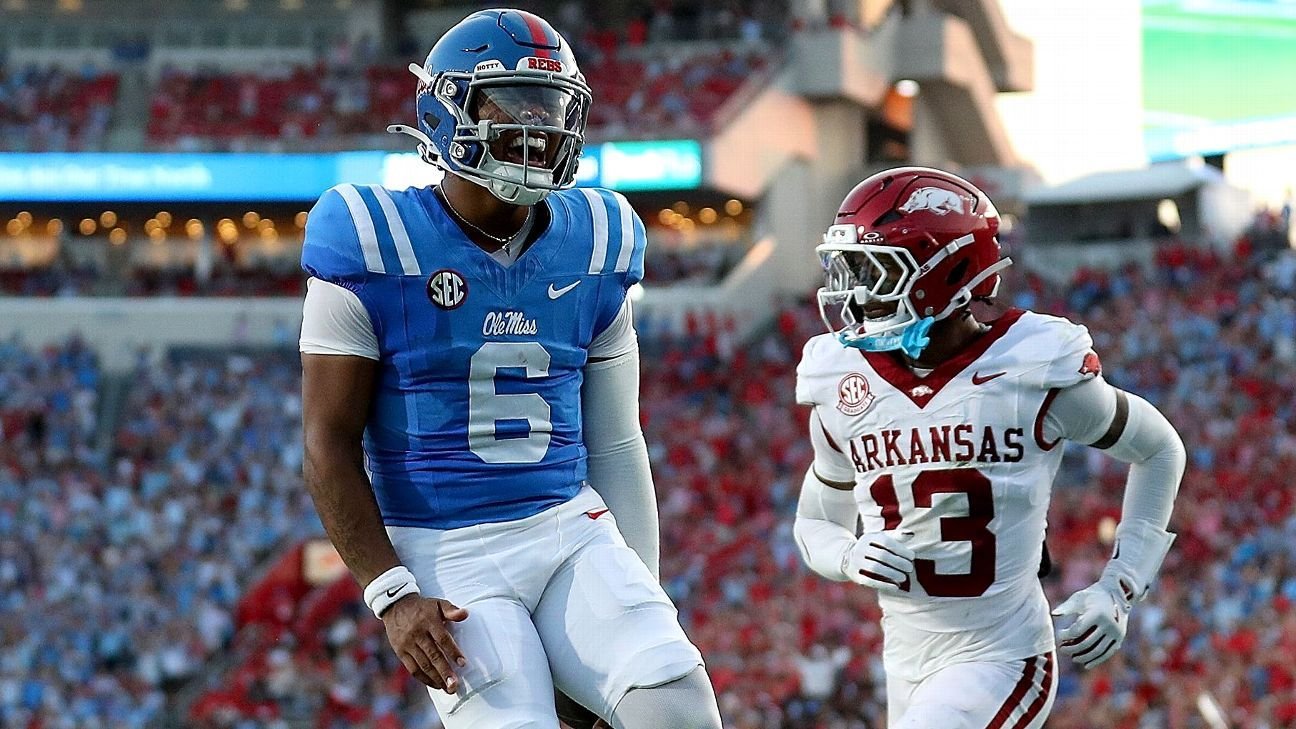
Every few years, college football brings back a group of quarterbacks set to dominate discussion and flood the races for the Heisman Trophy and other national honors. The 2026 season has one of those memorable collections.
Only two quarterbacks (Indiana’s Fernando Mendoza and Alabama’s Ty Simpson) heard their names called in the first two rounds of the NFL draft in April, while seven starters from the College Football Playoff field are back for 2026. The group of returnees includes several projected top prospects for the 2027 draft, including Oregon’s Dante Moore, Texas’ Arch Manning, Notre Dame’s CJ Carr and others, as well as Heisman candidates, such as Ole Miss’ Trinidad Chambliss, Ohio State’s Julian Sayin, Georgia’s Gunner Stockton and USC’s Jayden Maiava, and notable transfers such as LSU’s Sam Leavitt (Arizona State), Miami’s Darian Mensah (Duke), Oklahoma State’s Drew Mestemaker (North Texas) and Indiana’s Josh Hoover (TCU).
Manning likely will be the most-talked-about quarterback for the second straight season, but now he has some substance behind the buzz after his strong finish to 2025. There are many others in many different leagues to dissect, and I spent the spring and summer talking to coaches who mentor and scout the sport’s top quarterbacks.
My goal was to get a range of perspectives, not only about established players but up-and-coming ones in key roles. I spoke with coaches, coordinators and several general managers across college football to gather intel on 43 of the top returning quarterbacks. I tried to avoid those in competitions.
Here’s a conference-by-conference look:
Jump to a conference:
SEC | Big Ten
ACC/Notre Dame | Big 12

SEC

Manning faced outsized and largely unrealistic expectations entering his first season as Texas’ starter in 2025 and went through some predictable struggles before turning it on down the stretch. He accounted for multiple touchdowns in five of his final six starts, rushed for 208 yards and three touchdowns on just 16 carries against Texas A&M and Michigan to close the season, and eclipsed 325 passing yards three times in a four-game SEC stretch.
“It was not an easy year,” coach Steve Sarkisian told ESPN. “He grew up a lot, not only physically, but mentally, as the season went on. He was playing great football for us the second half of the season and at the end, and it so far has served as a great springboard. A lot of times, systematically, it’s the nuances, the changes of protections, the subtle hand signals of adjustment of a route, the knowing where your checkdowns are to get yourself out of trouble, not taking a sack, not taking an unnecessary hit, game management, special situations — third down, fourth down, red area — but it’s also leadership.”
Manning’s overall comfort with the constant spotlight and the schematic demands should serve him well this season as Texas tries to return to the College Football Playoff. An SEC defensive coordinator who faced Manning in 2025 said Manning’s maturity has stood out.
“He’s handled this situation better than anybody could possibly do,” the coach said. “The expectations aren’t fair, so personally, I hope he has a great year. Hopefully, he has an off game against us.”
Coaches say his willingness and selectivity on when to run can be a separator as a 226-pound player who moves well, but also his commitment to trusting his arm strength.
“He can absolutely rip it, like velocity, accuracy,” an SEC defensive coordinator said. “He got a little bit out of whack and made some mistakes, and then people were really defending him. It’s going to be really easy this year, because people are gonna have to double Cam Coleman. He’s a real one, and so is [Ryan] Wingo, so it’s like, you can’t double both of them.”

Arguably no quarterback ended last season playing better than Chambliss, who had three 300-yard passing efforts to close the regular season and then had 921 passing yards, four touchdowns and no interceptions in three CFP games. After being granted an injunction in February to play this fall, Chambliss projects as one of the leading Heisman contenders.
“You could see his ability, his arm strength and arm talent coming out of [Division II] Ferris State,” an SEC defensive coordinator said. “And then watching the whole season, his ability to make plays with his feet when things break down was exceptional.”
He no longer will be playing for coach Lane Kiffin, who left Ole Miss for LSU before the CFP, and must adjust to a new offensive playcaller in John David Baker. Coaches expect him to build on his impressive debut season at Ole Miss.
2:54
Ole Miss’ QB Trinidad Chambliss: ‘We went far, but we’re hungry for more’
“He’s a dude,” an SEC coach said. “Lane probably gets too much credit for Trinidad.”
A coach set to face Chambliss this fall praised his pure passing skills, saying, “His mechanics are more sound, and he played well last year. He played good football, and he led the team.”
Despite being listed at 6-foot, Chambliss adjusted to the bigger, stronger and faster SEC after transferring in from Ferris State. He completed 66.1% of his passes and added 527 rushing yards and eight touchdowns.
“Trinidad is not underrated now, and he’s a quick decision-maker,” an SEC defensive coordinator said. “He makes fast decisions. He can obviously hurt you with his legs, can hurt you with his arm. He’s just a playmaker. He makes guys around him better.”

Stockton doesn’t get as much NFL draft or Heisman buzz as other quarterbacks on the list, but he has proved more than capable of leading the offense for a national contender in Georgia. He enters his second season as Georgia’s QB1 after an extremely efficient 2025, when he completed 69.7% of his passes for 2,894 yards with 24 touchdown passes, only five interceptions on 386 attempts and a QBR of 84.9, which ranked sixth nationally.
The 6-1, 215-pound Stockton helped Georgia to an SEC title in 2025, and added 10 rushing touchdowns and 462 yards.
“He runs it better than you think, really smart, pretty accurate,” an SEC defensive coordinator said. “I don’t think he’s got unbelievable arm talent, but pretty good.”
Stockton delivered some of his best performances against top competition, from Georgia’s first meeting against Ole Miss (289 passing yards, four touchdowns, 83.9% completions) to a blowout out Texas (229 passing yards, four touchdowns, 81% completions) to the SEC championship game win against Alabama (three touchdowns, 20-of-26 passing). Although Georgia’s passing game could take another step, coaches see Stockton as a very reliable facilitator.
“He’s a great college quarterback,” an SEC defensive coordinator said. “He’s tough, so he can get some bull yards and take some big hits and all that stuff. I really like him, he’s a really good player. I don’t know if he’s an NFL specimen, but he’s a great college player.”

Leavitt entered the 2025 season at the helm of the reigning Big 12 champions at Arizona State and received some NFL draft attention as a third-year player. But a foot injury limited his effectiveness and ultimately shut him down in October. Leavitt showcased his mobility before the foot injury and helped ASU to a signature win against Texas Tech, the eventual Big 12 champion. His accuracy, however, remained below 62% for the second straight year, and he transferred out of ASU, eventually landing with Kiffin at LSU.
Coaches who have faced or scouted Leavitt recognize his talent, especially the playmaking he displayed in the second half of the 2024 regular season.
“He played better the year before than he did last year,” said a defensive coordinator set to face LSU. “He was really impressive during [Arizona State’s] playoff run the year before. So, just sneaky athletic, really way more elusive than you would think, just one of those make-something-out-of-nothing kind of guys. He’s a good, solid passer. He’ll miss on some throws that you expect him to make it to be that high-level guy. But where he gets you is when he extends plays.”
Leavitt had five rushing touchdowns in each of the past two seasons. The defensive coordinator said Leavitt’s health and how much LSU chooses to run him coming off the injury will be worth monitoring.
“He’s not the talent level that a normal LSU quarterback would be,” an SEC defensive coordinator said. “If they [have success], it’s going to be because they got him going in the system. He doesn’t freak you out when you watch him, but he is dangerous at times. I would rather play him than Diego Pavia.”

Reed entered the 2025 season with questions about his passing and answered most of them, putting up monster total yards in wins against Notre Dame (360) and South Carolina (439), and throwing multiple touchdown passes in nine of the first 11 games. He also mixed in his mobility, gashing LSU for 108 rushing yards and two scores in a signature road win.
“His goal is to lead this team to a championship and be an NFL draft pick,” Texas A&M coach Mike Elko told ESPN. “He’s very, very comfortable with where we’re at right now with the scheme stuff. Last offseason, I was dealing with people asking me if he would be able to complete a forward pass, and I tried to convince everyone that he would, and now there’s a thought that he’s hit his ceiling, but I still think there’s a ton of growth for him, and he’s committed to doing that.”
Reed still faces some doubts after he had four interceptions and no touchdown passes in losses to Texas and Miami to end the season, taking seven sacks against the Hurricanes. He also loses wide receiver KC Concepcion, an NFL first-round draft pick who didn’t always need precision throws to come down with the ball. SEC coaches see Reed as a momentum player who can thrive on the move and when attacking downfield, the type of quarterback “you’ve got to do a good job of confusing,” an SEC defensive coordinator said.
“The people that have been able to stop the run and play zone defense, he’s had a hard time against,” an SEC defensive coordinator said.
Another SEC defensive coordinator added: “He still thinks he’s a true quarterback, and we want him to, like, keep thinking that way. He doesn’t really want to run, but when he does, it’s the scariest part.”

Mateer came to OU in 2025 as the nation’s top transfer quarterback, especially after he followed offensive coordinator Ben Arbuckle to Norman from Washington State. He started off strong and appeared on early Heisman lists with 1,215 passing yards and 190 rushing yards in his first four games, but a broken thumb that required surgery sidelined him for several weeks, and he eclipsed 200 passing yards just twice in the first six games after he returned.
He finished with 14 touchdown passes and 11 interceptions, including three against both Texas and LSU, and eight total rushing touchdowns.
“His Washington State tape was way better than how he played last year,” an SEC defensive coordinator said. “But he’s a really good quarterback. You’ve got to do a good job [against him].”
Another SEC defensive coordinator noted that Mateer was “really good till he got hurt,” and thinks the quarterback should be more consistent at full strength this fall. Mateer added significant muscle to his frame in the offseason and adjusted his passing mechanics.
“Mateer’s a good player, he’s athletic,” said a defensive coordinator who will face Oklahoma this season. “There’s some balls he throws very well, and others that I think he’s just OK at. I don’t know that he always reads it the best, but that offense is suited well for him and they get a lot out of him. There were some games he looked outstanding last year, and others where he looked just OK.”

Sellers is one of the more fascinating quarterbacks to break down, as his performance this fall could shape the entire program’s trajectory under coach Shane Beamer. He entered the 2025 season as a Heisman contender but saw his completion percentage drop from 65.6 to 60.8, while his touchdown passes total declined from 18 to 13. South Carolina tumbled to 1-7 in SEC games, and Beamer hired TCU offensive coordinator Kendal Briles to help Sellers and a unit that finished 102nd nationally in scoring.
“He really struggles to process in the middle of a game,” an SEC defensive coordinator said. “When you move him around or you move things around on him, he just really struggles. But I think Kendal’s system, if Kendal can be like, ‘Hey, you do this or you do this or take off running,’ if he can get him to do that, I think the kid could be scary. He’s so hard to bring down.”
The 6-3, 238-pound Sellers was a feared runner after the 2024 season, when he set a team quarterback rushing record with 674 yards. His rushing total, however, dropped to 270 yards last fall as he operated more from the pocket.
“Kendal will make it a little bit more friendly,” a different SEC defensive coordinator said. “He’s not going to force him to be something he’s not, which I felt like at times he was last year. They’ve got to try to win games. You’re not a pocket passer. The best thing you do is take off and run, because no one can tackle you.”

Brown was the most significant member of USF’s program to follow Alex Golesh to Auburn, joining several of his teammates and assistant coaches. He eclipsed 3,100 passing yards in each of his two full seasons as USF’s starter, while combining for 54 touchdowns and only 18 interceptions on 766 pass attempts.
The 6-3, 235-pound Brown has exceptional size and mobility, and he rushed for 1,817 yards and 25 touchdowns during the 2023 and 2025 seasons (he missed most of 2024 with a leg injury).
“He’s improved every year,” Golesh told me. “He’s gotten better as a passer, he’s gotten better as a leader, he’s gotten better with his decision-making. The next step is just to take one more step, decision-making, understanding of defenses. He understands that it happens faster [in the SEC]. We played Bama, we played Florida, we played Miami. The game just is faster.
“But he’s a kid that embraces the challenge of ‘Man, what’s next?'”
Coaches are curious to see how Brown adjusts to the SEC, which will largely shape Golesh’s first season on the Plains. He was solid in USF’s win at Florida last fall but completed a season-low 55.6% of his passes and had just two net rushing yards in a loss the following week against Miami.
“I’m not one of these Byrum Brown haters, but I’m also not one of these guys who thinks he’s a first-round [NFL draft] pick, either,” said a coach who faced Brown at USF. “He’s all right. I’m not enamored with the guy.”
2:13
Chizik on how Mizzou QB Simmons should approach fall camp

The excitement surrounding Simmons at Ole Miss never materialized, as his Week 2 ankle injury opened the door for Trinidad Chambliss to take over the starting job. Simmons, who had 235 passing yards with two interceptions against Kentucky prior to the injury, had just 20 pass attempts the rest of the season.
He will get another chance to start in the SEC, taking over a Missouri offense largely resetting with both players and coaches. Simmons is a former top-80 national recruit who enters his fourth college season but has only 107 career pass attempts.
“He’s got physical talent, but he’s a processor and he’s a little robotic for me,” an SEC coach said of Simmons.
Simmons joins a Missouri program that has been successful with quarterbacks under coach Eliah Drinkwitz, whose offensive staff now features Chip Lindsey as offensive coordinator and Garrett Riley as quarterbacks coach.
“He’ll just do OK,” said a defensive coordinator set to face Simmons. “There’s definitely talent in his body. I just don’t feel like he likes to be hit. Obviously, Drink does a great job with those guys, but there’s some transition there with the new OC, new QB, all that stuff.”

Taylor, entering his first full season as a starter, could become the under-the-radar standout among SEC quarterbacks. He displayed playmaking ability in the final two games last season, especially in the Egg Bowl against CFP-bound Ole Miss, when he ran for 173 yards and two touchdowns. Taylor had 366 rushing yards and seven touchdowns in his final five games last season.
He has room to develop as a thrower in Jeff Lebby’s offense, which has produced five 3,000-yard passers since 2019.
“The thing that I’m most excited about is how he took care of the ball throughout the spring,” Lebby said. “He’s got this great understanding that the only thing that matters is the ball, and understanding if we can have every drive end in a kick, we’re going to be really excited with a lot of the outcomes. That’s part of playing the position and understanding the position. We all know he’s going to make the plays with his feet, but seeing his growth in the pocket has been fun to coach and fun to see.”
Although Taylor saw significant field time only toward the end of last season, his play and skill set caught the attention of opposing coaches.
“I don’t know if he’s panned out or not yet as a true quarterback, but athletically, I think he’s special,” an SEC defensive coordinator said.
“He had a really good year for a young guy,” an SEC defensive coordinator added. “He only started two games, but he really flashed.”
Big Ten

Despite a likely top-three position in the NFL draft, Moore returned to Oregon after the team’s blowout loss against Indiana in the CFP semifinal. He shined during most of his first season as the Ducks’ starter, passing for 3,565 yards and 30 touchdowns (tied for sixth nationally), while completing nearly 72% of his attempts. He can still take another step after struggling in two losses to eventual national champion Indiana.
Moore must adjust to a new playcaller in Drew Mehringer, who takes over for Will Stein. Moore, 21, has 20 career starts (15 at Oregon, five at UCLA) and could cement himself as the No. 1 draft pick with a strong 2026 season.
“When you get to see him every single day in practice, some of the things that he does on game day aren’t maybe as surprising as they should be, and we’ve been really fortunate,” Oregon coach Dan Lanning told ESPN. “He does have the arm talent, but he also has the intelligence to go along with that.”
Moore impressed Big Ten coaches last season.
“Dante was exceptionally good,” a Big Ten coach said. “He was the most confident back there. He had the best presence of all the guys. He looks the part, he acts the part, he controls the line of scrimmage. He throws a good ball, but he was a guy who continued to make good decisions.”
“His arm talent certainly jumps out,” a Big Ten defensive coordinator added. “His arm talent, his ability to improvise, the ability to throw from different locations, his ability to ad-lib.”
1:02
Dante Moore lets it fly to Malik Benson for a TD

Sayin won the starting job midway through fall camp and validated the decision by displaying maturity, sound decision-making and consistent execution during a 12-0 regular season that made him a Heisman Trophy finalist. He led the FBS and set a Big Ten single-season completion percentage record at 77%, never dipping below 65% in any regular-season contest. A Big Ten coach called Sayin “a great player.”
His first season as Ohio State’s starter placed him in the top eight in team history for passing yards (3,610), completions (301) and passing touchdowns (32).
“To think he wins the rivalry game [Michigan], goes 12-0 during the regular season, gets to New York City; that’s a hell of a first year,” Ohio State coach Ryan Day told ESPN.
Sayin didn’t have game-manager numbers but had that feel at times for an Ohio State team that relied on a historically elite defense. As a Big Ten coach said, “In the games that we played, there wasn’t much that I saw from [Sayin], other than he just ran the offense very well.”
Sayin threw three of his eight interceptions in losses to Indiana and Miami to end the season, including an especially costly pick-six against the Hurricanes that put Ohio State in a 14-0 hole. He has added muscle to his upper body and checks in at 6-1 and 208 pounds.
“He’s not a very big guy, I do like the way he manages the game and throws it,” a Big Ten defensive coordinator said. “The way they use him, he’s been pretty unwilling to run. He’s a good athlete, but you want to try to get him out where he doesn’t want to be.”

Maiava is among the buzziest returning quarterbacks with Big Ten coaches, who recognize his talent and production, but still wonder if he can help USC make its first playoff appearance under coach Lincoln Riley. Last fall, Maiava finished second nationally in QBR (89.9) and fifth in passing yards (3,711), while recording nine games with two or more touchdowns.
Although Maiava isn’t billed as a true dual-threat quarterback, he had six rushing touchdowns last season.
“He has the ability to be a better runner than Lincoln’s had,” a Big Ten coach said. “He reminds me of Caleb [Williams] in some ways. He’s a good passer, he can run, he can throw, he’s accurate and I felt like he was pretty poised back there. Guys were teeing off on him, he got hit and came back and stood back up in the pocket and kept making plays. He definitely can do that.”
A Big Ten defensive coordinator also noted Maiava’s poise, adding, “… He did a really good job of managing the game, showed composure. He threw the ball really well. He’s got that stature about him.”
Another opposing coach questioned if Maiava is truly being used the right way at USC, saying that teams must “make [Maiava] try to win in critical moments.” Maiava had two interceptions in three of USC’s four losses, and threw picks in seven of his final nine games in 2025.
“You just got to let him be him, and Lincoln won’t do that, because he’s going to try to make him his quarterback,” the coach said. “He’s got a lot of talent, but I don’t think it’ll match up.”
Another Big Ten coach disagreed, saying Maiava has thrived under Riley, who pivoted to him at quarterback during the 2024 season.
“A lot of respect for him,” the coach said. “Lincoln knew what he was doing when they made that change. I can see why. He’s really a good player.”

Curt Cignetti’s historic and rapid rise at Indiana is tied in part to hitting on his first two transfer quarterbacks: Kurtis Rourke (Ohio) and Mendoza (Cal), the 2025 Heisman winner. He aims to go 3-for-3 in Hoover, a former Indiana commit who arrives after 2½ seasons as TCU’s starter. Hoover set TCU’s single-season passing record with 3,949 yards in 2024, and ranked fifth nationally in completions of 20 yards or longer with 61.
He had 3,472 passing yards in 2025 and comes to IU with 9,629 career passing yards and 71 touchdowns.
“He’s a quick thinker, has played a lot of football, moves better than [Kurtis] Rourke, but Rourke had some natural quarterback instincts that Josh has, too,” Cignetti told ESPN.
Coaches respect Hoover’s experience and overall production, but he’s replacing an elite player in Mendoza, and must cut down his interceptions after throwing 33 at TCU.
“It’s going to be a step down. He’s not going to be [Fernando] Mendoza,” a Big 12 defensive coordinator said. “I wasn’t a hater of his, but I thought he was a pretty average to slightly above-average guy. I don’t think he’s going to go there and win the Heisman.”
A Big Ten coach who has scouted Hoover added: “I like him, I don’t love him, but I think he’s good.”

Becht is the on-field frontman for the Iowa State player contingent that moved with coach Matt Campbell from Ames to State College. Becht started 39 consecutive games for ISU under Campbell, winning 26 of them, and ranks in the top three on Iowa State’s career list for passing yards (9,274), passing touchdowns (64), passing efficiency (140.2 rating), quarterback rushing touchdowns (19) and other categories.
His leadership ability also stood out, and should help ease the transition at Penn State.
“For the last four years, everybody in our locker room would have fought for Rocco Becht,” Campbell told ESPN. “Rocco is an elite connector. When this transition happened, that’s still going to be our greatest challenge, right? Can we be a unified team, playing for each other? And somebody has to be able to do that, other than the head football coach. Rocco has done an unbelievable job of working to connect our locker room together.”
A defensive coordinator who faced Becht at Iowa State added, “He’d certainly have to be the driving force between Matt trying to change the culture there and get things right, if you can bring a quarterback with that type of experience, but that can go in two different directions. If it doesn’t go the way it should go, he’s going to be the one that’s going to fall on the sword.”
Becht helped Iowa State to wins over Iowa during the past two seasons. Although Penn State’s schedule seems very favorable — no Indiana, Ohio State or Oregon — Becht will be taking a step up in competition.
“He’ll be so protected in what they do,” a Big 12 defensive coordinator said. “I don’t think they’re going to be very explosive on offense. Physically, the Big Ten’s a little different animal.”
0:35
Rocco Becht finds Benjamin Brahmer for Iowa State TD

Of all the quarterback situations in the Big Ten this season, Underwood’s might be the most fascinating. Michigan prioritized retaining him during its unexpected coaching transition. Underwood, the nation’s No. 1 recruit in 2025, will lead the offense under new coach Kyle Whittingham and offensive coordinator Jason Beck.
His first season featured some strong performances, especially in wins against Washington and Maryland, but also some bumps, as his accuracy fluttered and he threw seven interceptions over his final five games. Beck has worked with a range of quarterbacks, but his most recent success story, Utah’s Devon Dampier, is a dramatically different type of player than Underwood.
“He’s excited about the new scheme, the new offense, and he’s been one of the hardest workers on the team,” Whittingham said of Underwood. “He’s got to assimilate the offense and get a firm command of what the offense is all about, an understanding of the concepts and the reads. He’s got a few things in his mechanics that we’re trying to smooth out. The ceiling for Bryce Underwood is really high. We’re just trying to make improvements each day, but he’s got a lot of natural ability.”
Underwood’s much-anticipated first season at Michigan didn’t wow opposing coaches, although many true freshmen go through challenges.
“The only reason there’s mixed reviews, and that they’re not talking about him still being young, is because of the expectations coming out of recruiting,” a Big Ten defensive coordinator said. “We’ve really put a bull’s-eye on a lot of these kids because of the exorbitant amount that they’re paying them.”
Other opposing coaches were more blunt in their assessments.
“I’m not impressed,” one coach said. “He just misses and misses. He’s tall, so he’s able to make certain plays that other guys can’t, and he’s big, so he can run. But I don’t see him as someone that’s dangerous at all. He’s a guy who can lose you some games.”
Another opposing coach doesn’t think Whittingham is best equipped to boost Underwood’s play.
“He’s a good head coach, but in 21 years, they haven’t had a quarterback drafted,” the coach said. “Just because you pay somebody money doesn’t make them good. There’s going to be a little reality check on that.”

After a brief flirtation with the transfer portal in the winter, Williams returned to Washington and will lead the offense for the second straight season under coach Jedd Fisch. Williams displayed playmaking ability and efficiency in 2025, completing 69.5% of his passes for 3,065 yards with 25 touchdowns and eight interceptions, and rushing for 611 yards and six touchdowns. He was dominant at times, in wins against Illinois and Rutgers, but struggled in Washington’s losses to Ohio State, Michigan and Oregon, failing to throw a touchdown pass against the Buckeyes and Ducks.
But Big Ten coaches came away impressed with Williams, especially as a relatively young quarterback who didn’t play much in 2024 until the end of the season.
“We had a ton of respect for him in terms of what he can do that isn’t necessarily traditional quarterback play,” a Big Ten defensive coordinator said. “Just the ability to improvise, the ability to really change the game from a plus-one standpoint with the ball in his hands. It’s unique because you don’t see it all that often when somebody is that talented in multiple facets, but not the biggest guy, either.”
Coaches say Williams’ mobility and willingness to look downfield make him tough to defend.
“He’s good, he’s athletic,” a Big Ten coach said. “I don’t know if he can win a championship, but he can win any game he’s in, just because he’s electric, dynamic, got a good arm. I wouldn’t say a great arm, but he can make the throws he needs to make. He’s a flashy kind of guy who can win any game he’s in, but on the same account, he can lose any game.”

Iamaleava’s much-anticipated arrival in Westwood was jolted by a coaching change after three games and an offensive coordinator change the next week. He had some challenging moments and was sacked 27 times last season. He completed just 48.1% of his passes with two interceptions against Indiana. Iamaleava also showcased his layered talents with five touchdowns (two pass, three rush) against Penn State and had 505 rushing yards for the season.
Despite the turbulent season, he opted to remain at UCLA with new coach Bob Chesney.
“He’s not timid, he’s not afraid. He’s not sitting back there wondering what to do. He has a good grasp of the offense. He’s very capable physically, and at the same time, he loves this game, and he plays it with a cool chip on his shoulder,” Chesney told ESPN this spring. “I don’t want to put any limitations on him. It’s important that we understand that not only this kid is special with his decision-making and his ability to throw, but when he pulls the ball down to run, he’s 6-6, almost 6-7, with a 42-inch vertical and can really do some damage with his legs.”
Big Ten coaches are impressed with Iamaleava’s size and arm talent, and curious how the new staff will use him.
“I’ve been impressed with him, he’s got some arm talent,” one coach said. “I do think that head coach [Chesney] has got some s— to him that is special, so we’ll see.”

No team needs better luck on the transfer quarterback front than the Badgers, who have lost their projected starters to injury (Billy Edwards Jr., Tyler Van Dyke) in each of the past two seasons. Unlike Edwards and Van Dyke, Joseph comes from the Group of 6 ranks, where he became one of the nation’s top dual-threat players at Old Dominion.
Last season, Joseph finished eighth nationally in total offense, recording 2,624 passing yards and 21 scores, and 1,007 rushing yards and 13 touchdowns.
“I saw in his film, it just seemed as if he was always in control,” Wisconsin quarterbacks coach Kenny Guiton told ESPN. “He’s always had an answer and knew, like, ‘Hey, if somebody comes free, I can make it work and create that second play to make sure I give my guys a chance downfield.’ You see fast guys; you see guys with his body type that you can draw up a play for them to be explosive. But he has a really good feel for the pocket. He knows how to move around in the pocket and keep his eyes down, feel and then tuck the ball once it’s time to run right, stay a passer.”
Wisconsin needs playmaking and durability from Joseph, who takes over an offense that ranks 132nd nationally in scoring since the start of the 2024 season.
“He played way better than I thought he would play,” said a coach who faced Joseph in 2025. “We knew he could clearly run, but I thought against us, man, he threw some really nice balls, did a hell of a job making the right decisions. I will not be surprised to see him have a good year in the Big Ten.”

Lindsey is the increasingly rare quarterback who has taken the traditional path, spending a year to develop in the program that recruited him and before taking over as the starter. He enters his second year as QB1 after completing 63.2% of his passes for 2,382 yards and 18 touchdowns with only six interceptions last fall. The 6-5, 230-pound Lindsey isn’t a running threat, but coach P.J. Fleck said his mobility has improved entering his third season in the program. Lindsey recently was clocked at 20.6 miles an hour.
“He’s exactly who we recruited, incredibly intelligent,” Fleck told ESPN. “The one thing he’s got to do is pocket movement. I thought sometimes that the pocket would be fine, and then the back would step up and pick up a B-gap blitzer, and it would spook him. He’d get out of the pocket, not trusting the protection as much, and that’s to be expected with a freshman standing back there in the Big Ten. So I think he’s going to continue to get better at that. His accuracy will continue to go up, and then his body looks completely different than it did last year.”
Lindsey had only one multi-interception game in 2025 and showed more accuracy as the season went along, completing more than 64% of his passes in four of his final five games.
“He can dice you up,” a Big Ten coach said. “I mean, he’s accurate. He’s a really good quarterback. He processes well. I was impressed.”

It’s significant that Maryland was able to retain Washington ahead of a pivotal season for coach Mike Locksley and the program’s trajectory. Washington, a former top-300 recruit, became just the second Big Ten freshman since 1996 to record at least 2,500 passing yards and at least 300 rushing yards. He set Maryland freshman records for passing yards (2,963) and completions (273), while piling up 17 touchdown passes.
The 6-5, 231-pound Washington had 200 passing yards in all but one game.
“He’s trimmed his body down, got rid of some of the baby fat,” Locksley told ESPN. “Super explosive athlete, makes every throw you need to make. An area that a year ago we didn’t emphasize because of the style we ran, but he’s very capable with his feet as well to make plays, and I think that adds a whole other element to how you defend him. This year, we’re going to make people defend him.”
Locksley added that Washington has “eased his way” into a larger leadership role as a returning starter. Despite Maryland’s team struggles, Washington made an impression around the league with his play.
“He makes some elite throws,” a Big Ten coach said. “I felt like he was one of the better players in the conference.”

Colandrea wasn’t Nebraska’s first choice to fill Dylan Raiola’s spot — the Huskers initially pursued Notre Dame’s Kenny Minchey, who landed at Kentucky — but he might be the right quarterback to spark an offense that ranks 112th nationally in scoring since the start of the 2022 season. The 6-foot, 205-pound Colandrea brings starting experience from Virginia and UNLV, where last fall he won Mountain West Player of the Year honors with 3,459 passing yards and 23 touchdowns, and 649 rushing yards and 10 touchdowns.
“He’s a playmaker,” Nebraska coach Matt Rhule told ESPN. “He can throw from the pocket. He’s smart and he can run the football. But I think the biggest thing is when the play breaks down, he gets outside the pocket. Your receivers have to run across the field, but I think with him, they realize that he’s going to get out on the edge and he’s going to try to throw the ball for a touchdown. … I think just the way that he’ll settle down the offensive line, the pass rush, because if they make a mistake, he could be gone, makes a big difference.”
Coach Dan Mullen unlocked Colandrea’s talents, as he led a top-20 offense and had at least one rushing touchdown in eight games.
“He’s a problem,” a Mountain West coach said. “He is a dynamic athlete. What type of a true quarterback he is will be interesting to see how he grows in their offense, but he’s so good at escaping the pocket and running for explosive plays. He’s a good football player. He’s tough. He’s going to give some people issues. He’s probably 5-11, but he’s fast. He’s got some of that Johnny Manziel feel to him, where he’s explosive.”
ACC/Notre Dame

Mensah will step into the brightest spotlight of any ACC quarterback, after transferring from league champion Duke to national runner-up Miami at the end of the transfer portal window. He will play on his third team in as many years and look to build on an extremely productive 2025 season, when he led the ACC in both passing yards (3,973) and passing touchdowns (34) while completing 66.8% of his attempts.
“I thought he had really good accuracy on the run,” an ACC coach said. “I actually thought he threw deep balls better running than he did from the pocket. He’s scary, because a lot of guys get outside of the pocket and it’s just sideline to checkdown, but he’s throwing touchdowns. He can hurt you in a lot of ways.”
Mensah threw only six interceptions in each of the past two seasons with Duke and Tulane. He joins a Miami offense returning standout wide receiver Malachi Toney and transferred alongside Cooper Barkate, an 1,100-yard wideout last fall at Duke.
“He’s an accurate passer, he can deliver it off-platform well, he’s athletic enough, obviously, to get outside the pocket and pick up some chunk yards, but I just think he’s a smart player,” an ACC general manager said. “He did a pretty good job of not taking bad sacks, but with his athleticism, his ability to deliver outside the pocket, his efficiency in getting the ball to his playmakers’ hands, and he’s just going to make the smart throw.”
“With the playmakers around him, him and Toney being able to link up — that’s a really good duo.”
1:40
Why Darian Mensah chose to transfer to Miami

Sagapolutele’s performance as a true freshman resonated around the league, as he completed 64.2% of his passes for 3,454 yards, which ranked 17th in the FBS. Despite an inconsistent offensive line and a wide receiver group prone to drops, Sagapolutele eclipsed 200 passing yards in every game and came on strong late with three 300-yard performances in his final four games.
“He’s a bigger guy than I thought, and he could throw it,” an ACC coach said. “I mean, that guy could be a first pick [of the NFL draft] at some point if they win, because he can play. He made throws against us that we’re hitting him, we’re in his face. He was throwing dimes. He’s standing in there, he’s throwing, he’s accurate. He was good.”
New Cal coach Tosh Lupoi notched his first personnel win by retaining JKS, who must adjust to a mostly different offensive staff led by coordinator Jordan Somerville (Cal retained quarterbacks coach Nick Rolovich from 2025). Sagapolutele should have a better supporting cast, as Cal added several notable offensive weapons, including wide receivers Ian Strong (Rutgers) and Chase Hendricks (Ohio), and tight end Dorian Thomas (New Mexico).
An ACC defensive coordinator said Sagapolutele “may be the purest quarterback of all” in the league.
“He’s a first-round pick in a couple of years,” another ACC coach added. “He’s really talented.”

Jennings has checked plenty of boxes during his time at SMU. He made his first career start in the 2024 American Conference title game and led SMU to victory. After winning the starting job early in the 2025 season, Jennings helped SMU to its first CFP appearance in the team’s first season as an ACC member. Last fall, he played through a severe ankle injury to finish seventh in the FBS in passing yards (3,641) and 16th in touchdown passes (26) while completing 66% of his attempts.
He has 6,886 passing yards and 46 touchdowns during the past two seasons.
“If he stays healthy, he’ll shatter every record we’ve ever had this year,” SMU coach Rhett Lashlee said.
Jennings is a respected player around the ACC.
“We can’t ever defend him,” one league coach said. “He kills us every game, it’s ridiculous.”
Added an ACC defensive coordinator: “He was one of the best quarterbacks we saw all year, the best we saw in the ACC.”
Jennings doesn’t have the biggest frame at 6 feet and 192 pounds, and his health and mobility will be worth watching after he was clearly limited at times in 2025. An ACC coach described him as “athletic, but he’s hot and cold.”
“The way he can contort his body and throw the ball is very unnatural,” an ACC defensive coordinator said. “It’s just like: How in the world did he make that throw? That arm, it just pops off his hand. He, to me, is the hardest one to defend, he looks like you can break this kid in half and knock him out of the game.
“He just contorts his body in awkward ways. It just works for him, so he’s hard to get to.”

Bailey made clear strides from his first season as NC State’s starter to his second, as he threw for nearly 700 more yards, improved his completion percentage by 3.9 points and had eight more touchdown passes and one fewer interception. Despite interest from other programs, Bailey is back at NC State and could enter the national radar with continued progress.
He has excellent size at 6-6 and 210 pounds, and he can move around with 11 career rushing touchdowns.
“His pocket awareness, he just has a clock and feels things,” NC State coach Dave Doeren said. “Some guys scramble, or they’re in the pocket and they see the blitz. His eyes are on his receivers, and some guys aren’t like that, man. As soon as they start feeling it, you see him put their head down. His eyes are always up. It’s like a point guard. You can see the court without looking at guys.”
An ACC coach had praise for Bailey, “We probably undersold him playing him last year, and he was incredible in our game. He’s one of the best in the league.”
Bailey “proved himself a little bit last year,” another ACC coach said, and should take another step with greater consistency. He completed at least 69.6% of his passes in nine games but fell below 57% three times and had three games with multiple interceptions.
“Bailey is talented as s—, man, he’s more talented than Mensah,” an ACC general manager said. “And he’s getting smarter. You saw some growth in his game last year. He made better decisions. He understands he’s got to take care of his body and not take big hits, especially with more of a slender frame.”

Carr isn’t technically an ACC quarterback, but he will face arguably the two best teams in the league in Miami and SMU, which both visit Notre Dame Stadium in November. Expectations are justifiably high for both the Fighting Irish and Carr, who showed NFL-like traits during his first season as a starter and drew strong reviews this summer at the Manning Passing Academy.
He completed 66.6% of his passes for 2,741 yards with 24 touchdowns and six interceptions. A coach set to face Carr this fall said he has “special” talent.
“He has unique talent,” Notre Dame coach Marcus Freeman told ESPN. “He’s got great arm strength, he’s extremely intelligent.
“CJ has that unique trait of being an ultra-competitor. He has the potential to be one of the best quarterbacks in college football, not only this year but in my time at Notre Dame.”
Carr will be the focal point of Notre Dame’s offense this season after sharing the backfield last fall with two running backs who became NFL first-round draft picks, including Doak Walker Award winner Jeremiyah Love.
“He was good,” a coach who faced Carr in 2025 said. “He made some big-time throws against us that I was like, ‘OK, that’s an NFL arm.’ I was more impressed with Jeremiyah Love, but he was poised. We tried to do some things to throw him off, and he was just smart. Like, for a younger player, smart, made some really good decisions, was never flustered. His future is super bright.”

Just a month into his freshman season, Heintschel replaced Eli Holstein, recorded 323 passing yards and four touchdowns against Boston College in his first career start, and never looked back. He had 2,354 passing yards and 16 touchdowns in nine starts, going 6-3 with four games of 300 passing yards or more. Miami made a push for Heintschel before landing Mensah, and Heintschel should be an All-ACC candidate with continued development under coordinator Kade Bell.
“To have the reps that he got this offseason, he’s figured it out, and so that’s given him more opportunity to go look and see what the defense is doing now,” Pitt coach Pat Narduzzi told ESPN. “And he’s a smart kid. You can talk football with that guy.”
Heintschel is more of a pocket passer and had just 88 net rushing yards last season, but an ACC defensive coordinator said, “He wins the game with his feet. He was able to make some plays. I want to see if he can be a true quarterback. I didn’t give him enough credit for his capability. He made people miss like it was nothing.”
“He delivers it well,” an ACC general manager added. “He’s athletic enough, moves around well in the pocket, stands tall, stands tough in there, not afraid to take shots, so I like him for sure.”

Angeli is the ultimate what-if story of the 2025 season. After logging several years as a Notre Dame backup and showing effectiveness when given the chance, he got off to a blistering start with Syracuse, piling up 1,317 passing yards and 10 touchdowns in the first three-plus games. Angeli tossed two more touchdowns at Clemson before suffering a ruptured Achilles tendon that ended his season. Syracuse lost its final eight games without its top QB.
He said he’s back to full strength and will aim for a full season in coordinator Jeff Nixon’s offense.
“He’s just very accurate, very poised, not really a runner, but doesn’t need to be in their system,” an ACC defensive coordinator said. “He just doesn’t get fazed. He’s very very level-headed, even-keeled. He can hurt you if you give him any look where he knows where the ball is going, he’s a machine. He’s impressive. That ball comes out on time, very accurate, so he’s going to make them a threat.”

Daniels isn’t a splashy transfer addition but might have the right makeup for an FSU team that hasn’t handled challenges well in recent years. As Daniels noted at the ACC Kickoff in Charlotte, “The adversity that I’ve faced my first four years of college is, like, out of this world.”
He has started games at both Stanford and Auburn but also handled backup roles, coaching changes and other tests along the way. Daniels certainly has delivered some strong performances — last year for Auburn against Vanderbilt (442 offensive yards) and Alabama, 2024 for Stanford against Louisville and NC State — but consistency has eluded him at times. He’s a career 60.2% passer with 22 touchdowns and 20 interceptions. Coach Mike Norvell, who reclaims offensive playcalling duties after Gus Malzahn’s retirement, said Daniels “fits the bill of what you want from a quarterback, his work ethic, the investment of time, he’s had the highs, the lows.
The next step is getting steadier play. “When you look at some elements of the dropback game, finding the things that he has comfort in but also things that we think can be a great fit for his skill set,” Norvell said. “He’s shown the ability to extend plays, he’s shown the ability to push the ball down the field, he’s got a really good arm. Just finding that confidence and consistency in those areas, it’s big.”
Daniels isn’t a stranger to the ACC, having played in the league in 2024.
“He doesn’t really move the needle for me,” a defensive coordinator said. “A good athlete, he’s a big dude, he’s pretty physically imposing. I just don’t think he throws it accurately enough or well enough, for how off-schedule his game is, and off-platform, he’s just not accurate on the move enough.”

Pribula has taken an interesting route the past 21 months, leaving Penn State amid its CFP run to secure the starting job at Missouri, only to transfer after one season and join Virginia. He will enter the fall as QB1, although Virginia has another option with ACC starting experience in Pitt transfer Eli Holstein. The 6-2, 209-pound Pribula was a run-heavy, changeup option at Penn State but last fall completed 67.4% of his passes for 1,941 yards with 11 touchdowns, nine interceptions and six rushing touchdowns. He overcame a dislocated ankle (non-fracture) to return for Missouri’s final two regular-season games. Pribula went 7-3 as the Tigers’ starter.
A defensive coordinator who faced Pribula in the Big Ten noted that he was “more scared” of Pribula than of Penn State starter Drew Allar because “he was so fast, and he just took the ball and just went.” Pribula has 16 career rushing touchdowns and 868 yards.
“He can roll now, I mean, he is fast, fast,” an ACC defensive coordinator said. “So he makes them dangerous. He’s one of those, if he doesn’t have the threat of his legs, his arm’s not good enough to just rely solely on his arm. He needs the threat of the run for him to be what he wants to be and can be.”

Grunkemeyer was a top-80 recruit for coach James Franklin at Penn State but didn’t see significant playing time until after the school fired Franklin in October. He took over for the injured Drew Allar and started the final seven games, helping the team to a four-game win streak to end the season. Grunkemeyer completed 69.1% of his passes, eclipsed 200 passing yards against both Indiana and Clemson, and did not throw an interception in his final four starts.
He rejoined Franklin and offensive coordinator Ty Howle at Virginia Tech.
“There’s a ton of trust there,” Franklin told ESPN. “There’s a ton of me understanding how he’s wired, knowing his parents, what buttons to push, what buttons not to push.
“He’s embraced the weight room. He’s leaner and stronger and faster than he’s ever been. He’s got a really good way with people. The Virginia Tech players love him. The Penn State players love him.”

Vizzina is somewhat of a throwback in that he waited for years behind an established starter in Cade Klubnik, opted not to transfer and could now get his chance to start as a fourth-year player. He has 105 career pass attempts for 596 yards with one start and 238 career snaps. He must beat out promising freshman Tait Reynolds in camp but carries an experience edge that should resonate with coach Dabo Swinney.
“He does everything well,” Swinney told ESPN. “He’s really smart, he’s a good passer … he’s an excellent leader, he moves well. He’s not quite as fast as Cade, but he’s an athletic, big, strong kid that can finish runs. He’s got some savvy and natural instincts in the pocket that I think is just natural to him.”
Swinney added that Vizzina, the No. 42 overall recruit in the 2023 class, was a decorated prospect for a reason. Opposing coaches just haven’t seen much of him yet.
“He’s been there for a minute now, and he’s done a good job of playing behind Cade and learning from him,” an ACC personnel chief said. “They’re smart with how they develop their players and I think he has always been talented. But the jury’s out on him.”
Big 12

Fifita has seen just about everything during his record-setting career at Arizona: the team’s fifth straight losing season in 2022; a 10-win breakthrough in 2023 when he won Pac-12 Offensive Freshman of the Year honors; a jarring coaching change from Jedd Fisch to Brent Brennan; a regression in 2024; and then a rebound last fall, when Fifita became the first Arizona quarterback to earn first-team all-conference recognition since 1975.
Brennan described Fifita as “an absolute badass.” The fifth-year senior is unquestionably one of the nation’s most valuable players. Fifita enters his final season with 9,183 passing yards, 73 rushing yards and 785 completions.
“He’s the best of the best of everything, where he has enough ability to hurt you with his legs,” offensive coordinator Seth Doege told ESPN. “… Now you’re starting to add a few more things because he can handle it. I know we can do everything with him. But what is he? What is he really, really good at?”
Big 12 coaches have a healthy respect for Fifita.
“He might be the best one in the league,” a Big 12 defensive coordinator said. “I’ve always thought that about him. Offensively, aside from him last year, I don’t know if they had anybody that was really noteworthy. He just kind of made everything go. He’s going to always have his eyes downfield. I don’t know what happened to them two years ago, because they kind of fell on hard times, and then last year, they were kind of back to where they were three years ago.”
Added another Big 12 defensive coordinator: “That guy spins it as good as anyone in the country. The only dilemma he has is for him to see it, he has to drop back like 10, 11 yards in the pocket. So for him to get a 10-yard completion, he’s got to throw it 25 yards down the field.”
Listed at just 5-10, Fifita lacks ideal quarterback size but has found ways to compensate over his career.
“Fifita is the best one [in the league],” a Big 12 coach said. “Last year, he could throw guys open, and that’s the biggest thing, that the ball was out prior to guys making breaks. It was difficult to defend.”

Bachmeier’s quick rise last season at BYU makes it easy to forget that he arrived on campus only in early May 2025 after Stanford had fired coach Troy Taylor, and was pegged to play significantly only when projected starter Jake Retzlaff left the team in July. As a true freshman, Bachmeier eclipsed 3,000 passing yards and added 527 rushing yards and 11 touchdowns, while helping BYU to 12 wins and a Big 12 championship game appearance.
He has now been through a full offseason in Provo working alongside playcaller Aaron Roderick.
“I don’t want to put too much on him or overstate it, but he’s like a veteran player now,” Roderick told ESPN this spring. “… He knows what we’re doing as well as any player we’re coached, he’s only in the second year. He’s a really smart guy, very competitive, very smart.
“We need him to be great. We would like to run him a little less this year and throw it a little more. It’s no secret, our opponents probably know that too, but he’s a very good passer, and I think he’s up to the task.”
Several Big 12 coaches saw Bachmeier make progress as last season went on and expect him to be a more complete quarterback. A Big 12 coach lauded Bachmeier’s competitiveness, saying, “He’s like Charlie Hustle, a grinder.”
“He got better as a thrower as the year went on,” a Big 12 defensive coordinator said. “He can run the crap out of it, but he’s actually a lot better thrower than people give him credit for.”
A Big 12 coach noted BYU’s new-look wide receiver group, saying of Bachmeier, “The guys that he’s throwing to, what’s the relationship they have there? They’ve got some good young skill talent for sure. He is really smart.”
But another Big 12 coach doesn’t expect a transformation in Bachmeier’s play.
“He’ll be the same type of player as he was last year,” a Big 12 coach said. “What you saw last year, though, worked. His style — hard to sack, don’t take negatives — is a formula to win a lot of football games. His style of play wins games.”

Dampier shined in his first season at Utah after transferring in from New Mexico, where he was a first-team All-Mountain West selection. Last fall, he was named the Big 12’s Offensive Newcomer of the Year and a Manning Award finalist after becoming one of only five FBS quarterbacks (and the only one in Big 12) to record at least 2,400 passing yards and 800 rushing yards, while combining for 34 total touchdowns (24 pass, 10 rush).
“I’m a big fan of Dampier; he’s legit,” a Big 12 defensive coordinator said.
“You can’t argue with his production,” added a Big 12 coach. “Whether it correlates with the NFL, I don’t know, but he would be right near the top [of the league].”
The 5-11, 210-pound Dampier will have to show adaptability this season, as his success at both New Mexico and Utah came under coordinator Jason Beck, who followed coach Kyle Whittingham to Michigan. Dampier remained with the Utes and will work under new OC Kevin McGiven this fall.
A career 60.7% passer, Dampier cut his interceptions from 12 in 2024 to five last fall.
“He’s dynamic,” a Big 12 defensive coordinator said. “He’s a good-enough thrower. I wouldn’t say he’s a great thrower. But he’s good enough to kill you.”

Mestemaker, who did not start at quarterback in high school, is the latest find for new Oklahoma State coach Eric Morris. After leading the FBS with 4,379 passing yards at North Texas last fall, Mestemaker followed Morris to Stillwater and will play alongside several other Mean Green teammates there.
The 6-3, 215-pound Mestemaker had multiple touchdown passes in 11 games last season and completed nearly 69% of his passes. Now he moves up in class to the Big 12 and to an Oklahoma State team with an almost entirely new roster.
“His superpower is how fast he processes information,” Morris told ESPN. “He’s big, strong, accurate, a great thrower of the football, all those things. We could talk about a ton of intangibles that the kid has, but he’s someone who really retains information. He’s able to regurgitate it back really fast, and his recall on stuff is just phenomenal.
0:47
Roddy Jones: Oklahoma State is going to be dangerous offensively
“Drew’s going to play football for a long time. I can’t decide right now if I want him to just go crazy this year and work himself up as a first-round draft pick. Maybe let’s take a little time on that so he can be here for a couple years.”
Morris’ last point resonates around the Big 12.
“The best quarterback in the league is at Oklahoma State,” a Big 12 coach said. “Accurate, sneaky athletic, can make all the throws. He’s an NFL quarterback when you watch his tape. And then you don’t think he’s athletic, but he’s way more athletic than people give him credit for.”
Another Big 12 coach did note that Mestemaker will face better defenses in a Power 4 league.
“He’s able to have a really good feel for zones and fitting the ball in spaces and can lead guys,” the coach said. “The timing, anticipatory, all that is impressive. I just think the level of defense he’s going to see is going to be increased. When I watched them play, they were better than most everybody they played at North Texas.”

Weigman comes off his best and most complete season in college football and will run it back under coach Willie Fritz. He completed 65.2% of his passes for 2,706 yards with 25 touchdowns and nine interceptions last fall, while rushing for 700 yards and 11 scores. For the first time in his college career, Weigman will operate under the same offensive coordinator (Slade Nagle) in consecutive seasons.
He will lead a Houston team that won 10 games last fall and returns standouts such as first-team All-Big 12 wide receiver Amare Thomas.
“The continuity is a big deal,” Fritz told ESPN. ” He had a system he ran in high school and then a couple different systems he ran at A&M and then obviously came into a new system here. This is the first time he’s gone through a full season healthy, through the offseason … This spring, he was throwing in competitive situations at an 84% rate, which is unreal. He understands the offense inside and out. He had a very good year for us last year.”
A Big 12 coach said Weigman must capitalize on the continuity he finally achieved at Houston.
“Can he do it two years in a row?” the coach said. “Last year, it wasn’t all on him. They had a great defense over there, and then they were able to get a running game going, but he was able to make throws and make runs with his legs really when he needed to. So can he do it again when they’re kind of the hunted?”
Weigman’s running ability really shined during the second half of the season. His next step is to perform in the biggest games after struggling against Texas Tech and with his accuracy in a loss to TCU.
“He’s a tough sucker,” a Big 12 defensive coordinator said. “We hit him a couple times blindside and he kept getting up. He’s an OK thrower, but he’s a good quarterback and he can really run.”
Added a Big 12 coach: “He’s a tough son of a gun, but I don’t think he’s a draft pick.”

Johnson enters the fall as one of the nation’s most experienced quarterbacks, having started every game the past two seasons and two in 2023. He is tied for the team record in career passing touchdowns (48) and ranks in the top six in K-State history for completions (458), quarterback rushing yards (1,378), passing yards (5,576) and total offense per game (210.7).
But the buzz around Johnson that existed in 2024 has decreased, as the team is just 15-10 the past two seasons and tied for 43rd in scoring offense.
“Very average,” a Big 12 defensive coordinator said. “He’s a really good athlete. They should have just run the s— out of him, and then the ball would have been easier to throw. He didn’t want to run last year, and that’s his superpower. [New coach] Collin Klein’s really good, so it will be interesting to see how they use him this year.”
Klein, the former Heisman Trophy finalist quarterback at Kansas State, returns to his alma mater this fall. He recruited Johnson as K-State’s offensive coordinator before leaving for Texas A&M.
“Great kid but he hasn’t won yet,” a Big 12 coach said of Johnson. “You’re going on Year 4. Now to his defense, he hasn’t had Klein, and Klein was the one who recruited him, and Klein will reap the most out of him. He’ll have his best year yet.”

The end of the Brendan Sorsby saga shifted the spotlight to Hammond, who could start and play the entire season having recovered well from a torn right ACL. He played in relief of Behren Morton last season and had 169 passing yards, two touchdowns and 69 rushing yards in a road win at Utah. Hammond also accounted for three touchdowns in a road loss against Arizona State and then sustained the ACL injury the following week.
Although Hammond’s original return timeline was several games into the 2026 season, coach Joey McGuire now expects him to play in Texas Tech’s opener Sept. 5 against Abilene Christian.
A Big 12 defensive coordinator said: “If they don’t give him too much, he can be very efficient, because I think they’re going to be really good on defense again, so you just can’t have a quarterback who screws it up.”

Craig is one of the nation’s most intriguing quarterbacks entering the fall, as TCU resets its offense with him and new coordinator Gordon Sammis from UConn. Coach Sonny Dykes is trying something different with Craig, who had 5,299 passing yards and 48 touchdowns the past two seasons at Harvard and put himself on the NFL draft radar before opting to transfer to a Power 4 program.
“Ivy League to Power 4, a lot of success stories are from that transfer path,” a Big 12 coach said.
“The TCU kid is probably a draft pick, a low-round draft pick,” added another Big 12 coach.
Coaches are curious how the 6-3, 230-pound Craig will adjust to the Big 12 and to Sammis, who oversaw the nation’s No. 11 scoring offense and No. 15 passing offense last season.
“He can go, he can play,” a Big 12 offensive coordinator said. “… It’ll be interesting to see how good they are early, how fast they’ve been able to adapt with [Kendal] Briles being gone.”
A Big 12 coach said Craig will be a different type of quarterback than his predecessor, Josh Hoover, and brings an approach that will help as TCU pivots philosophically.
“The defining feature on him is he’s just smart, and he does not make mistakes,” the coach said. “You look at TCU last year, they were really explosive with their quarterback, Hoover, but a lot of turnovers and stuff. I don’t see that happening with this guy.”

After a tough end to his time at Florida, Lagway hopes to recapture the form he displayed late in his freshman season, when he helped the Gators to wins against LSU and Ole Miss. Lagway, the No. 8 recruit in the 2024 class, certainly has talent and returns to his home state and the school where his father played running back. Lagway’s first challenge is cutting down mistakes, as he threw 23 interceptions in his two years with Florida and never had consecutive games without a pick in 2025.
Lagway’s arm strength is exceptional and he can be accurate, as he completed 75% of his attempts against Texas last year in an upset win. But consistency in all areas has been a challenge for the 6-3, 239-pound junior.
“He’s played a lot of football, so he doesn’t get fazed easily,” Baylor coach Dave Aranda told ESPN. “There is a great scramble ability, and so a lot of the plays in the spring, the biggest ones were off of scrambles for runs or passes, especially passes. He’s got a strong arm, and so if you’re on a hash, those field [side] throws are live. A lot of times in our league, the RPOs are so rampant here that people are lining up close to people and tight to not give them an advantage throw. … But you can’t really do that versus DJ, because he can make those throws, and so that’ll give us the ability for deeper, bigger plays.”
Lagway will get plenty of opportunities to throw in coordinator Jake Spavital’s offense, as Baylor ranked sixth nationally in pass attempts (511) last season.
“From a schematic standpoint, it’s going to be glaringly different for him,” a Big 12 defensive coordinator said. “What they do is so system-oriented. He may be a perfect fit, for all I know, so it’ll be interesting because he’s really talented.”

Lewis was the first prized high school quarterback for Colorado coach Deion Sanders, coming to Boulder as the nation’s No. 12 overall recruit. Initially a USC recruit, Lewis reclassified to the 2025 class and was one of three quarterbacks who started games last season. He logged significant time in three November games and showed promise, especially against West Virginia, passing for 299 yards and two touchdowns in his first start. Lewis had four touchdown passes and no interceptions last season but completed only 55.3% of his attempts.
“He’s got a good skill set,” a Big 12 coach said. “It’s tough when you’re a freshman and people are coming after you.”
Lewis is set to lead a revamped offense under new coordinator Brennan Marion, whose “Go-Go” scheme hit big at UNLV.
“Super talented,” said a coach set to face Lewis this season. “It’s going to be really interesting to see how he’s utilized in that offense. It’s just unconventional in a lot of ways.”

