
After an evening of Gershwin and Copland, the musicians of the National Symphony Orchestra stood for the applause of an audience diminished by more than a year of turbulence at the John F. Kennedy Center for the Performing Arts.
Many onstage and in the audience worried that Saturday’s performance could be the group’s last at the Kennedy Center for the foreseeable future.
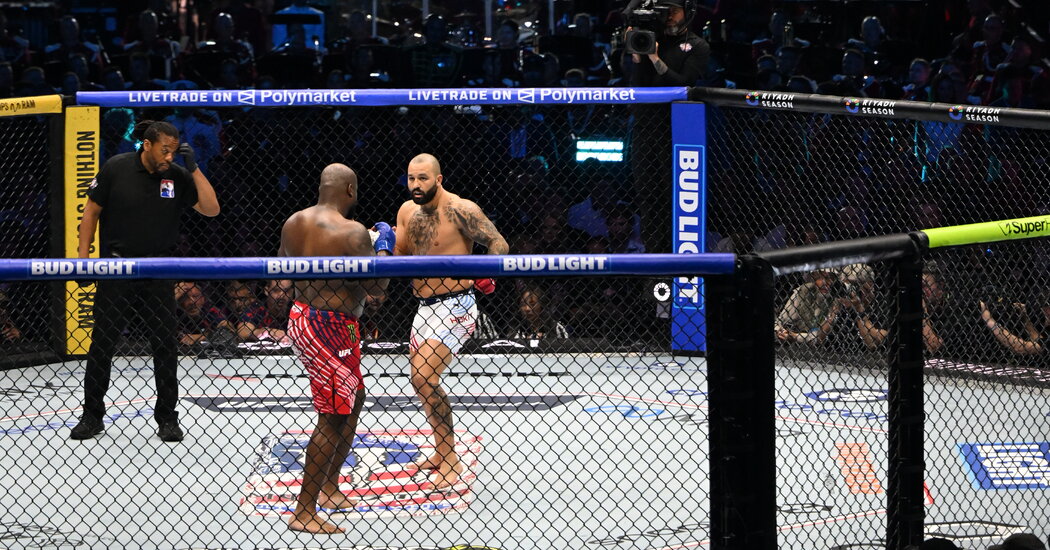
The next night, only a mile away, shirtless fighters walked out of the White House and into a mammoth caged Octagon built on the South Lawn, filled with 4,000-some screaming fans.
In a weekend of celebrations connected to the 250th anniversary of the United States’ founding, President Trump moved the nexus of culture in Washington from concert hall to cage match.
During the president’s second term, his efforts to shape cultural institutions in the capital have often been defined by what, in his view, should be eliminated. Mr. Trump asked for an end to “woke” at the Kennedy Center, staging a takeover of the arts institution before deciding to close it for two years of renovations. At the Smithsonian, he has called for a prohibition on exhibits that “degrade shared American values.”
But it was the Ultimate Fighting Championship spectacle that vividly displayed the president’s singular view of a night of entertainment in Washington.
Mr. Trump, who was celebrating his 80th birthday, presided over a flashy extravaganza that involved a fighter jet flyover; “ring girls” wearing sparkly red, white and blue; and 14 competitors intended to embody America’s “fighting spirit.” Sitting near the cage beside the first lady and Dana White, his longtime friend and the chief executive of the U.F.C., Mr. Trump shook hands with fighters, mingled with powerful guests and watched the bouts intently.
“Hey, we’re celebrating 250, what better way to celebrate it than a fight at the White House?” said Josh Heredia, 23, who traveled from Miami to be close to the action.
Held in a towering structure nicknamed “The Claw,” the fights became a 92-foot-tall lightning rod for debate on America’s cultural divide.
“Well, I wouldn’t call the cage fight culture, but that’s all right,” said Selby McPhee, 82, who attended the symphony’s performances of “An American in Paris” and “American Symphony.”
In mocking the event on his talk show, Bill Maher, who is accepting an award at the Kennedy Center this month, described Mr. Trump as a “redneck president” holding “gladiator games.” Nicolle Wallace, the television host, called it “tragically tacky.”
The common retort from Mr. Trump’s supporters has been to frame the issue as one of populists versus elites. Who are they to spoil the fun? The U.F.C. event was a time to “celebrate, crack a beer and high five,” said the podcaster Tim Pool.
Carlos Figueira, 26, who traveled from Brazil to attend the watch party at the Ellipse, a park south of the White House that can hold more than 75,000 people, was concerned less about optics than the action in the Octagon.
“I think we need to put this aside,” he said of the politics behind the event, “and just enjoy the spectacle.”
Cultural events at the White House are never just about a president’s personal taste, said Tevi Troy, a member of George W. Bush’s administration and a historian who wrote a book about pop culture and the White House.
John F. Kennedy was advised to try to improve the world’s view of “vulgar” American entertainment preferences by establishing himself as a connoisseur of high culture, which he did in 1961 with a White House performance by the cellist Pablo Casals. And in 1973, Richard Nixon’s White House appealed to his conservative base by hosting the country singer Merle Haggard, who sang the anti-hippie song “Okie From Muskogee.”
“It was sending a message to their voters, that this is the kind of culture we get behind,” Mr. Troy said of Nixon. “In all these events, presidents try to think who their voters are, who are they trying to appeal to, who will potentially be offended and do they care?”
A Reuters/Ipsos poll taken this month found that 16 percent of Americans surveyed thought it was appropriate for the White House to host the U.F.C. fights.
Mr. Trump embraced mixed martial arts in the early 2000s, agreeing to host U.F.C. matches at the Taj Mahal casino in Atlantic City after the sport had been shunned by many major venues and branded “human cockfighting” by Senator John McCain. Since 2019, the president has attended at least 10 of the league’s events across the country.
Watching the fights from the corner of a sports bar near the White House, Dale Hartt, a former U.F.C. fighter who now referees mixed martial arts, said it was not the brutish blood sport that its critics describe.
“Think of it as chess, not violence,” said Mr. Hartt, as one of the fighters pummeled another repeatedly in the head. “I know that sounds weird, because it is violent. And it has repercussions.”
Mr. Hartt, 47, who traveled from Maine with friends for the fights, pulled up a video on his phone from a match in 2008, when his opponent broke his leg so badly that the video went viral. It is sometimes referred to as among the worst injuries in U.F.C. history.
Jutta Hennig, 74, who has been a patron of the center for about 50 years, wondered if the symphony was the kind of performance the president would deem “woke” because it was not violent enough.
“They’re not playing anything by anyone who’s alive, and the average age is 100 usually,” she joked, shortly before the orchestra played Samuel Barber’s 1939 Violin Concerto (Op. 14).
The program that night included Aaron Copland’s “Lincoln Portrait,” a rousing and historically inspired composition that features a booming narration of speeches by Abraham Lincoln about democracy and civic responsibility.
Mr. Trump has shown an interest in classical music, recently comparing the tenor Christopher Macchio to Luciano Pavarotti. He has attended performances of “Les Misérables” and “Chicago” at the Kennedy Center.
But his takeover of the institution, where he is now chairman, quickly started driving away audience members, donors and artists. The departures escalated after the board voted in December to add the president’s name to the building. Saturday’s program was supposed to be a world premiere of a symphony by Philip Glass, before the composer withdrew.
Those the president hired to lead the center had a vision of more commercial programming — one cited the TV show “So You Think You Can Dance” as inspiration — that they imagined would appeal to a wider audience and to potential corporate sponsors. It was an ethos that did not bode well for the classical segment of the institution.
The Washington National Opera severed its long-term relationship with the Kennedy Center. The National Symphony Orchestra decided to stay, but must now find alternative stages after Mr. Trump announced renovations aimed at making what he said would be the “finest Performing Arts Facility of its kind.” (A federal judge has temporarily blocked the closure, and the Kennedy Center is pursuing an appeal.)
At its final Kennedy Center concert of the season, the orchestra remained unsure whether it can return to the building in the fall. It is unable to book other venues without an approved budget.
“I really wanted to be here tonight,” said Ms. McPhee, who was wearing a button with a purple heart meant to show support for the orchestra. “God knows if anything is going to be going on in this place for a while.”

