
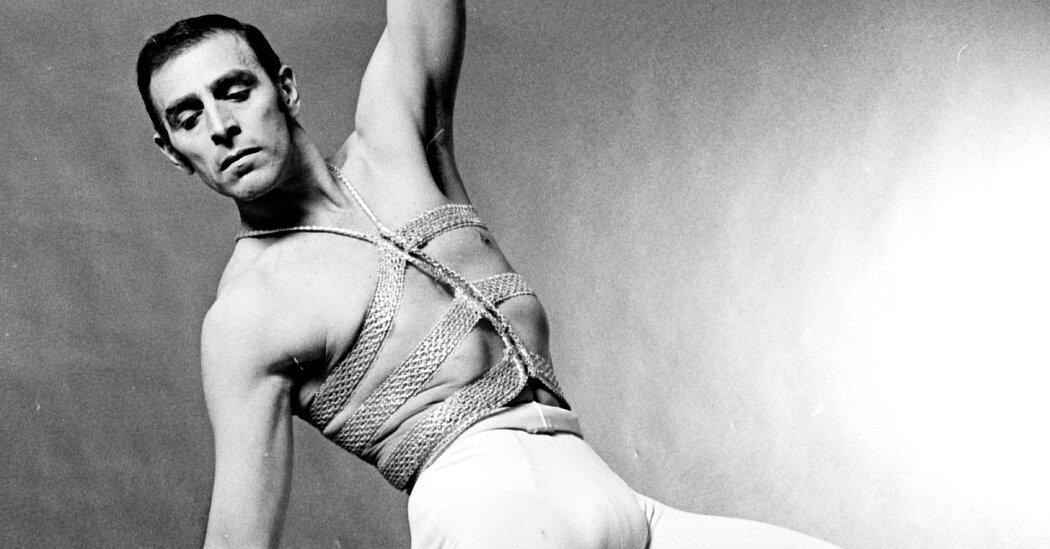
Paul Sanasardo, an American choreographer who created intense, often psychologically dark dances that influenced the vividly theatrical works of Pina Bausch, died on July 23 in Park Ridge, Ill., outside Chicago. He was 97.
His death, at a hospital, was confirmed by his protégé David von Erlicher.
Mr. Sanasardo and his formative artistic partner, Donya Feuer, started out in the late 1950s as part of a new generation trying to escape the imposing shadow of Martha Graham and other modern-dance pioneers.
In a field that tended to valorize the individual perspective, Mr. Sanasardo and Ms. Feuer conceived and choreographed their works as a pair. And at a time when almost all modern-dance performances were collections of short pieces, they presented ambitious evening-length productions. One 1961 work, “Excursion for Miracles,” extended across two nights.
Their style — experimental, with an expressionistic bent — was challenging for audiences. In “Laughter After All” (1960), women in high heels meowed, hissed and screamed, then reappeared in male drag. To the sound of canned laughter, Mr. Sanasardo (wearing a gorilla wig) threw a woman to the ground; when she got up, he threw her down again. Later, he punched and kicked other dancers while laughing maniacally. After the premiere, Mr. Sanasardo’s mother told him, “You shouldn’t let people know that you’re like that.”
In the carnivalesque, two-evening “Excursion for Miracles,” Mr. Sanasardo played a lackey in a sadomasochistic relationship with a female master. The choreography that he and Ms. Feuer created — like that of their contemporary Paul Taylor, in whose notorious “Seven New Dances” (1957) she had performed — experimented with stillness, pedestrian poses and unadorned walking. Chained to each other, they blew up a balloon with a bicycle pump.
“We were trying to understand the life we lived,” Ms. Feuer told Mark Franko for his 2005 book, “Excursion for Miracles: Paul Sanasardo, Donya Feuer and Studio for Dance, 1955-64.” “Trying to understand was itself a religious act.”
In 1959, they began working with Ms. Bausch, who was then 19 and had just dropped out of Juilliard. “They took care of me,” Ms. Bausch told Mr. Franko. “I never went home. I was kind of like in the family.”
Ms. Bausch performed in “In View of God” (1959), an enigmatic, imagistic piece about family and death, and created a trio, “Phases of Madness,” with Mr. Sanasardo and Ms. Feuer.
“We just beat each other up onstage,” Mr. Sanasardo recalled in a 2021 video interview for the Chicago Dance History Project, noting that there was “a lot of that” in Ms. Bausch’s later work.
If she had not worked with Mr. Sanasardo and Ms. Feuer, Ms. Bausch told Mr. Franko, “everything would have been different.” In 1962, she moved back to her native Germany, and in 1973 she founded Tanztheater Wuppertal, which became one of the world’s most successful and influential dance companies. The dreamlike, sometimes brutal aesthetic for which Ms. Bausch became famous echoed Mr. Sanasardo’s.
Early on, Mr. Sanasardo and Ms. Feuer rented three floors of loft space above a cardboard-box factory on West 19th Street in Manhattan. This became the headquarters for Studio for Dance, where they taught classes and lived. Some of the students in their children’s classes stayed over on the weekends to work with them, camping out in sleeping bags. Many of these children appeared in their works, which were very far from conventional children’s theater.
In 1963, Ms. Feuer moved to Stockholm, where she joined the Royal Dramatic Theater and collaborated extensively with the director Ingmar Bergman over the next three decades. For Mr. Sanasardo, it was the end of a remarkable creative partnership.
“We never slept together, yet we couldn’t have been closer,” Mr. Sanasardo, who was gay, told Mr. Franko. “I never had a relationship as close as I had with Donya, as intricate, as complex.”
Mr. Sanasardo continued with a company he called Paul Sanasardo and Dancers. Among its members was Janet Panetta, who later became an important teacher in New York and Europe, especially with Ms. Bausch’s company. Among Mr. Sanasardo’s dozens of works, “Metallics” (1963), a piece of high sexual tension with an electronic score by Henry Cowell, was later performed by Alvin Ailey American Dance Theater and Nederlands Dans Theater.
“It is impossible not to respect Paul Sanasardo as a choreographer,” the critic Anna Kisselgoff wrote in a review of a 1971 performance for The New York Times. He was, she added, “an uncompromising artist” who “combines both purity of movement and emotional depth.”
From 1969 to 1974, Mr. Sanasardo led the summer modern-dance program at the Saratoga Performing Arts Center in upstate New York. From 1977 to 1980, he was artistic director of Batsheva Dance Company in Israel.
After returning to the United States, he started a new company, which lasted until 1986. Some of his new works were lyrical and light, but most were still what Ms. Kisselgoff called, in 1982, “excellent unpleasant dances.”
Mr. Sanasardo sometimes pushed back on the idea that he was a purveyor of pain and darkness. “I’m really a very happy person,” he told The Times in 1982. But he acknowledged that he was interested in intensity.
“It is at extremes that we reveal ourselves,” he said.
Paolo Savior Giuseppe Vincenzo Franco di Sanasardo i Bonadona was born on Sept. 15, 1928, in Chicago. His parents — Giuseppe Sanasardo, known as Joseph, who ran a tavern, and Francesca (Bonadona) Sanasardo — were immigrants from Sicily.
The fifth of seven children, he is survived by a younger brother, Vincent.
He later recalled dancing in the family’s basement when he was 9, improvising and expressing himself. “These were dances of death,” he told Mr. Franko. “I loved dying.”
He took ballet classes as a child, but his focus was on visual art. He graduated from the School of the Art Institute of Chicago with a bachelor’s degree in painting in 1952. By then, he had attended a lecture by Martha Graham, who had enchanted him.
“Since she was a modern dancer, I decided to be one,” he told The Times in 1982.
He was drafted into the U.S. Army, and while serving near Washington, he studied and performed with the German modern dancer Erika Thimey.
Moving to New York in 1954, Mr. Sanasardo studied on scholarship at Graham’s school, where he met Ms. Feuer, and later took classes with the prominent ballet choreographer Antony Tudor and the ballerina Mia Slavenska. From 1953 to 1956, he performed in the company of Anna Sokolow, one of the most prominent choreographers to emerge from the Graham company, appearing in the original cast of Ms. Sokolow’s seminal 1955 work, “Rooms.” From 1957 to 1965, he appeared as a guest artist with the company of Pearl Lang, another important Graham alumna, often serving as her partner.
Studio for Dance, which had endured even as Mr. Sanasardo took other posts, closed in 1989. About 20 years ago, he returned to Chicago, where he continued to teach and choreograph until 2018.
The dancers he most admired, he told Mr. Franko, were those who could “hang on forever at a high level of intensity and take you somewhere else.”
He added: “Down with choreographers, up with good dancers. Give me a handful of very interesting dancers and I can make something.”

