
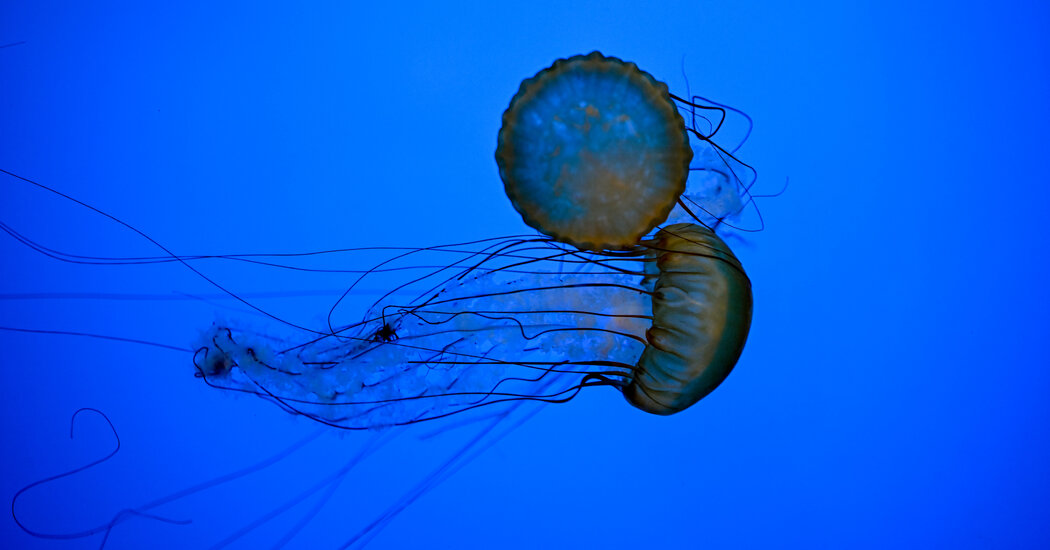
Is urinating on a jellyfish sting helpful? Can jellyfish still sting when they are beached? And what should you do if you find one in the water or the sand?
With beach season upon us, here are some things to keep in mind about these boneless tentacled creatures, which populate all the oceans, from tropical waters to freezing depths.
They have been around for more than 500 million years.
“Jellyfish are some of the most resilient creatures on Earth,” said Yana Yanovsky, who recently founded the Jellyfish Museum in Pompano Beach, Fla., about 12 miles north of Fort Lauderdale, with her husband, Alex Yanovsky.
To researchers, jellyfish are fascinating not only for their colorful and bulbous shapes but also because they play important roles in the marine ecosystem and are a key source of food for some fish and sea turtles.
Scientists estimate that there are at least 1,000 species of jellyfish and that they have survived for more than 500 million years.
Jellyfish lack backbones, heart, blood or gills and are more than 95 percent water, according to the Florida Fish and Wildlife Conservation Commission.
They are known to drift with the currents, but they occasionally swim by pulsing their umbrella, or bell, at the top of their bodies, according to the commission.
“Their movement is mesmerizing, almost meditative,” Ms. Yanovsky said. “While they lack a brain, they maintain a simple nerve net that allows them to respond to their environment.”
Jellyfish don’t ‘go after’ people.
“Any contact with jellyfish is incidental,” the National Oceanic and Atmospheric Administration said on its website, noting that humans are not on their menu.
“They eat a variety of prey using their tentacles,” including plankton, fish, shrimp and even other jellyfish,” said Heather Bracken-Grissom, a professor of biological sciences at Florida International University in Miami.
But when people swim in a jellyfish’s environment, humans can get in the way of their tentacles, which have stinging cells.
Don’t urinate on a sting.
You may have heard that urinating on a jellyfish sting is a useful remedy to relieve the pain.
“There’s something, like ammonia in that, that kills the pain,” Chandler (Matthew Perry) tells Monica (Courteney Cox) and Joey (Matthew LeBlanc) in an 1997 episode of “Friends” after Monica is stung by a jellyfish.
But urinating on a jellyfish sting can actually cause more pain than it provides relief, Dr. Thomas Waters said in a 2024 article published by the Cleveland Clinic.
“The logic is based upon the idea that ammonia, urea and other compounds found in your urine can break down the stinging cells and get them to detach from your skin,” according to the article.
“But the truth is that your urine is made up of mostly water, so there isn’t enough ammonia and other chemicals to have the desired effect of stopping the stinging cells and their barbs,” he wrote.
What should you do if you are stung?
“A saltwater wash is the best first step for all species of jellyfish and their look-alikes because it will not stimulate further ‘firing’ of stingers, or further release of their venom,” Dr. Christopher Bazzoli of the Cleveland Clinic said in an interview.
Vinegar can also help.
“Vinegar rapidly halts the thousands of tiny unfired stinging cells left on the surface of the skin after tentacle contact,” according to University of Florida Health.
Dr. Bazzoli suggested that people apply ice to the affected area to help reduce inflammation.
Someone who has been stung should also consider taking an antihistamine to reduce itching and skin reactions, or an anti-inflammatory, such as ibuprofen, to reduce pain and swelling.
Don’t touch them.
Although they may look like small balloons on the sand, avoid stepping on jellyfish and don’t touch or pop them.
Even if you are wearing shoes or sandals, washed-up jellyfish — no matter the size — can still pose a risk because of their tentacles, according to the Cleveland Clinic.
“The stinging cells on small jellyfish can be just as potent as the stinging cells on large jellyfish, so it’s possible to get a painful sting even from a microscopic jellyfish,” James Douglass, a professor of marine science at Florida Gulf Coast University in Fort Myers, Fla., said in an interview.
“The thing about large jellyfish, though, is that they have more and longer tentacles with more stinging cells overall, so they can get you with a lot of stinging cells at once,” he added.
Can stings be fatal?
Yes, though fatal stings are “very rare” and are “associated with allergic reactions,” Dr. Bracken-Grissom said.
Dr. Douglass said that while there are many species “that sting quite painfully,” there are a few species, such as the box jellyfish, whose stings can be life-threatening.
Box jellyfish live in tropical areas, and are commonly found on the northern coast of Australia and the Indo-Pacific Ocean, according to the Cleveland Clinic, which noted that the Australian box jellyfish is the most venomous jellyfish in the world.

