
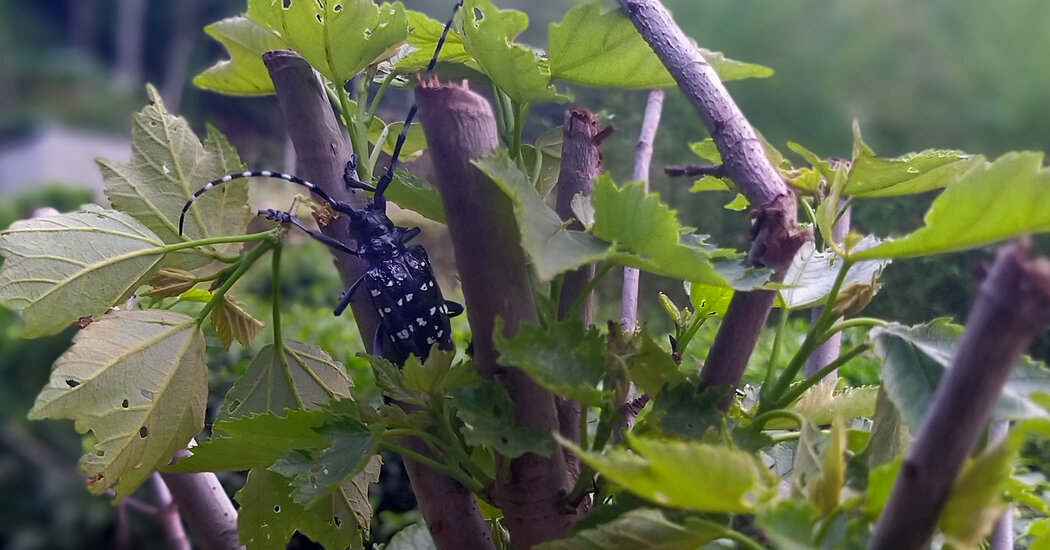
The wriggling larva would one day metamorphose into the red coffee-borer moth, an invasive species that damages many plants. It hasn’t yet infested the United States — but here it was, on a cloudy morning in early 2023, burrowing into the trunk of an American oak tree.
Fortunately, that particular oak tree was growing in China, in what scientists call a “sentinel garden.”
These gardens, scattered around the world, are plots of foreign trees that researchers closely monitor to figure out what local bugs and diseases can damage them. The goal is to learn as much as possible about these potential threats before they cross the ocean and become a problem at home.
“We send our trees overseas to see what bugs chew them up,” said Jiri Hulcr, a professor of entomology at the University of Florida, who is leading one of these projects.
Thousands of nonnative insects and plant diseases have found their way to the United States, often hitchhiking in on imported goods. As warming temperatures make it possible for species to survive in new places and global trade continues to expand, the spread of invasive species is expected to grow.
Many of these outsiders prove harmless, but some go on to ravage citrus groves, soybean fields and forests.
It takes just one to cause a huge problem, said Yiyi Dong, a researcher at the University of Florida. Native trees may have not evolved the defenses necessary to deal with foreign diseases and pests. Every so often an invader is able to exploit these vulnerabilities to overwhelm an ecosystem.
Extreme weather driven by climate change, like drought and floods, can also weaken trees, making them more vulnerable to damage. The combination of drought and bark-beetle infestation is estimated to have killed more than 100 million trees in California over several years starting around 2011.
Dr. Dong spotted the red coffee-borer in China while she was a graduate student in Dr. Hulcr’s lab. Like a detective fingerprinting a crime scene, she photographed the damage to the oak tree, dropped the grub into a sampling bag, and brought it back to a lab for DNA testing. Her findings went into a guide for U.S. regulators that deal with invasive species.
Similar sentinel garden projects have existed for years in Europe. Dr. Hulcr’s gardens, established eight years ago, are among the few run by a U.S. institution.
At its peak, the project included six gardens in different parts of China and two in South Korea. Each contained dozens of trees, representing at least 10 different commercially and environmentally important American species like oaks, almonds and sweet gums. And as with other sentinel-garden efforts, the team also maintained a plot of Asian trees in Florida, to spot bug threats that might move in the other direction.
Recently, his team’s work in China was halted after the Florida state legislature passed a law limiting research relationships with “countries of concern” and funding was not renewed. As a result, the sentinel gardens in China may now be abandoned. His team may have fewer gardens, Dr. Hulcr said, “But even those few are producing incredible data.”
While planting nonnative trees in a foreign country might sound like it poses its own risks to the local ecosystem, many such species are already traded in local markets. Researchers say any newcomers brought in for the project don’t pose a problem because they’re grown in a carefully monitored space. And unlike insects and plant diseases, trees are slow growing and don’t spread as easily.
In recent years, two researchers at Seoul National University collaborating on the gardens in South Korea, Jinbae Seung and Seunghwan Lee, have found brown-winged planthoppers swarming American trees, including pecans. The pest behaves similarly to the spotted lanternfly, an Asian invasive already notorious for infesting Northeast states.
When the planthopper was recently detected in Georgia, the pecan-producing capital of the U.S., Dr. Hulcr said his lab was able to warn authorities about the potential problem it posed.
Monitoring invasive pests is primarily handled by the United States Department of Agriculture, which spends millions of dollars a year on programs that screen imports and inspect farms for invasive pests and diseases.
Stopping all invasives isn’t possible, so knowing more about the potentially harmful ones can help regulators focus their efforts, said Andrew Johnson, a University of Florida beetle researcher on the project.
Plant diseases caused by harmful fungi, bacteria and viruses are another concern, said Enrico Bonello, a professor at Ohio State University who runs a separate sentinel gardens project. Problems like root rot, wilt and “bleeding” cankers caused by such pathogens have taken a significant toll on forests and crops across the United States.
Many plants don’t show obvious symptoms, and a plant that looks good during border screenings could be invisibly harboring something that later escapes into the local environment, he said.
His gardens, planted in China, Europe and North America, have revealed more than 100 pathogens on trees that they hadn’t previously been known to attack. “It’s a numbers game,” he said. “We are constantly waiting for the other shoe to drop.”

