
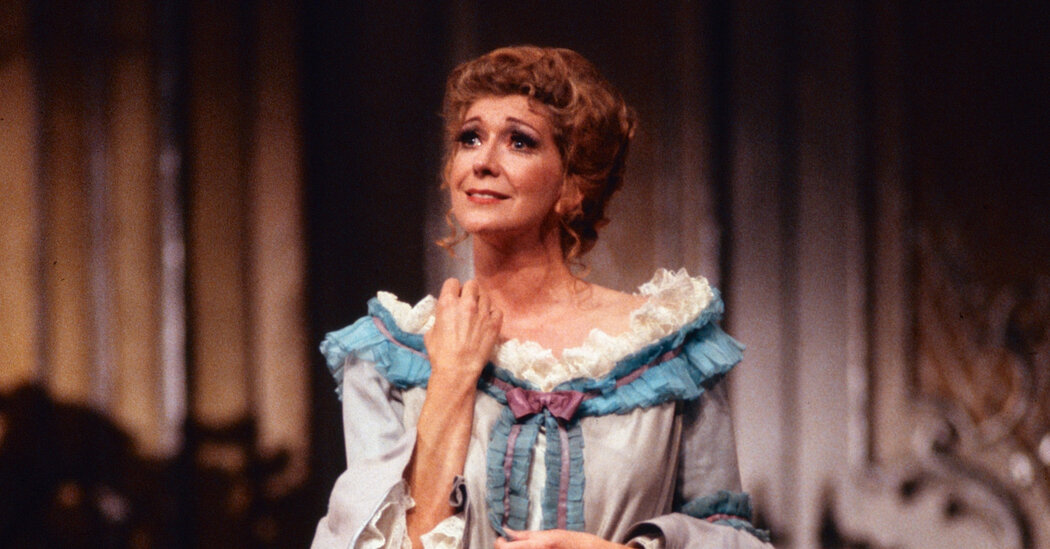
Felicity Lott, an elegant British soprano who gave radiant performances of Mozart and Strauss at many of the world’s leading opera houses, and was equally acclaimed as a stylish, wide-ranging recitalist, died on Saturday in the Sussex region of England. She was 79.
Her death, in a hospice facility, was from lung cancer, her manager, Sue Spence, said. Ms. Lott lived near Brighton, a city on the coast in Sussex.
Tall and self-possessed, with an air of wit and sophistication, Ms. Lott was ideal for parts like the introspective Marschallin in Strauss’s “Der Rosenkavalier,” the Countess in his “Capriccio” and yet another wistful Countess, in Mozart’s “Le Nozze di Figaro.”
“What Lott has going for her,” the critic Richard Dyer wrote in The Boston Globe in 1999, “is intelligence, musicianship, curiosity and a voice that is as fresh and as clear as a mountain stream. She disappears inside whatever she is singing.”
Over the course of a career that lasted more than half a century, Ms. Lott appeared with the Royal Opera in London, the Bavarian State Opera in Munich, the Vienna State Opera, the Paris Opera, the Metropolitan Opera and many other major companies. But she particularly relished performing at the idyllic summertime Glyndebourne Festival in the Sussex countryside, where the artists could rehearse together for weeks with few distractions.
“I like to feel I know exactly what everyone’s going to do on the night, otherwise I feel inhibited,” she told The Times of London in 1987. “I am a spontaneous person in a way, but not on the stage.”
While still a conservatory student in her early 20s, she met the pianist Graham Johnson, and they began a lifelong musical partnership focused on the lieder, or art song, repertoire.
“He would come to play for my lessons,” she told Mr. Dyer in The Globe. “On our own, he made me learn sheaves of songs.”
In 1976, when Mr. Johnson founded the Songmakers’ Almanac, a performing ensemble that specialized in themed concerts, often with literary connections, Ms. Lott was in the group alongside the mezzo-soprano Ann Murray, the tenor Anthony Rolfe Johnson and the baritone Richard Jackson.
Through Mr. Johnson and her song recitals, Ms. Lott developed a close association with Wigmore Hall, the intimate venue in London. She served on its board and gave her final master class through its French Song Exchange program last month.
Felicity Ann Emwhyla Lott was born on May 8, 1947, in Cheltenham, in Gloucestershire, England, to Iris (Williams) and John Lott, who ran an accountancy practice.
Theirs was a family of amateur musicians. As a child, Felicity learned some piano and violin and took singing lessons.
“I made my first recording when I was 2, on a little machine in a booth in a store,” she told The Globe in 1999. “I sang ‘Rudolph the Red-Nosed Reindeer’ and ‘Away in a Manger,’ and it’s bang in tune.” (She added that it might have been the only recording she ever enjoyed making.)
She had an early love for the French language, and studied French and Latin at Royal Holloway College, part of the University of London, considering a career as an interpreter.
But while spending a year near Grenoble, France, she was encouraged enough by lessons with a singing teacher to shift her path, and she earned a scholarship from the Royal Academy of Music in London.
While studying there, she sang roles like Pamina in Mozart’s “The Magic Flute” and Dorabella in his “Così Fan Tutte,” which is often taken by mezzo-sopranos.
“I sang Dorabella because I still couldn’t get the high notes for Fiordiligi,” Ms. Lott said. “It wasn’t until after I gave up smoking that I got the high notes.”
In 1975, she made her debut with a major company, singing Pamina with the English National Opera. Most of her early career was in Europe, though she appeared at Carnegie Hall as the Countess in a sumptuously cast concert performance of “Capriccio” in 1986, and debuted at Lyric Opera of Chicago as Mozart’s Countess the next year.
She made her Met debut in 1990 as the Marschallin in “Der Rosenkavalier,” with Carlos Kleiber conducting. It became her signature role, and she appeared with Mr. Kleiber in a superb run of “Rosenkavalier” performances in 1994 at the Vienna State Opera, recorded by Austrian television.
Her background in French made her particularly sparkling in songs by composers like Ravel, Chausson and Chabrier and operas by Poulenc, Charpentier and Offenbach. In 1996, she was made a Dame Commander of the Order of the British Empire.
She married the music writer Robin Golding in 1973; they divorced in 1982. In 1984, she married the actor and writer Gabriel Woolf. He survives her, along with their daughter, Emily; and a sister, Deborah. (As Mrs. Woolf, Ms. Lott once received a letter addressed to Virginia Woolf. “I know you’re dead,” the letter began, “but I think you’re wonderful.”)
In 2019, Ms. Lott made her London West End debut in the small, touching role of Heidi Schiller in Stephen Sondheim’s musical “Follies.” In 2024, she gave her final opera performances at the Paris Opera, as the over-the-top Duchess of Krakenthorp in Donizetti’s “La Fille du Régiment.” Her final solo recital was also in Paris, in May 2025.
While Ms. Lott’s voice was lucid and sensitive, what set her apart were her dramatic gifts and her refined yet warm bearing.
“When she rises from her chair in her tailored suit, you are struck by her height and grace of bearing,” Mr. Dyer wrote in The Globe. “She’s built along the lines of Vanessa Redgrave, and people who have seen Lott’s Marschallin in the video of ‘Der Rosenkavalier’ will tell you that she’s an actress in the same class.”

