
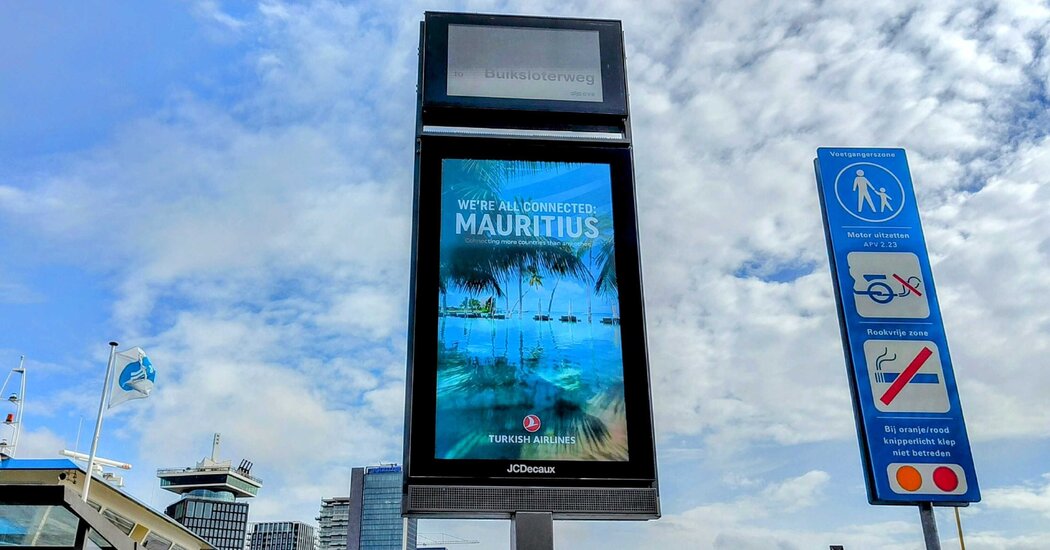
Amsterdam is famously a place where anything goes. Prostitution is legal. Coffee shops sell marijuana and hashish. Truffles laced with the psychoactive compounds found in hallucinogenic mushrooms are available at “smart shops.”
But what is no longer allowed in the freewheeling city’s public spaces are advertisements for products that some city councilors consider to be true vices: Big Macs. Exotic vacations. Gas-powered cars.
On May 1, Amsterdam became the first capital city in the world to ban ads for fossil fuel products and meat. It is part of the city’s efforts to discourage consumption of goods linked with high carbon emissions.
Ads for airlines, cruises, and faraway destinations are no longer allowed, because they implicitly promote the burning of fossil fuels. Ads for beef, chicken, pork and fish are also banned, because of the environmental harms caused by animal agriculture.
“If you spend lots of tax money and have lots of policies trying to manage climate change in Amsterdam, why would you rent out your public walls to exactly the opposite?” said Anneke Veenhoff, a city councilor whose party, GreenLeft, championed the ban, along with Party for the Animals (GreenLeft is now merging with another party).
Ms. Veenhoff likened high carbon lifestyles to an addiction. “If you’re trying to get rid of an addiction, it’s not very handy to see it everywhere,” she said.
Amsterdam’s law applies to city-owned properties and public spaces, such as buses and bus shelters, benches, trams, trains and metro stations, and billboards. Advertising in privately owned stores and in media such as newspapers, radio and online formats is exempt.
The City Council in The Hague, the seat of the national government, passed the first law banning fossil fuel ads in 2024. The following year, a Dutch travel trade association and several travel agencies sued, arguing that the ban was an overreach that violated freedom of expression rules and European Union consumer law. But the judge sided with the city, ruling that the health of its citizens and the climate was more important than commercial interests.
“It is not up to the municipality to refrain from taking measures to promote the health of its residents in order to strengthen the future position of travel providers,” the judge wrote, according to Euronews.
The Hague’s win opened the door to Amsterdam’s law.
Amsterdam passed a motion to ban ads for fossil fuel and high emissions travel in 2020, but it wasn’t legally binding and carried no penalties. The new law gives the city enforcement teeth, and includes the meat advertising ban. This year will largely be considered a grace period, but fines can still be issued to scofflaws.
Before the Amsterdam ordinance was voted on in January, a major outdoor advertising company, JCDecaux, urged city councilors to reject it, warning that advertising revenue helped maintain public infrastructure. In an email to The Times, a representative for JCDecaux declined to comment.
Amsterdam is also pushing its citizens to eat less meat, and has set a goal for residents to get 60 percent of their protein from plant-based sources by 2030. “Because of climate reasons, because of health reasons,” Ms. Veenhoff said.
Anke Bakker, a city councilor with Party for the Animals, said the advertising prohibition was initially written to include all food derived from animals, including dairy. But a compromise was struck to limit the ban to meat products, and it helped secure a majority vote.
Among the recent promotions that are no longer allowed in Amsterdam: Ads for Range Rovers. Marketing for flights to Zanzibar, Mauritius and Dubai, and getaways to Thailand, and even, gasp, New York City. Advertising for any kind of meat, be it from Burger King or Kentucky Fried Chicken, is also verboden.
In a 2024 speech, the United Nations secretary general, António Guterres, called for governments to ban fossil fuel advertising, calling fossil fuel companies “godfathers of climate chaos,” and likening their tactics to that of Big Tobacco. (There have also been calls for media outlets to stop fossil fuel advertising, including The New York Times. The Times accepts oil and gas ads with some restrictions, such as for its climate newsletter and climate events.)
In a recent paper in the Canadian Medical Association Journal, Samantha Green, a family doctor in Toronto and president of the Canadian Association of Physicians for the Environment, said that banning fossil fuel advertising can shift behaviors and improve health outcomes.
“It’s very clear that fossil fuels kill people through air pollution and climate change,” Dr. Green said. “Given the previous success of tobacco advertising bans and the previous success of other advertising bans for health-harming products, it only makes sense that we stop allowing the promotion of this deadly product.”
According to Femke Sleegers, founder of the advocacy group Fossil Free Advertising, 12 municipalities in the Netherlands and one in Italy have now passed laws banning fossil fuel ads, while dozens more jurisdictions worldwide have adopted motions, which are often more limited in scope.

