

Want to bookmark your favourite articles and stories to read or reference later? Start your Independent Membership today.
Already a member?
Log in
The pound has hit its highest level against other currencies since the Brexit referendum.
Ahead of the Bank of England (BoE) expected decision to raise interest rates today, the Sterling effective exchange rate index – which measures the pound against a combination of 18 major world currencies – has hit a reading of 86.4, the highest level since the first quarter of 2016.
The index has a base value of 100, set in 2005, and is updated each month to measure how valuable the domestic currency is against the likes of the dollar, the euro and more. It has not had a reading of over 100 since 2007 and more recently was as low as 78.08 in late 2022.
It helps show the overall relative strength of the pound, while for more frequent, everyday reasons – like holidays, business or sending money overseas – we might more often compare the pound to individual currencies.
As an example, £1 was worth €1.1334 exactly a year ago, while today it is worth €1.1981 – a rise of more then 5.7 per cent. The pound is also worth 3.5 per cent more US dollars than a year ago.
A stronger pound is better for Britons when buying on holiday, or importing from overseas.
BBC News say the BoE will confirm the index reading on Thursday, after the results of the interest rate vote is announced.
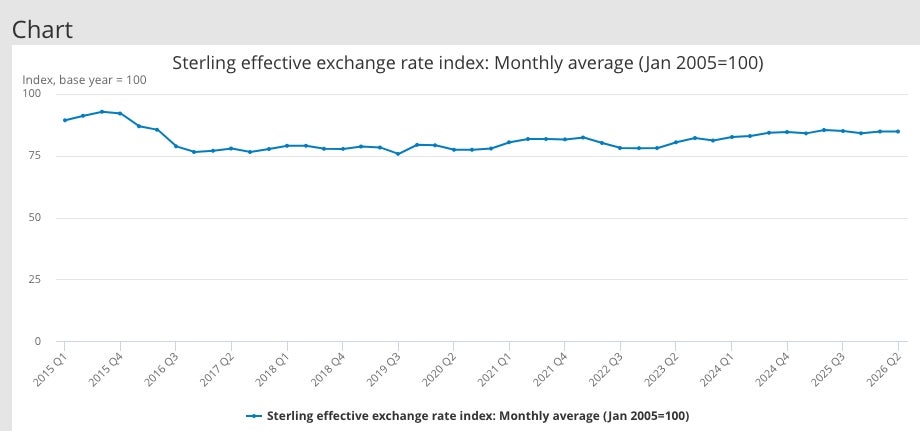
That level, however, will be tested by today’s Monetary Policy Committee (MPC) vote.
While interest rates are nailed on to rise on Thursday, the greater scrutiny will come with the vote numbers and the wording given by the members.
Any pushback against consecutive future rate hikes – and with money markets pricing in almost exactly four rate hikes in short order – could significantly impact sterling’s value, says George Vessey, macro strategist at global payments firm Convera.
“The hike itself is not the story. With markets assigning around a 95 per cent probability to such an outcome, attention instead turns to the vote split, updated forecasts and Governor Bailey’s guidance,” he explained.

Invest at least £100 in Stocks or ETFs of your choice. Get fractional shares worth £50!
Terms and conditions apply.
ADVERTISEMENT
Invest at least £100 in Stocks or ETFs of your choice. Get fractional shares worth £50!
Terms and conditions apply.
ADVERTISEMENT
“Markets currently price almost 100bp of additional tightening through late 2027, a path that looks increasingly ambitious in our view. If the BoE pushes back against those expectations, the resulting dovish repricing in rates could prove more important for sterling than the hike itself.
“The MPC may raise rates today as a risk-management exercise while simultaneously signalling scepticism towards the aggressive path currently priced by markets. If so, gilt yields would fall and drag sterling lower. For now, the pound remains supported by its carry appeal and improving domestic data. But with positioning already heavily skewed towards further tightening, the hurdle for a genuinely sterling-positive BoE surprise looks high.”
The two-year gilt yield on Thursday, a proxy for short-term interest rate movement expectations, sits just under 4.73 per cent. One base rate hike – so from 3.75 to 4 per cent for example – is a 25 “basis points” movement, so 100bp of tightening signals four rate hikes.
However, most analysts do not expect this to play out into four actual votes to raise rates, as the bond market can quickly fluctuate based on improving economic data, changes to the global environment and many other factors.


