
Did we “overdo” the emphasis on university – and leave young people facing a jobs crisis as a result? That’s what Larry Fink, the chair and CEO of the world’s largest asset management company, BlackRock, reckons.
In a recent interview with the BBC, the billionaire businessman said that we have spent decades idolising office jobs in industries such as finance and law, while undervaluing skilled trades. But now, as developments in AI are putting junior jobs at risk, Fink believes that “we need to now rebalance that approach” and recognise that a career as a plumber or an electrician “can be just as strong”.
Technological advances are rapidly reshaping the job landscape, as many recent graduates are now discovering. According to a recent report by the British Standards Institution, a quarter of bosses believe that all or most tasks carried out by entry-level workers could be performed by AI.
Another survey from recruitment agency Randstad suggested that 38 per cent of employers plan to hire fewer graduates over the next year because of AI, while 41 per cent of workers feared that entry-level roles could disappear altogether within the next five years.

But the flipside to this is, as Fink recently pointed out in his annual letter to BlackRock shareholders, that the AI explosion will bring with it swathes of new roles “related to electricians and welders and plumbers”, to support the vast amounts of infrastructure needed to support this growth. “[AI] is going to create many jobs and we’re not prepared as a society to fulfil those jobs,” Fink said. “And to me, this is a crisis.”
So should Gen Z and Gen Alpha be rethinking the traditional wisdom that a degree of any kind will open up the careers market, and opting instead for a skill that could have far greater longevity?
PR director Hayley Reynolds has three children in their teens, and is keen to encourage them to go for career routes that might be less impacted by AI. “If your children have a real vision of what they want to do, which requires a university degree, then they should definitely try and follow this path,” she reasons.
“However, university is expensive and with the current cost of living, I believe there are plenty of opportunities both through apprenticeships and working in general, which can be just as beneficial.”
Her 17-year-old son Freddie, she adds, is considering a more vocational route by planning to do a personal training course. “He can live at home whilst finding his feet and save money to build towards his future”.
It seems like a shift in attitudes is already taking place. Earlier this year, a study from housebuilder Barratt Redrow found that nearly half (48 per cent) of teenagers believe earning a living from a skilled trade is more aspirational than an office-based management job.
Separate research from Draper Tools also found that 61 per cent of under 28-year-olds believe a trade is a “cool job”, with 55 per cent reporting that their perception of working in a trade is more positive than it was five years ago.
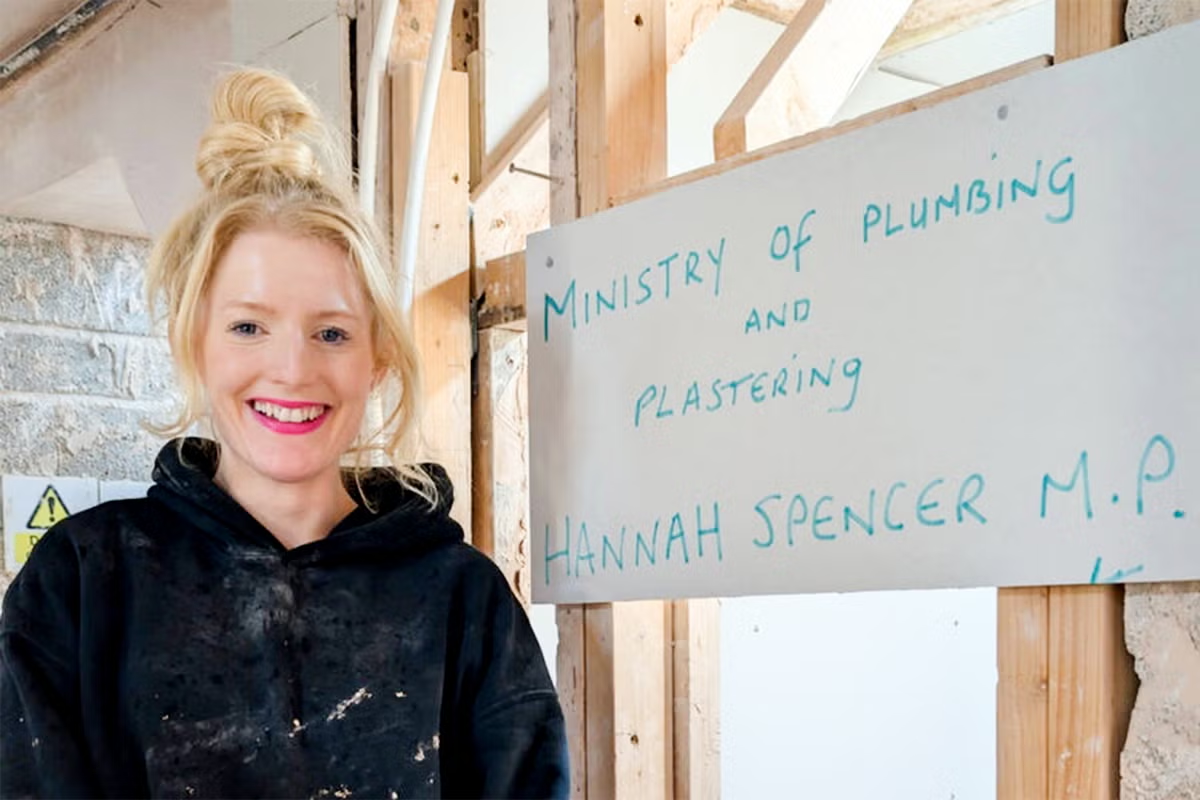
Over on social media, you’ll find day-in-the-life videos of young people working in construction on #TradieTok, while 34-year-old plumber Hannah Spencer, who recently became the Green MP for Gorton and Denton after a historic by-election win, shared updates from her recently completed plastering course while campaigning for her seat.

After finishing her GCSEs, 18-year-old Freya knew that she “didn’t really want to stay on to do [her] A-levels” as “I don’t think it really suited me”. Instead, she was keen to “start working straight away”, and after spending a year doing a more theoretical course at college, she landed her electrical apprenticeship with training provider JTL. She’s now in her second year of the four-year programme.
Working Monday to Friday every week while shadowing experienced electricians, she is something of an anomaly in her friendship group, who have all headed off to university. “For the first one or two months, I’d get home, have a shower and eat, but I don’t remember falling asleep,” she laughs. “I’d literally just get into bed, start watching something, fall asleep and wake up with all the lights on. I was so tired because you’re just learning so much.”
But she’s “really glad” she has chosen this path. “I always thought, ‘that’s a good job that I can earn well in, and I can always do it – it’s not going to get taken over by AI or whatever,” she says, noting that she had considered going into mechanics, but her parents cautioned her that the shift to electric vehicles might mean fewer traditional mechanical jobs in the future.
And being based on site holds far more appeal for her than working from home, she adds, contradicting lazy narratives about Gen Z being desperate to dodge the workplace. “You’re constantly meeting people and making new connections. It’s so easy to pick it up when you’re actually doing the work.”
I have worked on construction, heritage restoration sites, film sets, art fabrication. I had no idea when I started out where it would take me
Evie, 30
Thirty-year-old Evie, meanwhile, initially opted for the university route, studying for a liberal arts and sciences degree in Amsterdam before heading back to London. But within a year or so of her return, she had decided “that I wanted to be more flexible and I really wanted to work for myself”, she explains. The process of interviewing for jobs wasn’t for her, and she “just felt like having a physical skill would mean freedom”.
So she “took a bit of a punt” and headed to Glasgow to start a multi-trade course for women considering construction careers, before focusing on plastering and tiling. After that, she got a traineeship as a plasterer on a film set in Scotland, then headed back down to London where she has found jobs across a whole range of industries ever since.
“I have worked on construction, heritage restoration sites, film sets, art fabrication,” she says. “Sometimes we’ll do domestic jobs too. I had no idea when I started out where it would take me.”
The creative industries, she cautions, are still being impacted by technological advances such as AI, 3D printing and CGI. But, she adds, “the amazing thing about having a practical skill like this is that when that work falls through, you’ve got a physical trade that you can rely on. You can go and work in people’s houses, or on construction sites” – although it is a job “that does rely on you being physically fit”, she says.
The fact that she can “use these skills in quite a few different sectors”, then, makes it feel “a lot more future-proof” – but she does caution against oversimplified “discourse” that presents learning a trade as an easy or straightforward option.
Since finishing her course “in a class of all women”, the industry has been “an entirely male-dominated sphere”, she says, “and I would definitely think that for women going into trades, that’s something you have to have your eyes wide open for and be prepared for. I’m quite tough-skinned, but it has still been very difficult at times”.
She sometimes hears radio hosts, she adds, “speaking to people who’ve just been to university, and they go, ‘why don’t you just go and learn to be a carpenter?’ But it takes a really long time and it’s a really big investment. Yes, you can do your apprenticeship, but you’ve got years after that before you start to feel really capable and competent in your job.” Acting like it is some sort of quick fix is unlikely to do young people any favours in the long run.
A trade, she adds, is “a lifelong skill to learn. I think it’s an amazing thing to do when you’re 18, and I’m so glad that I’ve done it, but it’s definitely a long journey”.

