
In 2019, the British interior designer James Thurstan Waterworth, now 41, was hired to refurbish the Bradley Hare, a mid-19th-century inn located in the village of Maiden Bradley, in South West England. His wife and fellow interior designer, Scarlett Supple, 36, would often accompany him on visits to the area, which is part of a 3,000-acre estate that’s been owned by the Duke of Somerset since 1554, and the couple were increasingly taken with its natural beauty and vibrant community of farmers, young families and creative types. “We fell for it pretty hard,” Waterworth says.
They soon began renting a 4,000-square-foot farmhouse outside the village, where they’d spend weekends away from London and their design practices: Waterworth runs Thurstan, which recently designed the Zetter Bloomsbury hotel, and Supple has Studio Supple. But four years in, with their renovation plans having been rejected by the local council, the complexities of managing this large second home were weighing on them. Last year, together with their two children — Bibi, 5, and Bertie, 3 — they relocated to a more modest 1,722-square-foot, four-bedroom house in Maiden Bradley’s center.
The two-story limestone-and-brick structure is made up of two 19th-century cottages that were combined at some point and then added on to. When Waterworth and Supple moved in, the interiors had recently been stripped back to their bones, providing “a blank canvas,” says Supple. They opted to take a light touch, infusing the space with their individual tastes while striving for a cozy cottage feel. To open up the ground floor, they merged a small porch just inside the front door with the sitting room. Mostly, though, they focused on decorating, painting the walls in warm whites, dusky mauve and a custom teal from Francesca’s Paints that’s now known within the company as Thurstan Blue.
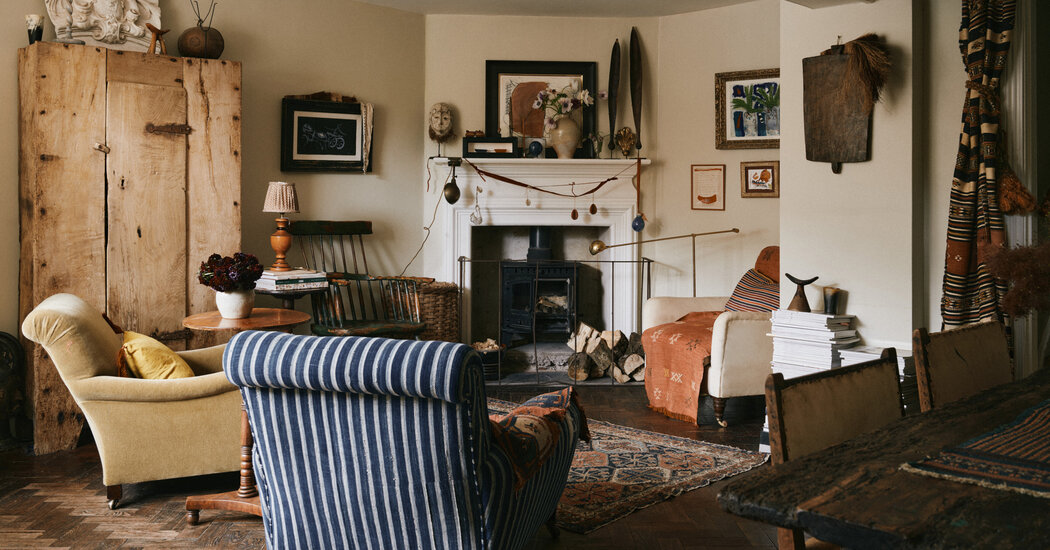
The rooms are filled with an eclectic array of furniture and other décor that reflects the couple’s shared passion for collecting. “There’s no reason for it all to work, but it does,” says Waterworth. In the sitting room, a pair of early 19th-century gilt finials — a 21st-birthday gift from his stepmother — rests on the Georgian-style mantel, around which sit a trio of mismatched 19th-century armchairs. There’s also a long 18th-century Spanish walnut banquet table and a rustic cupboard that was crafted in the Pyrenees mountains in the 1600s. Down a hallway, the snug, or den, holds a Georgian English antique cabinet, a mid-20th century West African ceremonial chair and a teak-and-cane chair by the Swiss architect and designer Pierre Jeanneret. On the wall are a pair of 1950s vases shaped like ostrich eggs in brass holders by the Viennese artist Carl Auböck, and in one corner is an upright Steinbach piano that Waterworth plays on occasion — usually, he says, after a few drinks.
Supple’s interest in antique fabrics, which she traces back to her mother, a decorative-antiques dealer, is also on display in the room, where the windows are framed with a jewel toned perde, a type of Persian textile, and a midcentury striped Turkish kilim is draped over the back of the 1850s oak-legged sofa. A cushion-topped ottoman combines a late 19th-century hemp sheet with a denim-colored hemp-and-cotton blend from Studio Supple’s home collection, which launched last year and draws inspiration from Supple’s vintage finds. Initially the line was limited to textiles, but last month she expanded into other types of goods, including cushions, ceramics done in collaboration with the London-based artist Ho Lai, double-sided bed throws and reupholstered antique furniture. Upstairs, the primary bedroom includes several pieces from the collection, including a pair of hand-pleated lampshades and, on the bed, a vintage walnut-dyed hemp sheet in bottle green and an acorn-printed bolster cushion .
In addition to functioning as what is, as of last year, their full-time family home, the house also serves as an informal testing ground for both Supple’s collection and Waterworth’s design projects. (When the family stayed at the newly unveiled Zetter Hotel in Bloomsbury in April, Bibi was surprised to spot an early 20th-century embroidered Turkmen caftan that had previously hung on her bedroom wall.) Someday, the couple hope to have their home and both of their businesses on the same property, which would likely necessitate another move. Whatever happens, though, they’ll always be grateful to the Maiden Bradley house for fostering experimentation. “If something’s not working,” says Supple, “it can keep evolving. It doesn’t have to be ‘the dream.’”
Stylist: Twig Hutchinson

