
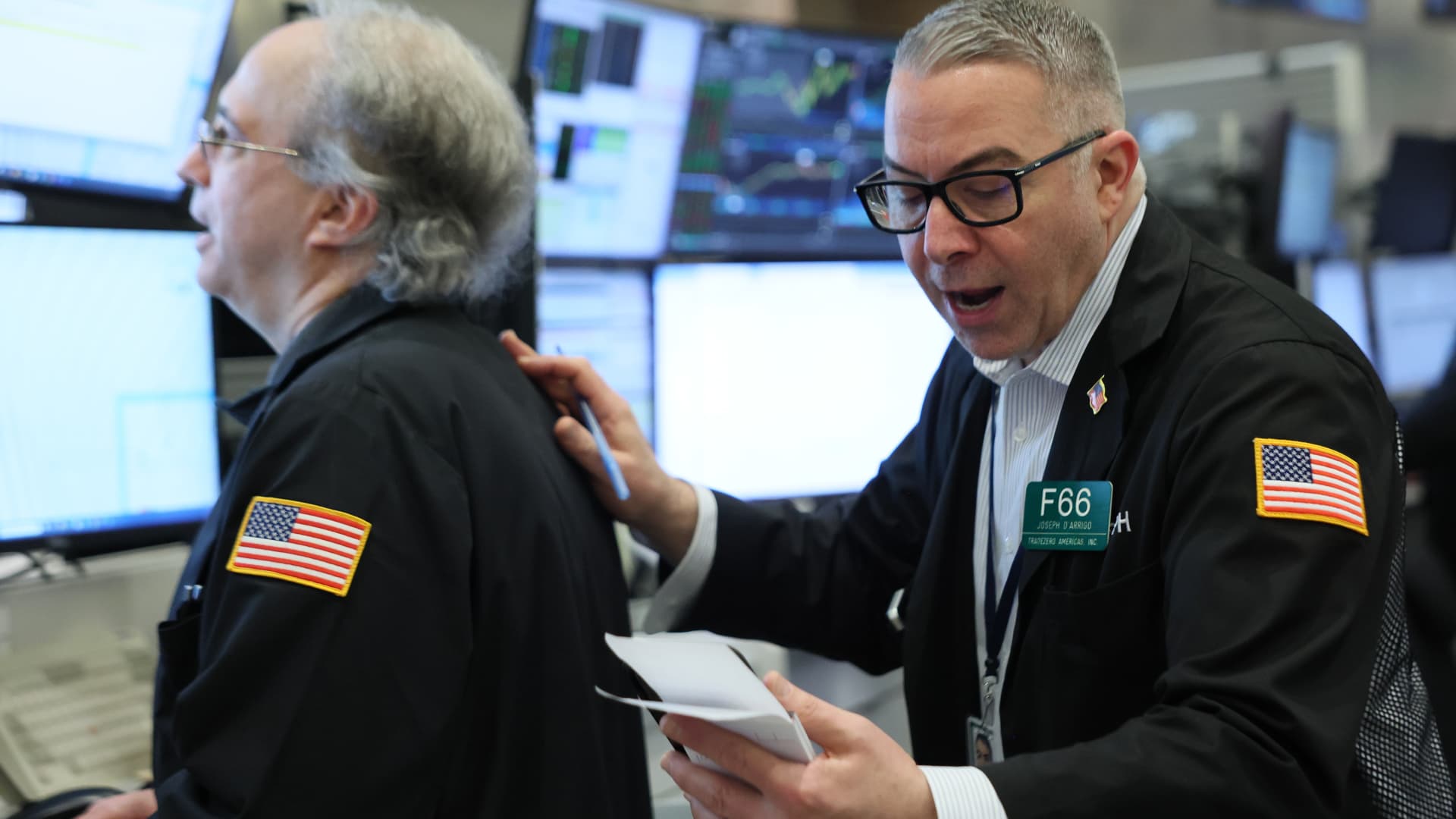
Traders work on the floor of the New York Stock Exchange during afternoon trading on Feb. 20, 2026 in New York City.
Michael M. Santiago | Getty Images
U.S. equities fell on Monday after President Donald Trump said he’s raising his global tariffs to 15% following the Supreme Court‘s decision to strike down the president’s “reciprocal” tariffs.
The S&P 500 shed 0.2%. The Dow Jones Industrial Average dropped 122 points, or 0.3%, while the Nasdaq Composite declined 0.6%.
Gold prices jumped, as the new tariffs heightened market uncertainty about the outlook for inflation and global growth. Spot gold advanced more than 1%, while gold futures rose 2%.
Bitcoin slumped, tumbling at one point to below $65,000, before recovering to around $66,000. It remains down 2% as the cryptocurrency’s sharp sell-off continues.
Those moves come after Trump on Saturday said he would increase the global tariff rate to 15%, up from the 10% he announced on Friday. Trump added that the new duties would go into effect immediately, though it was unclear whether any official documents had been signed regarding the timing.
The president also warned that additional levies would be coming over the next few months.
“I, as President of the United States of America, will be, effective immediately, raising the 10% Worldwide Tariff on Countries, many of which have been ‘ripping’ the U.S. off for decades, without retribution (until I came along!), to the fully allowed, and legally tested, 15% level,” Trump wrote in a post on Truth Social.
Trump later warned of higher duties for countries that want to “play games” after the high court’s ruling.
“Any Country that wants to ‘play games’ with the ridiculous supreme court decision, especially those that have ‘Ripped Off’ the U.S.A. for years, and even decades, will be met with a much higher Tariff, and worse, than that which they just recently agreed to,” he wrote in a Truth Social post. “BUYER BEWARE!!!”
Officials in Europe expressed concern over the move, warning that its trade deals with the U.S. could be in jeopardy. The European Commission said in a statement Saturday that “the current situation is not conducive to delivering ‘fair, balanced, and mutually beneficial’ transatlantic trade and investment” and asked for “full clarity” from the U.S. government regarding its next steps.
Wall Street is coming off a choppy trading session. On Friday, stocks initially rallied after the Supreme Court struck down a broad swath of Trump’s trade agenda, before pulling back, and then ultimately recovering again. Investors hoped the Supreme Court ruling would soothe tensions between the U.S. and its trading partners and lead to possible refunds to companies affected by the tariffs.
But volatility surrounding Trump’s global tariff policy — which was invoked under Section 122 of the Trade Act of 1974, a statute that allows the president to impose the duties for 150 days until Congressional approval is needed — might not be over anytime soon.
“The big question for the economy is what happens after this window, and if the tariff policy stays down this path, we may very well be back at the Supreme Court later this year,” said Michael Landsberg, chief investment officer at Landsberg Bennett Private Wealth Management. “The push and pull with tariffs is likely to be a distracting theme for markets for the remainder of the year, albeit with less volatility than the initial shock last April.”

