
- archived recording (child)
-
(SINGING) Zoom, zoom, zoom. We’re going to the moon
If you want to take a trip, climb aboard my rocket ship
Zoom, zoom, zoom. We’re going to the moon
[FUTURISTIC MUSIC]
From The New York Times, I’m Rachel Abrams, and this is “The Daily.”
Two weeks ago, we asked if you — or more specifically, your kids — had questions for the Artemis II astronauts.
Hello. My name is Mateo.
Hi. I’m Isla and —
?] Hi. My name is Benjamin [? Souza. ?]
My name is Owen. I’m three years old.
Kids definitely had questions.
How yummy was the food? I think they ate stars. [LAUGHS]
Is the moon made out of cheese?
How did you get to the moon without using Google Maps?
Kids wanted to know about life on board the spaceship, about the wonder and the vastness of space —
Were you scared? Because I would be scared.
Why did they go on the mission thing when it was super, duper, duper, duper risky?
My question for the Artemis crew is, how do you think people will look back at this mission in 50 years?
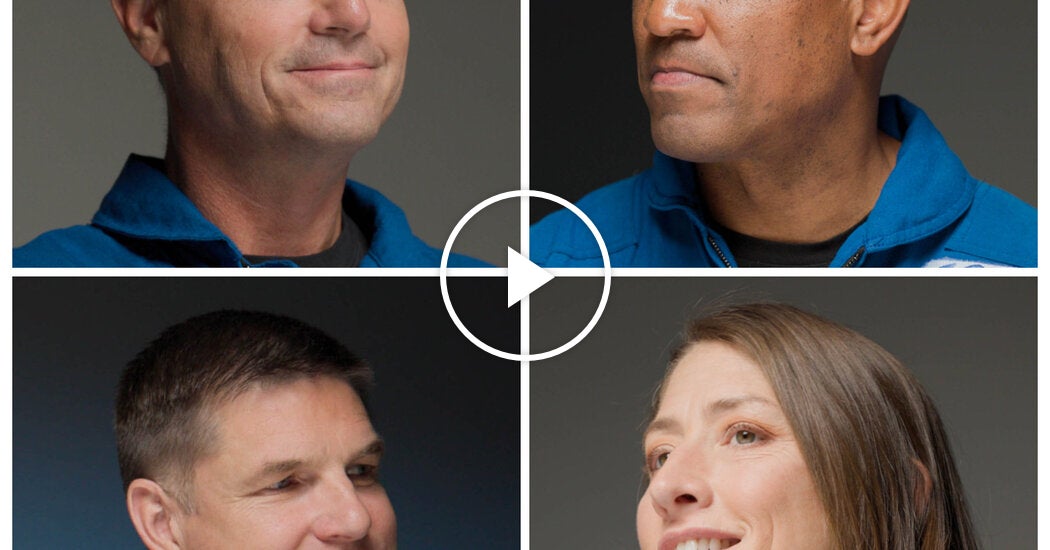
And today we posed these questions to the astronauts themselves — Reid Wiseman, Victor Glover, Christina Koch, and Jeremy Hansen to learn what their mission to the moon was like, how it changed their perspective about life here on Earth, and whether it is possible to drink soda in space. It’s Wednesday, May 6.
[FUTURISTIC MUSIC]
Crew of the Artemis II, welcome to the daily.
?] Thank you.
Thank you.
?] Thank you.
Reid, Jeremy, Victor, Christina, you have been answering about a thousand trillion questions since you got back from your mission to the moon. And that makes sense, because space captivates us in a way that very few things do. And perhaps no group of people embraces the wonder and curiosity of space better than children. And so for that reason, we asked kids to submit questions to “The Daily.”
Can I go to space with you?
And we got so many responses, more than in my entire time at “The Daily.” And —
Amazing.
— a lot of kids, as I’m sure you’ve heard, they want to go to space too.
I’m going to be a grown up. I’m going to be an astronaut too.
I’m saving up to go to space camp next summer.
What does it take to be an astronaut?
When you were a kid, did you guys ever imagine that you would go to the dark side of the moon?
I want to be an astronaut when I grow up. What is one piece of advice you can give me?
[INTRIGUING MUSIC]
What would you tell a child about the qualities that allow you to do what you do, to be astronauts, and how a child might cultivate those? Reid, would you like to start?
I think curiosity and the wonder of nature. You cannot leave out the wonder of nature. Walk outside. Look at a tree. Watch a bird fly. Watch water go around rocks as it’s coming down a waterfall or a stream, just any way you can look at nature.
Jeremy?
Persistence is another one we talk about a lot. Because the one thing that we can all guarantee kids today — there are going to be challenges between you and your goal, and there are going to be times where you do not believe you’re going to make it. And you’re just going to have to have persistence to keep trying and let other people know where you’re trying to go so they can help you.
Victor?
The number one thing I would say to a young person is being a good teammate. And the reason I would start with that one is because at the end of the day, you don’t get to say if you’re a good teammate. It’s your teammates who say that. And so focusing on that, they can start practicing that today.
Mm-hmm. Christina?
Rounding it out — there’s so many left to choose from. I’m thinking about humility. I’m thinking about hard work. And I’m thinking about supporting the people around you.
Well, those are all very beautiful answers. And now I want to actually talk about the mission that you went on. So this was a historic trip, of course. You were gone for 10 days. You were farther than any human has ever been from Earth. You orbited the moon. You went to the far side of the moon. You lost contact with people back on Earth briefly. And we got a lot of questions about what that felt like. So here is a question from Colin in California.
My question is for the astronauts of Artemis II is, how did it feel like to be on the dark side of the moon? Was it scary, or was it adventurous?
Christina, scary or adventurous?
Wow. I would say, in some ways, I would almost call it solemn. We had so much work to do, so we were also very busy. But we did know it needed to be commemorated amongst us when we were the four people out there by ourselves. And we did that. We took a moment. And then we kind of got back to work.
But I can’t imagine, Reid, that you’re not up there, looking at what you’re looking at and being at least momentarily distracted from the very important work that you’re doing.
[LAUGHS]:
He laughs because it’s funny that you asked me that question. It turned out that Victor — he didn’t his job before launch would be to always pull me away from the window, back into —
Is that right?
— the vehicle, but that did end up being his job. But when we’re on the far side of the moon — first, for us, the far side of the moon is often lit by the sun. Whenever we have a new moon here on Earth, that means that the far side is fully illuminated. And as we’re looking at the far side, it was the right side of the moon that was lit up, which was really special for us because human eyes, even though we went to the moon in the 1960s and 1970s in the magnificent Apollo program, human eyes had never looked at what we were looking down on.
There are a few craters, a basin called Orientale, which is kind of the marquee basin of the solar system that we were able to look down on, craters like Vavilov and Ohm. And Ohm’s ejecta rays streak from the far side around to the front side. That was really special for us to get to see. The thing that I just can’t stress enough is, we did take a moment, but then we had so much science that we were trying to conduct. We were trying to record everything that the human eye saw on the far side, because we never see it here on Earth. We are gravitationally locked to only see the near side of the moon here. So we did take a moment, and then it was right back into the work.
I haven’t found good words to describe it, but how it felt was overwhelming. There was a time when Reid mentioned that our brains have not evolved to see what we’re seeing. And so we were actually transitioning from the far side to coming back toward the near side when the sun went behind the moon. It got really bright and then really dark. And looking out at this really large orb, it was all of the things. I mean, there were so many different emotions at the same time.
I can’t tell you how many times I heard something like, oh my god. And I think, that was not in vain. That was inappropriate response for what was happening at that moment. It was so unreal.
And you have described yourself as a religious person. And so I wonder, did you have a singularly spiritual experience in those moments?
The whole thing. The entire mission to me was about God’s glory. I think at any point in the mission, you could go, look at that. That’s kind of amazing. And we did not build that. The amazing spacecraft we were in that we built that allowed us to go do it, but it was like, we’re next to the moon, which dwarfs us. And, like, we didn’t do that, right? That just happened over billions of years. It’s quite an amazing perspective to have.
All of that is very beautiful. But we did get one question that I think embodies a little bit of the skepticism that some people have about the cost-benefit analysis of space travel. So here is Isaac from Arlington, Virginia.
Hello. I’m 13. I’m a normal listener of “The Daily.” And I just want to, why is it important that we are spending billions and billions of dollars on something — we’re not even going to the moon. We’re just looking at it.
I believe he said, why are we spending the money when we’re not even landing on the moon? We are just looking at it. Jeremy, do you have a thought?
Yeah, sure. First of all, Isaac, I think it’s a really important question to ask, because we have a lot of problems here on the planet that we need to tackle. And we are investing a lot of money in space exploration. But I do see it from a different perspective. I see the genius that we bring together under the focus of a common goal. And the solutions that people create that allow us to go out into deep space do benefit us here on the planet.
And I think if we didn’t have that push of exploration, we would miss out on these extraordinary innovations that only come together when it’s not one mind, but when it’s a thousand minds trying to solve a problem together.
Well, we got questions that were about things that were much less serious and much more tangible than
Do you take bubble baths in space?
The kids were actually obsessed with every single part of your trip.
I wonder if the astronauts played any games on the spaceship, like tag or something, while floating.
And I was wondering if your ears pop.
How do you shower and clean yourself? Because first, that would smell really bad for four people in space.
They wanted to what space smelled like.
What happens if the astronauts run out of fire?
Was it colder than you thought it would be?
They wanted to know whether it was cold, whether it was hot.
Astronauts have to eat broccoli?
And they had a lot of questions about what you guys ate.
My question for the astronauts is, Was the food in space as good as the food at your home on Earth?
Quick question for the astronauts — Do they have pizza parties up there?
How do you guys get food if there’s no restaurants?
(GIGGLING) What do you eat in space for dessert?
Can you drink soda in space?
I’ll take first stab at this. First, yes, we have broccoli, and it’s actually delicious. Broccoli au gratin — one of my favorite things to eat. It’s — you just have to —
You’re just saying that. You’re just saying that because you’re talking to parents of the children.
Absolutely not. It’s got cheese in it. But you just add a little bit of water and heat it up. It was very good. But the food is magnificent.
We have tortillas. You can put brisket on a tortilla. We have chicken and beans, broccoli. Spicy green beans is another favorite. What were some of your favorites? Beets.
Yeah.
Kale salad.
Kale salad. And I wanted to bring in tortillas, because Jeremy, on the first day — if you invented it, but you may have seen we had Nutella, and taking Nutella and spreading it on a tortilla, and then folding that in half, it almost made like a chocolate crepe. And Jeremy was just distributing those around the cabin, and they were a great dessert.
Did any of that stuff spill? Like, did you have a moment where the tortilla opened and it —
Constantly.
But you know what? It’s funny, I like to say that we shared a lot of meals, sometimes it was on purpose.
And so, pieces of things would fly by, and you make sure it’s food, but then you just enjoy it.
(LAUGHING) Make sure it’s food.
Make sure it’s food.
One of the coolest moments on that first day up there — I had some oatmeal, and I didn’t put quite enough water in it to rehydrate it. And so when I opened it, there was crumbs of oatmeal that just started floating out. And I don’t mean, like, two crumbs. I mean, like, 10,000 crumbs of oatmeal.
And I was very embarrassed. You know, I’ve flown in space before. I shouldn’t be making these mistakes. And instead of being annoyed, Victor just floats over, and he goes, oh, this is my favorite game, and just starts eating them all out of the floating area around me. It’s really great.
That’s amazing. I think there’s actually a “Simpsons” episode where that exact thing happens.
With the potato chips, yes!
(LAUGHING) Yes, exactly.
(LAUGHING) Oh, my god.
Wait, so OK, we did get a question about soda in space. How do you do that?
Soda, I haven’t seen it happen successfully. I think there have been attempts, but for many astronauts, that’s something that they crave when they get back. Something bubbly.
What’s the problem with carbonated beverages?
We tried. When I was on Space Station, we did try to drink carbonated beverages. Some of my Russian crewmates had a soda bottle, and we couldn’t even open the cap, because the bubbles do not go to the top.
They’re just distributed throughout the entire thing. And anytime we would twist the cap a little bit, it would start to spray out, like if you shook up a can. And so we would twist the cap and just try to suck it off that cap. And we eventually gave up.
That sounds like the worst way to drink a sprite, so — Our next question is from Leonardo in New York City. It is about another aspect of daily life.
My big question for the Artemis II crew is, What does it feel like to sleep upside-down in space when there is no gravity? Also, is there gravity in your dreams? Thanks. I want to be an astrophysicist when I grow up.
Love that.
Great question. I think one of the great things about being in weightlessness is there is no upside-down.
There is no upside-down. I’m just thinking that through — meaning that any side could be right-side-up?
It all feels the same.
Mm.
It’s all convention. What do you call the floor and what do you call the ceiling? Could be anything.
Wow, you just blew my mind. Everyone listening, their mind just got blown in that moment, thinking about that. Did you have to strap yourself in some way? And did anybody ever bump into anybody else in their sleep?
I’m sorry, Jeremy.
Yes.
(LAUGHING) It was you? He just outed you?
No, it was me.
(LAUGHING) Oh.
Well, we kind of slept almost as if we were in bunk beds, so like, two this way, two this way, but in opposite directions. And I ended up sort of in this middle space, with Reid and Victor underneath me. At one point, I made the mistake of saying, I kind of like how I float around and I move around. And so, once I said that, then we would just —
Kick, kick.
— and I would float, bounce around for a bit, and then I would just be drifting off, and then I’d get another kick and go for another ride.
The second part of Leonardo’s question was, Is there gravity in your dreams?
I think we all dreamed that we were floating at different times. And one really neat thing that happened, I think, to all of us, was when we got back and woke up in our beds at home, we all felt like we were floating for a little while.
Wow.
Yeah.
So you obviously traveled more than a quarter million miles away from people that you love and your home, and we got a lot of questions from kids about what that distance might have felt like. This one is from [? Aidan. ?] He’s eight years old, and he lives in Santa Cruz Mountains, California.
My question is for Reid, Victor, Christina, and Jeremy. How did you feel when you were that far away from Earth? Was it lonely?
Was it lonely, Reid?
You are flying with great friends, and so I never really felt lonely. I would say the one thing that I definitely felt — and I think it’s all individual, but I definitely felt some fear. You are so far away, and you’re trusting this vehicle. And ours handled marvelously well. But if something went wrong out there, it could be a very tough day. So that, to me, is always — it was always in the back of my mind.
I didn’t feel lonely at all. But what I did get this new sense of was how everything is sort of distributed in our galaxy. When you look up in the night sky, every star you see in our night sky is in our galaxy. This is one galaxy in the entire universe.
And we were looking out from our spacecraft, and we were just seeing these other stars in our galaxy. But I was seeing them in a three-dimensional space. Some of them looked closer than others. And the Earth and the moon, and seeing them, and just seeing how they’re juxtaposed — have such a hard time explaining it to people, but it was very different than I expected. And when I see the pictures now, I’m like, wow, those are really beautiful pictures, but that’s not what I experienced when I saw it.
I didn’t feel lonely, but I felt longing for Earth. It’s all of the people I love, and Shakespeare was down there. It’s everything, right? But then you get out there and you go, there’s a lot of nothing out there. Space is emptiness. There is no air. There’s a lot of nothing.
And you go, wow, if all of the things we know of, even this spacecraft that we’re hanging out in, was built there, it is an infinitesimally small piece of the universe. But Mary, Jesus, Gandhi, it’s all there. And these folks and their families, it’s special, even though it’s small.
I don’t know that this will relate, but if you look at the crescent moon, it’s rounded, and it stops where the sun goes to shadow. But when you look at a crescent Earth, the same thing happens, but the edge of the Earth just extends a little bit longer. And if you look at it, you realize the extension right there, this tiny — it’s like two little tiny whiskers coming off the edge of Earth.
It’s the whole atmosphere. It’s everything that keeps us alive. You really sense fragility. You just sense such a special little tiny thing right there, that atmosphere. You can just tell the moon cannot sustain life, but Earth can. And when you put those two things next to each other, the thing that enables us to live here is so tiny, it’s impossible to even rationalize in your mind.
We’re gonna take a very quick break. And when we come back, I am going to present questions to you about the number-one topic that we got questions about.
[MUSIC PLAYING]
It probably does not come as a surprise that the number-one topic we got questions about was the bathroom.
Of course.
And so we want to play you a very small number of questions that we got about this topic.
My name is Atticus. I’m 4 and 3/4. And how do they poop or pee in space?
How do they go potty in space?
How do you go to the bathroom?
How do the astronauts use the bathroom? What is it like to go to the bathroom in space? And do you guys have any privacy?
How do you go poop? [LAUGHS]
Who farts the most in space?
Does the poop go up or down?
And where does it go?
Did you poop in space and did it float?
I was wondering what you did while your toilet was broken on the spaceship.
Where do you throw away your toilet paper when you go poo poo? [LAUGHS]
OK, Artemis crew. The children have spoken.
Children need to know.
They demand answers. How do you have a bowel movement in space? What part of the toilet broke, and what did you do when it did?
Well, there was a lot of, does it go up, does it go down, where does it go. If it’s going up, you have a problem, and you did something wrong. Because you’re right. We don’t have gravity to naturally bring all the things where they need to go. But what we do instead is we create an entrainment with a suction-slash-fan. It’s not very, very strong like a vacuum cleaner or anything.
I was about to say, is it like sitting on a vacuum? Is that what this is?
It’s enough to make everything go where it should go, if you do everything right.
So for us, we have the primary toilet, which handles the bowel movements and the urine normally. And then, once you urinate into this hose, it gets stored in a tank, and then that gets vented to space.
OK.
The capability to vent it to space clogged, and that failed. And so we needed to go to a backup method, which is these just very simple tubes that you can connect to a port on the side of the spacecraft and vent them to space.
I just assumed you did what we all do, which is use an empty water bottle.
[ALL SPEAKING AT ONCE]
Space water bottle.
OK, I wasn’t too far off.
Well marked.
It was definitely a challenge for us. And we lived that way the whole entire time.
And what’s the privacy situation here, with all of this?
For a capsule, pretty good. There is a separate toilet area with a door. It’s in the floor, so you get to float in there, and you can close it off. It’s actually pretty good. It’s one private space we had, other than putting on headphones, which was a signal that you might want a little privacy.
We could not talk about questions from kids without a question about aliens, so we have one.
?] Hello, my name is [? Seline. ?] I’m eight years old, and I live in California, but I want to live in New Jersey. So I have a question for you guys on the Artemis II. Is there other life out there, a.k.a. aliens? And did your experience on the dark side of the moon change your answer? Uh, yeah, that’s it. Bye-ee!
Aliens, guys? Who wants to answer?
I mean, I’ve been to New Jersey.
Jeremy?
Oh, well, when I think about the universe — and I was talking to you before — every star you see is in our galaxy, the Milky Way. But then we think there’s maybe a couple trillion other galaxies out there. So it’s pretty hard to fathom that there’s not alien life out there.
If you look at the closest neighboring galaxy, which is Andromeda, let’s say there’s this amazing civilization there. They have the most extraordinary telescopes, and they’re looking at Earth right now while we’re chatting. What do they see?
They see us a couple hundred thousand years ago, and so we’re not here.
Hmm.
That’s our closest neighboring galaxy. So it gives you an idea of how hard it is to look for life in the universe. It’s just really far away, even at the speed of light.
As the details about the toilet show, you guys prepared for every single eventuality. So I have to ask, did any of your training, Victor, include what to do just in case you encountered an alien?
No. But the other part of that question — Did our experience on the far side of the moon change that? No. We’ve looked. I mean, we have a lot of resources pointed at this dark sky, looking for answers. And it’s a great question, and I hope it continues to drive us to explore further.
I just want to point out that “no” is the answer that somebody who saw an alien but wasn’t allowed to talk about it would say.
You realize if we found alien life out there and we came back and reported on it, NASA would never have a budget issue for the rest of eternity. So trust me.
That is one — that is one good argument. I’m not — I’m not gonna argue with that.
Also, we tell Reid not to say things all the time, and he does, so.
True.
We have one more question about your experience while you were actually in space.
This is Clara Jones, age nine, of Dallas, Texas. What was the most beautiful thing you saw?
What was the most beautiful thing you saw? Victor, would you like to start?
Oh, I’m sorry to be boring on this, but it’s the Earth.
Wow.
It just stood out. It was so different. The colors, the shapes. Our planet looks alive. Even though we can’t see human structures and boats and roads, it looks alive, because the swirls change. And it just — it demands your attention. When you see it out the window, you have to stare at it.
I think one of the most beautiful moments from this, at least for people watching back home, was the video, Reid, where you dedicated the crater to your late wife, Carroll. Would you mind describing that moment and what you were thinking and feeling?
Well, thank you for that. I mean, that was a special moment for this crew. And it was clearly a special moment for everyone watching.
- archived recording (jeremy)
-
Thank you, Houston. We have a couple more things we’d like to take this moment for.
Christina had the idea, and Jeremy approached me before we launched, and said, hey, the crew would like to do this. And I said, Jeremy, that it would be amazing honor for my family, and I would love it if you all did that, but I cannot do the talking, and so Jeremy did.
- archived recording (jeremy)
-
A number of years ago, we started this journey in our close-knit astronaut family, and we lost a loved one.
And it was very emotional for all of us. It was — I mean, I just — Jeremy, I still can’t believe you made it through that.
- archived recording (jeremy)
-
There’s a feature in a really neat place on the moon, and it is on the near-side-far-side boundary. In fact, it’s just on the near side of —
I can’t believe that — thought that you all put into that was very special for me.
- archived recording (jeremy)
-
We will be able to see this from Earth. And so we lost a loved one. Her name was Carroll.
And as we were approaching the moon, even days away from the moon, we could look out and see that crater.
- archived recording (jeremy)
-
The spouse of Reid, the mother of Katie and Ellie.
And it turned out that both of my daughters were in Mission Control. They were in the viewing room.
- archived recording (jeremy)
-
It’s a bright spot on the moon. And we would like to call it Carroll. And you spell that C-A-R-R-O-L-L.
And that moment, even though it was an honor of my late wife and primarily to my two daughters, but that was the moment that our crew coalesced, and I think we were bonded there forever.
How did your daughters react when they first learned that you’d be able to do this for their mom?
We still haven’t talked through that, but I know it was — They did not it was coming, and I know it was — I think, for them, I can’t think of a more special moment in their lives to get to hear those words come down.
That sounds very beautiful.
It was.
You guys have done so many interviews since you’ve gotten back. You’re obviously doing one right now, and you will probably get asked about this trip for the rest of your life. And I wonder how you plan to hold on to something this singular and special, Jeremy.
We talk a lot about gratitude and just remembering what a privilege this was. And we’re not doing it that well right now on the planet, but we can at least have the stated goal of trying to get to where we collaborate to lift one another up here.
Victor, I think I heard in an interview that you tried to seal yourself off from the world for a week just to process. Can you talk a little about that?
Two weeks, actually.
Two weeks! You managed two weeks, wow.
It ended when we started this trip to get out and share the news. And I think that, for me, that two weeks was nice. It was medical checks and reconditioning, working out and — It’s also given me time to just get ready for this, to just think about it and be very intentional as we transition to being more in the public.
And to connect it to the previous question you asked, I’ve actually decided it’s not as a person who gets to be an ambassador of the cosmos. Like, that’s a crazy job title, to be an astronaut. I don’t want to hold on to it.
I was there, and I will never be able to put words to what we actually saw or felt there. I’ll try. But really, I want to give it away. I want to give it away, technically to the next crew, and I want to give it away socially and culturally to people who made it possible. So thank you again — gratitude for doing this — but it’s not mine to hold on to.
I think one of the astounding things about your trip was just how much it brought people together. You’re talking about your crew back home, but also you guys have said you wanted to do something that was really unifying for people watching. And now that you’ve had a chance to come back and reflect, we want to ask one more question from a kid that gets at what your takeaway might have been.
?] Hi, my name is [? Amali. ?] I’m 11 and 1/2 years old, and I’m calling from Los Angeles. My question is, when you saw the whole Earth from far away, did it make you think differently about what really matters in life, what people should care about, or how we should treat each other? Thank you.
It’s such a deep question. There’s so many — there’s so many things that I want to say. I guess the thing that I would relate to that is, you see the purity of Earth, and you can sit there and wonder why we can’t get along and why we have differences. I would also say that maybe those differences are what makes us great sometimes. It lets us explore different avenues. If we were all the same, I don’t think we would do what we do.
Well, we’ve talked about joy. I think it really set in our hearts that our purpose here on this planet is joy and lifting one another up. And I don’t think that’s new, but I think it certainly reinforced that for us.
I have one last question for you guys, which is, I think most people believe you when you say that nobody can understand this experience. You had something wonderful happen. And you’re gonna carry it with you for the rest of your lives, and we’re just not gonna get it.
But I also wonder whether being up there, with no life, gave you a renewed appreciation or wonder for what I think is the unlikely scenario of life down on Earth, and just all the things that had to come together for us to even be here right now.
1,000 percent.
Absolutely.
That was one of the biggest takeaways. Because when you look out and you see the Earth, tiny Earth, and you mostly see blackness around it, you recognize what a completely unlikely scenario this is, and how precious it is. There is some such thing as a global scale, and we have a choice as to what we do with that.
I think what I wanted to end with is just a gratitude to people who paid attention to the mission. We look a lot and pay attention at the negative right now, and the things that are different and how they’re wrong. But you can also look at the things that are different between us and how that’s right and how that’s an asset.
And so what I have a renewed sense for is that people are willing to spend energy and pay attention to the positive things, and therefore, we have a choice of where we put our energy and our attention.
Our world, our choice.
Thank you all so much for spending this much time with us.
– I get my last word?
Oh, sorry, I was looking, and I thought you were nodding like you were — this is their last thing —
– This is the most profound —
OK, OK, wait, let me reset. – — comments you could ever hear, so if there’s kids listening, I want to give homework.
You absolutely can.
– My homework would be, the next time you see something in bloom or something growing out of the ground, just stop for a second and look at it, and just be impressed by it.
Because sometimes you have to leave and look back, and then come back to realize the simplest little thing can be the most impressive thing you have seen all week.
Crew of Artemis II, it has been such a pleasure, and congratulations.
Thank you.
Thank you.
Thank you.
Here’s what else you need to know today. Officials at the Food and Drug Administration have blocked publication of several studies supporting the safety of widely used vaccines against COVID 19 and shingles. The latest step by an administration that has tried to limit access to vaccines and promote information that casts doubt on their safety.
The studies were conducted by scientists at the FDA and cost millions of dollars in public funds. Researchers found serious side effects to the COVID 19 and shingles vaccines to be very rare. And Senate Republicans have inserted $1 billion for security enhancements for President Trump’s new ballroom into the immigration enforcement funding bill they hope to rush through Congress this month.
Democrats pounced on the proposal, signaling that they intended to make the ballroom a centerpiece of their opposition to the measure, and their election year message that the President and his party were not meeting voters’ needs. The President had previously insisted that the renovation would be funded through private donations, and the proposed new ballroom is currently being challenged in court.
The crew for today’s episode includes producers Lexie Diao and Anna Foley, with help from Rachelle Banja. Our episode was edited by Marc Georges with help from Paige Cowett, and contains music by Diane Wong, Pat McCusker, Sophia Lanman, and Chelsea Daniel. Original music by Marion Lozano and Dan Powell. Our theme music is by Wonderly.
This episode was engineered by Alyssa Moxley. And a special thanks to our entire video team, including Peter Colpaert, Christina Avalos, Mustafa Mirza, and Devin Greenleaf. And to our studio engineers, Kyle Grandillo and Sam Winter.
If you want to see the Artemis astronauts react to these questions from kids, check out the video version of our interview at our website. And finally, thank you to everybody who called in — the kids, the parents, the teachers who got their whole classrooms to ask questions. We really loved listening to all of you.
[MUSIC PLAYING]
That’s it for “The Daily.” I’m Rachel Abrams. See you tomorrow.

