
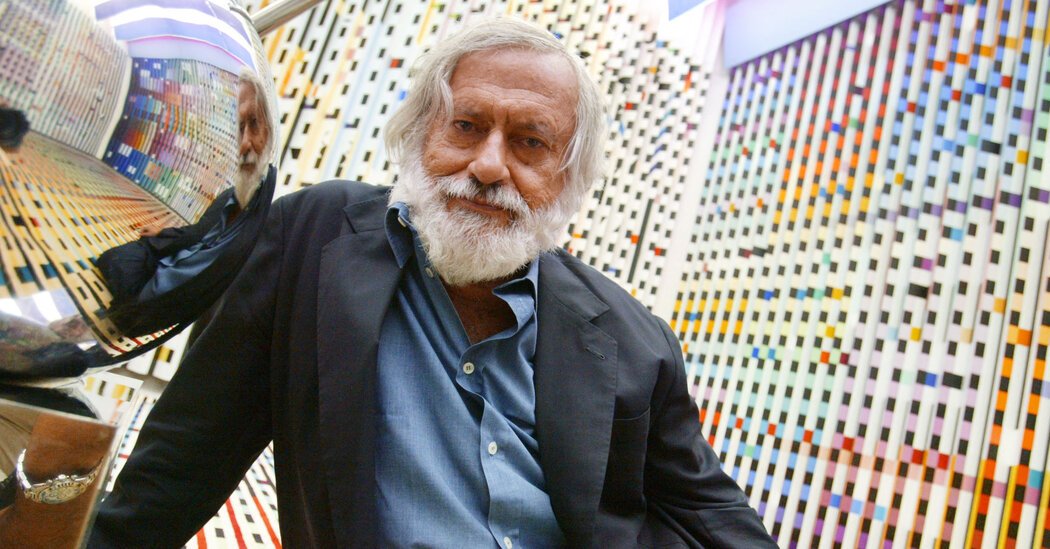
Yaacov Agam, an Israeli artist whose brightly colored geometric sculptures and paintings delighted the eye with optical illusions and moving parts, and whose many public artworks included the world’s largest menorah and a rainbow-hued fountain that breathed fire and played music, died on June 18 at his home in Rishon LeZion, Israel. He was 98.
His son Ron Agam confirmed the death.
On the surface, Mr. Agam (pronounced a-GAHM) was a merry practitioner of what is known as kinetic art. He had studied in Zurich with Johannes Itten, the Swiss color theorist; imbibed the spatial provocations of Constructivism; and then moved to Paris, where he spent most of his life. His cohort included artists like Alexander Calder, Constantin Brancusi and Yves Klein.
In 1953, when Mr. Agam was 25, he had his first show at the Galerie Craven in Paris: 18 pieces that teased the eye with color and movement. The show was a hit, critically and financially, and the work was of its moment: It anticipated the Op Art of the 1960s and had a kinship with earlier kinetic sculptures, including Calder’s mobiles.
But there was another element to Mr. Agam’s abstractions. He was the son of a rabbi and kabbalist, and that mystical strain of Judaism permeated the ideas behind his work — ideas about space and time, about the infinite and the mutability of reality.
In 1965, Mr. Agam was one of 75 artists from 10 countries assembled by the Museum of Modern Art in New York for “The Responsive Eye,” a blockbuster show about “a new grammar” of art that critics had begun to call optical art — artwork that challenged perception.
In his New York Times review, John Canaday declared the roundup “brilliant.”
“There is a wonderful suggestion here,” he wrote, “that, at last, we have an art form that must exist only in its own presence, as art used to exist before the process of mechanical reproduction.” (His point was that the work was hard to photograph.)
Mr. Canaday singled out Mr. Agam’s “Double Metamorphosis II” as “an example that falls between the new idea of constantly shifting perceptions and the old idea of static design.”
A massive piece — roughly nine by 13 feet — that remains in the museum’s permanent collection, it is made of corrugated aluminum, one side of each ridge painted in a black-and-white pattern, the other side in color. Mr. Canaday compared it to double portraits from the Renaissance that used a similar pleated surface to trick the eye: If you looked at them one way, you saw one image; when you shifted your gaze, you saw another.
Later critics sometimes dismissed Mr. Agam’s work as kitschy and repetitive, but he was beloved by collectors, heads of state and civic boosters around the world. Donors commissioned a five-ton, movable stainless-steel work that resembled three zigzagging branches for the Juilliard School at Lincoln Center on behalf of the America-Israel Cultural Foundation. The dedication in 1971 was attended by the violinist Isaac Stern and Bess Myerson, then the city’s commissioner of consumer affairs.
Mr. Agam told The Times that the piece was “not a statement, but a constant becoming, not a sculpture but many possibilities for one.” He demonstrated by using a steel winch to rearrange the branches of the sculpture — each one weighing a ton and a half — to vigorous applause from the crowd.
Former President Georges Pompidou of France was a fan, and commissioned an entire room from Mr. Agam. “Salon Agam” was a mind-bending plastic-and-aluminum container in psychedelic colors that would be installed at the Élysée Palace, the 18th-century hôtel particulier that is the French president’s official residence. Mr. Pompidou died in 1974, before it was finished, and in 1979 it was moved to the Pompidou Center.
“Usually, you look at a work of art from the outside,” Mr. Agam told The Times. “Here, the viewer is inside. You see it from every angle, you never see the same way twice, and different people always see it differently. It is the plastic expression of Einstein’s space‐time continuum.”
By then, he was a marquee name. In 1980, the Solomon R. Guggenheim Museum in New York held a retrospective of his work. The Walter Annenbergs were collectors; so were the Ronald Reagans. (There were four Agams in Mr. Reagan’s private residence at the White House.)
In 1981, when a black-tie dinner was held in conjunction with the opening of an exhibition of Mr. Agam’s work in Washington, Mayor Marion Barry declared it Agam Day, calling Mr. Agam “the greatest artist of his generation.”
At the event that night, Mr. Agam signed catalogs with colored pens and announced, as The Washington Post reported, “Art is a rainbow.”
When a critic asked if he agreed with Mayor Barry’s assessment of his talents, Mr. Agam, exhausted by the attention and the crush of people, replied, “I am a bubble, and if I don’t get some air I shall collapse.”
Yaacov Gibstein was born on May 11, 1928, in Rishon LeZion, then a settlement in Mandatory Palestine just south of Tel Aviv, one of 11 children of Kendel Yocheved (Povembrovski) Gibstein and Yehoshua Gibstein, an Orthodox rabbi and kabbalist.
The household was religious, and Yaacov was educated at home, but he often ditched his studies to play in the dunes. He liked to say that watching the wind mold the sand was the inspiration for his artwork, and that reading “Lust for Life,” Irving Stone’s 1934 biographical novel about Vincent van Gogh, made him want to be an artist. (Mr. Stone would later join the ranks of Agam collectors.)
But he was delayed by politics: At 18, he was arrested by British forces as part of a sweep of Zionist activists, and spent eight months in prison.
After studying art at the Bezalel Academy of Art and Design in Jerusalem, he moved to Zurich in 1949 to study with Mr. Itten at the Kunstgewerbeschule (now Zurich University of the Arts). At Mr. Itten’s urging, he planned to move to the United States to attend the School of the Art Institute of Chicago. On his way, he stopped in Paris, changed his surname to Agam (which means “lake” in Hebrew) and decided to stay.
Mr. Agam called his artworks Agamographs and created an eyepiece fitted with prisms for viewing them, calling it the Agamoscope.
He also designed tapestries, toys, furniture and buildings. He designed stamps and created an educational program for children. He produced limited editions of his work in take-home sizes. He designed two fountains, one in Paris and another in Tel Aviv that resembled a color wheel, although it also spit fire and played music.
In the mid-80s, Mr. Agam designed what is surely the largest menorah in the world, at over 30 feet tall, made from steel tubes. Every year, it is brought out and lighted in Manhattan’s Grand Army Plaza, at 59th Street across from the Plaza Hotel.
He also designed elements of his own museum, the Yaacov Agam Museum of Art, which opened in 2018 in Rishon LeZion, where he moved a decade ago.
Mr. Agam’s wife, Clila (Lusternik) Agam, died in 1982. In addition to his son Ron, he is survived by his longtime partner, Chantal Thomas d’Hoste, a harpist; another son, Orram; a daughter, Orit Agam Einat; and a grandson.
“Art is one of the most important things from a moral, educational and public point of view,” Mr. Agam told the Haaretz newspaper of Israel in 2011. “We have a great deal of aggressiveness and hatred, and art softens this. We need art in the public space, not in the museums and not in the collections of rich people.”

