
On April 5, 1914, Frieda Lagus and Gabi Möschl, two women in their 20s from Vienna, caused a stir when they strode down a Manhattan gangplank “with the latest assured swagger of the female masculine type,” according to a report in The Buffalo Morning Courier.
One of these Amazons descended in a man’s straw boater atop an outfit she called her “Futurist Vision,” featuring a skirt with side pockets — placed “where men’s trouser pockets would be,” according to a shocked report in The New York Tribune — with a “mannish” jacket and white shirt and tie to complete what The Courier called “the male effect.”
The two women had learned that “effect,” and their swagger, as designers at the great Wiener Werkstätte — the Vienna Workshops — a design studio and retailer founded in 1903 and known worldwide for its aggressively modern goods.
And now the Jewish Museum in New York is giving us a window onto these radical women, and their tastes, in a thrilling show called “Modernity and Opulence: Women of the Wiener Werkstätte.” It pulls together more than 200 objects designed at the Werkstätte over the company’s three-decade life. Although the museum has chosen to focus on Werkstätte women who were born Jewish (about 25 percent of the firm’s female artists), I don’t see that ethnic identity is truly at stake in this show; gender is its very vital subject.
The exhibition doesn’t only do the now-common job of spotlighting the work of talented women overshadowed by their male contemporaries, the way the female staff at Tiffany & Company have recently been given credit once reserved for their bosses.
Going further, it presents a fresh image of the Werkstätte, and of the women there who crafted a whole new idea of how a woman might be — no longer a modest and seemly helpmeet to men, but someone with the power and courage to make a mark.
At the Jewish Museum, we get the novel objects these female designers came up with, of course, but we also see how they counted themselves as their own fresh creations. The two viragos who shocked New York were early avatars of their century’s New Woman, crafting goods that helped other women become equally New. You might say that all the many objects in this show count as brushstrokes in a brash, self-confident portrait its female creators were keen to construct, of themselves but for all their sisters to see.
Traditionally, the Vienna Workshops have been known for the work of two of its founders, the architect Josef Hoffmann and the painter Koloman Moser. Their creations had a sleek modernism that foreshadowed the glass and chrome of the Bauhaus, and even the minimalism of the iPhone.
But that’s almost never the look or spirit of the objects in this exhibition, assembled by the curator Kristina Parsons with the MAK design museum in Vienna, the show’s major lender. (A much larger show was at MAK in 2021; its catalog is fantastic.) Where those male founders were working out a new aesthetic for objects, the women of the Werkstätte, who dominated the firm’s production after Austria’s men went to serve in World War I, were crafting something much bolder: a new aesthetic of female power.
Instead of seeking the restraint of industrial goods, they deployed the expressive hand-crafting of traditional “woman’s work.”
That reached an apogee, maybe, with the expressionist pottery of Vally Wieselthier, who was head of the Werkstätte’s ceramics department from 1927 to 1928, before beginning a fine career in the United States. At the Jewish Museum, three of Wieselthier’s female heads reject the sleekness of her bosses’ designs: They are boldly, almost crudely, hand-modeled in clay then glazed in colors that capture the gaudy flapper’s makeup Wieselthier seems eager to celebrate.
“Don’t try to rival the billboard or a color chart when you are making up to go out,” said a prim beauty book of that era. Wieselthier’s heads proudly do just that. They also wear the fearlessly wacky hats designed and sold by the women of the Werkstätte, sitting atop the boyish haircuts they dared to favor.
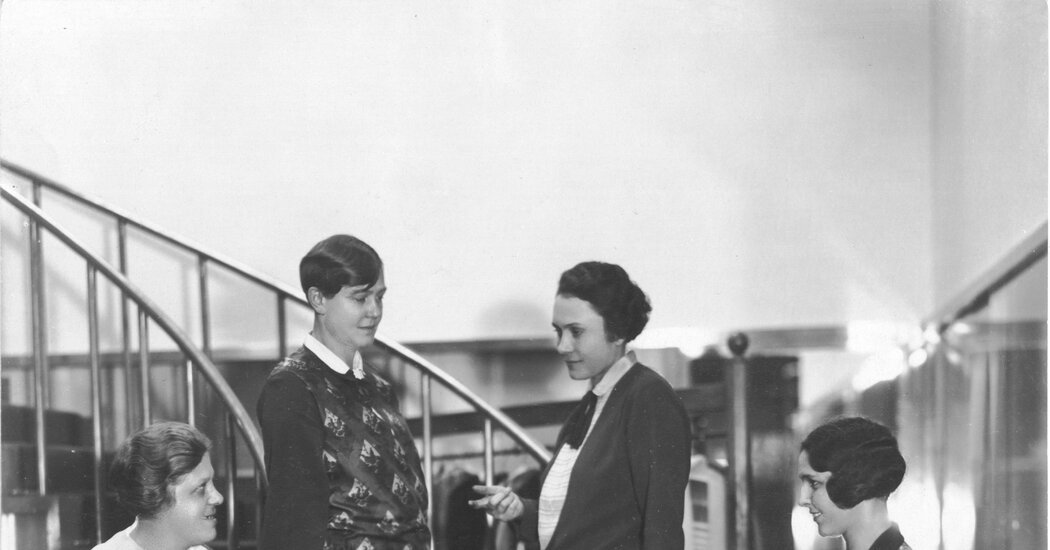
One of Wieselthier’s gloriously wild heads has the initials “VW” carved big into its base, declaring it as a portrait of its maker. Surviving photos show how brazen the women of the Werkstätte could truly be, sometimes going so far as to smoke for the camera.
In 1938, when Wieselthier was fired from an American university job for behavior seen as provocative — she wore slacks to work — she telegraphed President Roosevelt himself: “Tell these people who I am,” she demanded, insisting that her talent as an artist ought to speak for her.
The Werkstätte’s women “had the ideal of being unconventional, expressing themselves through love affairs, having as many sexual experiences as possible,” recalled one early witness. Their goings-on, which included the same-sex love also captured in some of their works, was another marker of the limits they rejected.
The clothing these New Women designed was nothing like the boned and corseted fashions of just a few years before. In 1912, Fritzi Berger, all of 18 at the time, drew and signed one of the fashion postcards that were a Werkstätte specialty: the woman pictured wears a black skirt that is nothing more than a slender, clinging tube, with no hint of constricting structure; her top is equally tubular, except white with bold biomorphs floating across it. Her hair is in a bob that was truly radical: European women had been wearing their hair long for most of the last 3,000 years.
Berger offers an image of a woman not afraid to be new, and free.
Even Vienna’s underwear could aim to escape Victorian constraint. At the Jewish Museum, a painting by Wilhelm List from around 1911 shows a young model on a Werkstätte chair clad in nothing but bright rouge, lipstick, a camisole and the era’s roomy new “umbrella drawers”; they might make today’s women jealous, as they squeeze into their thongs.
The Werkstätte’s textiles and fashions, mostly designed by the firm’s women and especially important to its income, have a Jazz Age energy. In 1923, a client wearing an outfit cut from Felice Rix’s “Sheet Lightning” pattern — brilliant slashes of color flashing across a field of black silk — would have felt almost compelled to dance the Charleston, landing on Victrolas that same year to an outcry from conservatives everywhere.
The Werkstätte’s women faced the same kind of reaction in 1925, in Paris, when designers including Wieselthier and Rix dominated the firm’s presentation at the landmark Exposition Internationale des Arts Décoratifs (origin of the term “Art Deco”). One male critic described their display as “a scandalous bimbo business.” Two years later, just when Wieselthier was making her female heads, the modernist architect Adolf Loos, famous for billing ornament as a crime, delivered a polemic against the Werkstätte and the decorative drive of its craftswomen, describing them as “dilettante daughters of senior civil servants,” just killing time before marriage.
Some members of his audience threw punches in the women’s defense.
This exhibition lets them speak, plenty loudly, for themselves.
Modernity and Opulence: Women of the Wiener Werkstätte
Through Nov. 15, at the Jewish Museum, 1109 Fifth Avenue, Manhattan; 212-423-3200, thejewishmuseum.org.

