
The parched grasses and thorny shrubs seemed to stretch from horizon to horizon, and I was hot and sticky from a cocktail of sunscreen, insect repellent and dust. This hardly seemed like a place to take a swim, but that was why I had come.
I heard the water before I saw it. In a hidden gorge, an underground stream emerged, tumbling down a rock face into a pool shaded by palms. I couldn’t wait to jump in and feel the cool relief.
Last year, I traveled to Isalo National Park, which sprawls over 300 square miles in the southwestern corner of Madagascar, to experience a landscape both blistered by the elements and dotted with incredible, unexpected natural pools. And I had my heart set on seeing lemurs.
While many visitors to Madagascar head east and north to rainforest or to resort-filled islands in the Indian Ocean, the south offers a starkly different experience. Isalo — often called Madagascar’s Grand Canyon — features towering sandstone domes, sculptural rock formations, expansive canyons and night skies that burn bright with stars.
I began my journey in Antananarivo, the capital, and then caught a domestic flight to the southern port city of Toliara. To get from there to the Isalo Rock eco-lodge, I hired a driver (the hotel can help make arrangements; I paid 950,000 ariary, or about $230) and we drove nine hours east through a savanna dotted with the occasional baobab tree, gradually rising up into foothills of a craggy massif.
I arrived at Isalo Rock (from $128), in darkness. But exhausted as I was, craning my neck and staring at the sparkling constellations above was like having a shot of espresso.
Isalo National Park, founded in 1962, was protected shortly after Madagascar gained its independence from France in 1958. The parkland and surrounding area is the homeland of the Bara ethnic group, traditionally nomadic herders of zebu cattle, which have distinctive humps. I saw many locals guiding their zebu, their humped backs swaying and their curved horns casting long shadows in the morning sun.
My guide, arranged through the lodge, was Peter Romi, originally from Madagascar’s central highlands (160,000 ariary, plus tip, per day). We began our hike a short distance from one of the park entrances on a gradual incline through grassland and small trees. Further along, Mr. Romi, 44, who had been stewarding visitors here for 12 years, showed me tea bushes flecked in dew whose narrow leaves he used to make morning brews when leading camping expeditions.
Pausing to take in the ocher cliffs rising up ahead, he explained that the Bara have long used these mountains as burial sites. The curved ribbons of sandstone conceal small caves, often less than four feet tall, where families place deceased relatives inside coffins. After several years, they wrap the remains in a shroud and place them in their final resting place, a smaller cave, usually at a much higher altitude. Mr. Romi pointed to several indentations high in the rock faces, barely visible against the bright blue sky.
As we climbed into the mountains, shade became scarce and the heat began to build. I admired the ridged crest of a Malagasy giant chameleon and the slate-colored lizards known as Madagascar swifts scurrying into cracks. Lichen on the cliffs looked like neon green spray paint. Mr. Romi gingerly picked up a large stone. Grinning, he revealed a tiny scorpion in the dark soil — a baby, he said.
By now, my legs were caked in dust. I was regretting my decision to pack light and not bring hiking boots. And then, through the haze of heat and the hum of insects and bird calls, I heard the sound of falling water. We had reached the first of the pools, the Piscine Naturelle, and not a moment too soon. I stripped down to my swimsuit.
The cold water felt electric against my skin. The pool was clear, and I spotted several silvery minnows darting away from my feet as I swam out into the depths. Two men climbed the rocks under the waterfall, splashing and laughing. The sunshine filtering through the foliage made this sunken oasis all the more tranquil.
As I toweled off, the men came over to say hello. They were Spanish. Miguel hailed from Majorca, and Koka from Valencia. After collectively marveling at the beauty of our swimming spot, the two dived back into the water and I pulled on my running shoes.
On our way back, I asked Mr. Romi how residents felt about tourism in what was also their burial ground. “We like to have tourists. We get a life from that,” he said, explaining the park attracts Malagasy visitors as well as foreigners. The Bara, who live in the area, also receive a small percentage of revenue from visitor tickets to the park (65,000 ariary for a day pass).
New Friends and Ancient Landscapes
Madagascar is perhaps best known for its unusual wildlife. The island, about 250 miles off the southeastern coast of Africa, is often referred to as the eighth continent, largely because 90 percent of its plants and animals are found only there.
Tourism to Madagascar peaked in 2009, when around 350,000 people visited. “At that time the road was very nice, and it was easy to access to the south of Madagascar,” said Severin Besabotsy, 40, the general manager of the Isalo Rock lodge.
Last October, youth-led protests and a military coup brought insecurity and travel warnings, which have now eased. Mr. Besabotsy said he was feeling more optimistic. The military government has even begun repair work on the highway.
Eco-tourism is a critical source of income for the country, which consistently ranks as one of the poorest nations based on G.D.P. per capita. At the same time, the island confronts serious conservation challenges. From 2002 to 2025, Madagascar lost nearly three million acres of primary rainforest, largely from slash-and-burn agriculture, which is common in the country. Habitat loss, poaching and climate change threaten native species.
I hoped to see lemurs, a large-eyed primate that’s sort of a brand ambassador for Madagascar. Isalo is home to 14 species. But so far, the closest I had been to one was a boy selling lemur carvings at a park entrance as my guide and I embarked on the Namaza circuit that afternoon.
This route, which passed through lush greenery inside a canyon, was a sharp contrast from the desert landscape of the previous hike. We traced a creek toward more swimming holes, maneuvering along reedy banks and climbing over moss-covered stones.
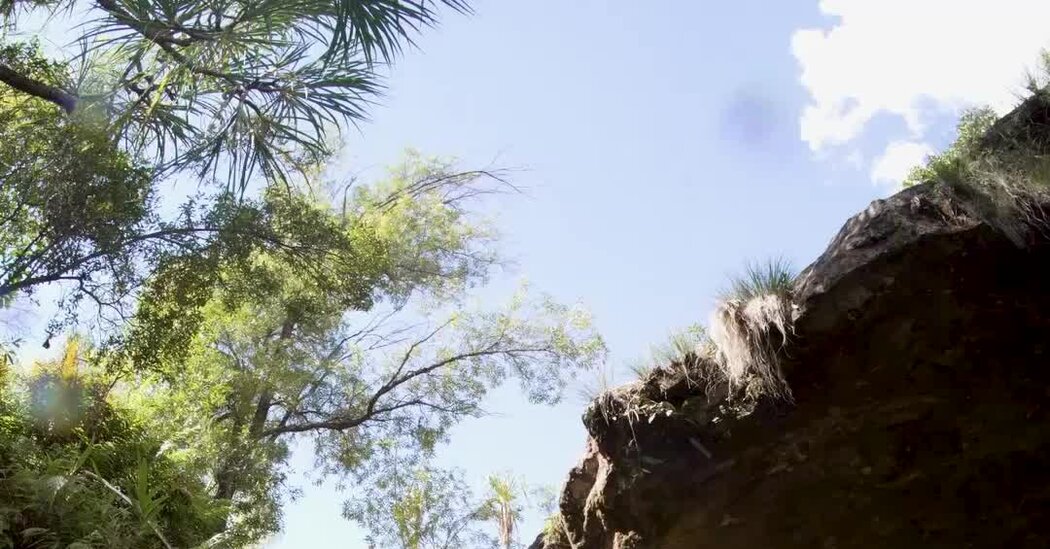
One soaked sneaker later, we reached our destination, the Piscine Bleue, or the Blue Pool, a deep crevice of turquoise water. I floated, staring up at the slice of blue sky cutting through the green foliage.
A little farther down the canyon, the Piscine Noire, or Black Pool, was mostly shaded by the canyon, giving its waters a dark appearance. A waterfall roared down, and swimmers splashed around. As I jumped in, a familiar voice called my name. Miguel appeared beside me. He and Koka were also swimming their way through the park.
For visitors, these pools were refreshing attractions, but for residents, the water in these mountains, piped to villages, was a lifeblood, Mr. Romi told me. “The climate is changing every year and we feel it,” he said, explaining that the rainy season has been arriving late and the last few dry seasons have brought water shortages.
As we were trekking back, Mr. Romi’s phone buzzed. Lemurs had been sighted. We quickened our pace and found a nimble brown lemur sitting on the thatched roof of an open-air campsite dining area. Above, several critically endangered Verreaux’s sifakas, which look like black-and-white teddy bears, leaped from tree to tree, oblivious to the cluster of cooing people below. I felt someone grab my hand. It was my new Spanish B.F.F.s Miguel and Koka, who pulled me over to a better vantage point.
That evening, on my hotel room’s balcony, I found myself again looking up with a sense of wonder. The Milky Way, dotted with sparkles, was smeared across the sky, impossibly bright in one of the increasingly rare corners of the earth still unspoiled by light pollution. The massif that sustains the Bara in both life and death stood as a dark silhouette against a backdrop of stars.
I hung my swimsuit to dry and let myself get lost in the heavens. No telescope needed.

