

I grew up in the Nineties; the time of “cocaine chic”, hip bones jutting out over jeans – and Kate Moss. When a close friend of mine developed a debilitating eating disorder, it was shocking but almost inevitable, like we’d been conditioned to hate the bodies that carried us.
Despite studying fashion design in New York, I was lucky that it was the artistic side – rather than the inescapable pressures of appearance – that stuck closest to me. Although I struggled with some disordered eating of my own when I was a teenager, it was short-lived, unlike what my loved one went through. Over two decades, I watched them suffer and push everyone away. I tried to help, but I felt panic-inducingly ill-equipped. Even now, I still wish I’d done better.
Three and a half million people are estimated to suffer from an eating disorder in the UK, it was announced by Beat last month. This number has tripled from 1.25m in 2017, meaning one in 20 British people are now affected by the condition. So, I reached out to SWEDA (the Somerset and Wessex Eating Disorders Association) to see if they’d work on a project with me to explore the complexities of eating disorders through my work as an artist. The topic was, of course, worthwhile; but I had my own uncertainties to resolve, too.
All in all, I painted 18 landscapes and portraits of those who’ve suffered eating disorders, those who supported and stood by them, and the advocates fighting for better treatment. Whenever I do a portrait, I always sit and talk to the sitter first – to understand their story, their energy and, in this case, when they first began struggling. Some people had developed issues with food as young as five; others mentioned girls’ schools impacting their self-image. For many, the journey was hard and fast; the congratulations for losing weight were addictive.
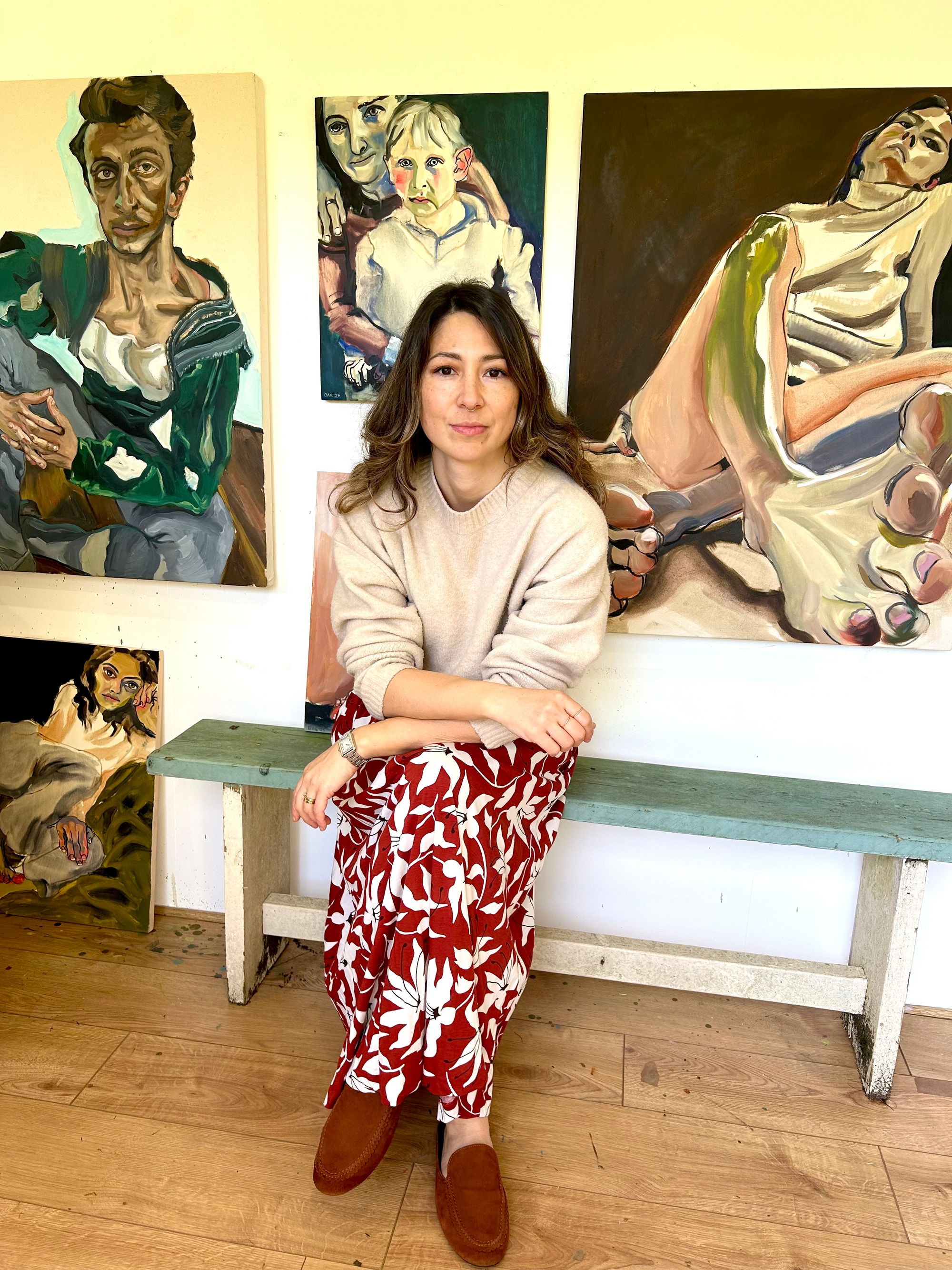
I’m acutely aware just how brave it was for my subjects to sit for me. One woman named Hannah revealed it was actually a recovery goal for her to sit for a portrait. After years of self-scrutiny, being seen through the eyes of someone else was a terrifying prospect – but she did it. There were a lot of tears (from both of us); She was so raw and open with me. There was a lot of pain, and equally a lot of love coming through in the colours and dynamism. Hannah has had a really intense, heart-wrenching journey involving domestic abuse in her family. She was forced to manage her life upwards, while also trying to still be a child.
Dave Chawner was another sitter; a comedian known for teaching people how to use comedy to cope with mental health issues, whose 2014 show about his history with anorexia was critically acclaimed. As a man, Dave’s journey was interesting to me. Statistically, it’s estimated that half of men with eating disorders don’t receive any help. Although Dave went through periods of extreme exercise and restrictive eating, and was even hospitalised at one point – he still didn’t feel he had the validity to say he had an eating disorder until he was officially diagnosed. He didn’t feel able to say he needed treatment, because we all have a degree of interest in how we look. Dieting covers a spectrum: from mindful to extreme.
.jpg)
Ultimately, the reason many of the sitters wanted to be part of the project was to promote early intervention. Prompt detection improves speed of recovery, reduces symptoms to a greater extent and improves the likelihood of long-term recovery – but we need to have empathy, awareness and access to resources to allow fast action to take place. Because the longer these behaviours stay, the more ingrained in the neural pathways they become.
This process has definitely changed me and the language I use. After speaking with Zoe, an eating disorder counsellor who sat for me, I decided never to speak about dieting in front of a child. She told me that it is, of course, expected and normal for a parent to have a relationship with food – but that we need to try and show our children that other things are important too; that they’re funny, or clever, as well as beautiful. Never to call certain foods “naughty” or “treats”.
That’s the nature of the condition; sufferers make a wall to keep themselves separate from the people who love them
Recently, a friend of mine started losing weight on Mounjaro. Rather than praising her by saying that she “looks great” or celebrating that she’s gone down a few dress sizes, I now ask if she feels great, because that’s the crucial thing. Words are important, and it’s vital not to suggest that someone is more worthy or acceptable than before when they’re smaller.
Eating disorders can be incredibly scary. I know this because I’ve heard it through a wall – I’ve seen it face to face; but not everybody understands that. They’re so hidden that you don’t realise the full extent. One councillor told me there were cases where somebody was throwing up as much as 30 times a day. That can be terrifying. But when you’re in the position where you want to help someone, it can be easy to forget there’s someone out there you can talk to who can deal with it professionally. Which sounds silly to say, right?
.jpg)
I resonated with Wera Hobhouse, another sitter – and the Liberal Democrat MP for Bath – whose own daughter went through recovery. One day, Wera became so frustrated and sad that she lost her temper and screamed, “Eat the f****** banana. I don’t understand. Just eat.” She knew it wasn’t the right thing to do and I completely understood that feeling. That anxiety of not being able to break through while you’re desperate to. You do your best with a very challenging situation, then question whether you did, really. You replay events in your mind, wishing there was better support, or you had more of your family around to help.
Selfishly, my main takeaway from this project was that eating disorders are so scary and isolating that it’s common for them to cause relationships to break down – just like mine did. It was about me trying to learn, grow, understand, and unpick something. We had always seen eye to eye, and then, after a certain point, I just couldn’t understand them any more. They were so far away that they didn’t make sense. But that’s the nature of the condition; sufferers make a wall to keep themselves separate from the people who love them.
This exhibition, like all my work, is about human purpose, trauma, growth and resilience. In many cases – not all – but most, the eating disorder was related to something else the sitter had been through; it was more a symptom of that. There are behaviours that we learn in society, language that we use, coping mechanisms we adopt that bury the root of the issue. It’s not easy to understand in yourself or others – but charities like SWEDA are getting there.
‘Nourishing: Reflections of Resilience’ will be presented at Sworders’ London Gallery from 1-11 September 2026. 20 per cent of proceeds from works sold will be donated to SWEDA’s counselling, support, and outreach services. For support, you can visit SWEDA’s website at swedauk.org
For anyone struggling with the issues raised in this article, eating disorder charity Beat’s helpline is available 365 days a year on 0808 801 0677.
NCFED offers information, resources and counselling for those suffering from eating disorders, as well as their support networks. Visit eating-disorders.org.uk or call 0845 838 2040.
As told to Lydia Spencer-Elliott

