
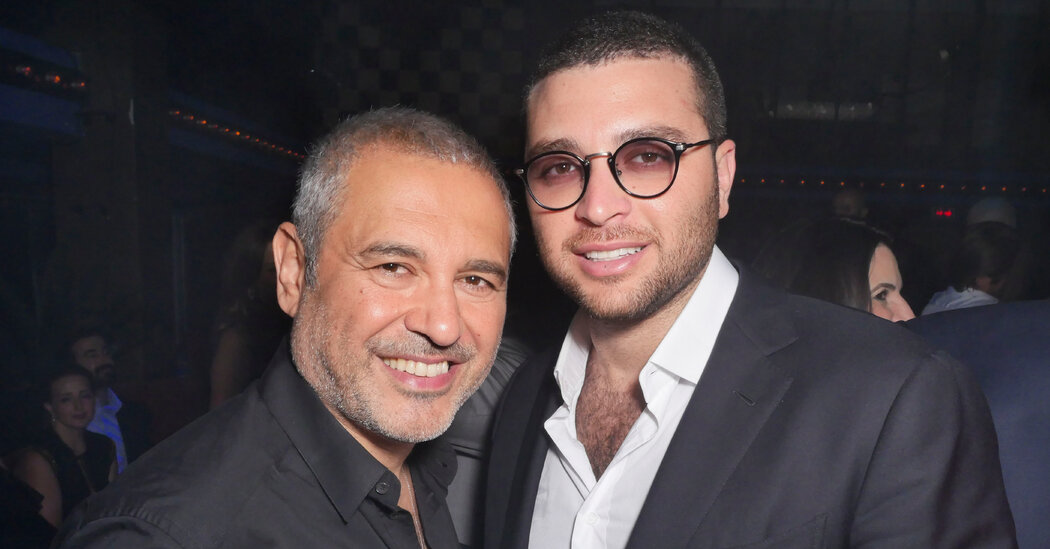
Fairy-tale couture gowns are not normally associated with wartime, but ever since Elie Saab founded his namesake label in Beirut in 1982, he has been making his signature frocks under often extraordinary circumstances. He started his fashion house during the Lebanese civil war, which lasted from 1975 to 1990, and continued it through the 2019 financial crisis that devastated the country’s economy, the 2021 port explosion and the war between Israel and Hezbollah. It currently employs 700 people in Beirut, who are working on the next resort, bridal and couture collections.
Last week, he and his son, Elie Saab Jr., the company’s chief executive, were in Milan for the Salone di Mobile furniture fair, and they spoke to The New York Times about the situation in Beirut and the role of fashion in even the darkest times. The company also has headquarters in Lugano, Switzerland, but the pair said they had never considered leaving Lebanon, despite the current conflict in the Middle East. They were about to get on a plane to return home, and the elder Mr. Saab said he could not wait.
This interview has been edited and condensed.
Was getting in and out of Lebanon difficult?
Elie Saab Jr.: Travel has been OK. Middle East Airlines, which is the national airline, did not cancel one flight since the beginning of the war, even as all the international airlines canceled. Even during the toughest time, you would see a plane landing while a rocket was hitting Beirut. This is a reflection of how the Lebanese operate.
We’ve been through this a few times now. We are in Lebanon by choice. We understand and acknowledge the risk of being in Lebanon, but we have also taken all the necessary precautions to make sure that the business is never interrupted.
What is the mood like?
ES Jr.: It has been very challenging. You can see bombs, especially around Beirut. You can definitely hear bombs. You are sitting in the office, and suddenly you hear that there are attacks around the city. Everyone has to stop their day and go and check on their loved ones. This can happen three to four times a week.
We’ve seen a situation where some of our people’s homes were hit directly by a bomb. They lost their home, and they still showed up the next day at 8 a.m. They say, “We want to focus on something else and focus on the future together.” But people are suffering.
More than one million people were displaced from the south, and they are now in Beirut, which is a very small city.
Elie Saab: They have to sleep in tents under the rain, and in schools. It’s affecting everything.
What sort of lessons have you learned from your past experience that you are using this time around?
ES: We are used to this situation, unfortunately. For me, fashion was always the means to transform what is going badly into something beautiful. That was the mission from the very beginning. I feel like it is my responsibility to present the beautiful side of our country all around the world.
ES Jr: We have, over the years, chosen very strategic locations for our offices that we know are safe. In 2024, we were preparing to deliver one of the biggest fashion shows that ever took place, so we moved most of our staff up north. Everyone was staying in one hotel that we privatized. The ballroom was our atelier. So, no matter what, we have a solution ready and a backup plan ready.
Have there been infrastructure problems?
ES: Lebanon does not have an infrastructure, so there’s no infrastructure to end.
ES Jr.: Lebanon has been running on private generators for ages now, and we haven’t seen any disruption in the flow of fuel or gas to fuel those generators. The ecosystem of the country is equipped to absorb very difficult situations because it has been running in this way since the early ’80s. Lebanese don’t need a lot. They just need stability.
Is anyone shopping in the Gulf? Bernard Arnault, the chairman of LVMH, recently warned that the near future of luxury “all depends on how this crisis unfolds.”
ES Jr: The whole region is affected. Instead of growing in the first quarter as we had expected, by 30 percent, we had total growth of 10 percent. But one region can compensate for the other. New York was up 45 percent.
You called the basis of your recent pre-fall collection “the spirit of Beirut.” What is it that inspires you about Lebanon?
ES: Maybe the blue sky or the sunlight. I’m very attached to my country. I feel my presence there is very healthy for me and for the people around me. And not only for the people in my company. Sometimes, people see me in the road or something and say: “I don’t understand. You have houses everywhere. What are you doing here?”
But, for me, I feel better when I’m there, especially when there are difficult days. I don’t want to be abroad.
ES Jr.: Lebanon has been through beautiful times as well as hard ones. During the golden age of Lebanon, in the 1960s, it was the Paris of the Middle East. That’s the Lebanon we hope for. That’s the Lebanon we want to see come back.

