
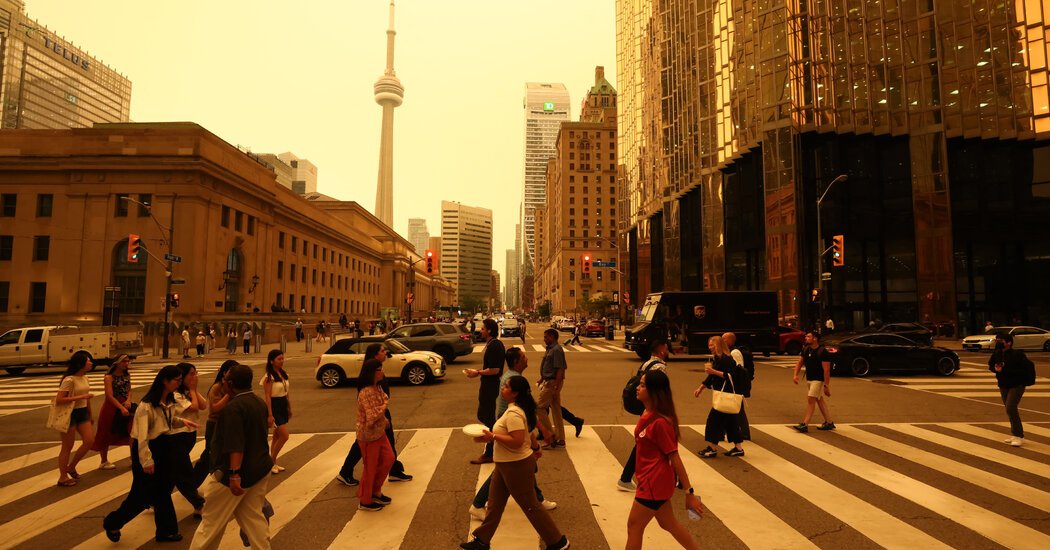
Smoke from the Canadian wildfires is causing hazy orange skies and a red-tinged sun. The reason behind those colors has to do with physics.
The sun emits light in a rainbow of different wavelengths, or colors. Longer wavelengths appear red to our eyes, while shorter wavelengths look blue. Sunlight reaching us on Earth first passes through our atmosphere, which is made of molecules that more readily scatter shorter wavelengths of light in all directions. That’s why our sky usually looks blue during the day.
But during wildfires, an abundance of smoke is also present in our atmosphere. Smoke particles are larger than air molecules and are able to scatter longer wavelengths of light. This causes the sky to tint red.
Dust, water vapor and other types of particles will also scatter longer wavelengths of light, which is why the sky can change color after volcanic eruptions or in places with high amounts of air pollution.
Atmospheric scattering creates other effects in our skies. When the sun is close to the horizon, its light travels through more of the atmosphere, causing more blue light to scatter away. Red and orange light is more likely to pass through, painting our sunrises and sunsets in dramatic hues.
It also comes into play during a total lunar eclipse, when Earth passes between the sun and the moon. Light from the sun spills over the edges of Earth and filters through its atmosphere, illuminating the face of the moon and causing it to flush crimson.

