
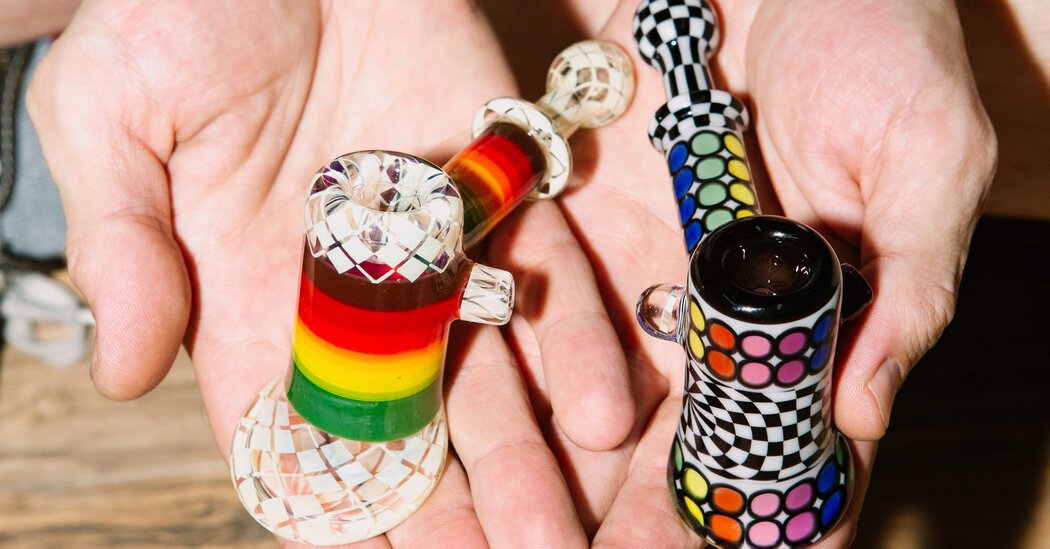
Marijuana lacks the scent of scandal it once carried. Nearly half of the country has legalized its recreational use, and thousands of state-licensed cannabis shops across the United States sell strains of the psychoactive drug under quaint names like “spinach” and “shred.”
So the Toledo Museum of Art, in Ohio, decided it was time to organize an exhibition celebrating the artistry of bongs.
About three years ago, it approached a former curator at the Corning Museum of Glass, in New York, to coordinate the show. It spent $250,000 to organize it, and it attracted interest from dozens of artists whose sculptural smoking tools top anything one might find in the average head shop.
But this spring, only months from its opening, “High Style: the Art of Cannabis Pipes” was canceled. The museum cites logistical issues, but the curator and others have questioned whether that was the central concern.
“How do you plan a show for over three years, plan a book, spend all that money and then cancel it?” said Aaron Golbert, an artist who makes cannabis pipes under the name Marble Slinger and whose work was to be in the exhibit.
The museum’s director, Adam Levine, said the museum needed to focus on a renovation project scheduled for completion next year. Although the exhibition was to have opened this summer, the timing would have overextended his staff, he said, with the amount of paperwork regarding loans and insurance still left to complete.
Levine noted that one delay had been caused when some artists wanted to use their professional pseudonyms on legal and other forms.
The cancellation “is personally painful for me,” Levine said in an interview, “not only to lose trust from the community but because I feel really passionate about what the show could have been.”
The curator who organized the exhibition, Susie Silbert, described herself as heartbroken for the nearly 100 artists who had planned to participate.
The Museums Special Section
“This exhibition was meant to solidify pipe makers’ inclusion within the broader sweep of art history,” Silbert said. “Instead, its cancellation risks cementing their outsider status.”
Over the last decade, Silbert has played an instrumental role in showing pipe makers to be artists, instead of drug culture hooligans. As a Corning curator, she oversaw the institution’s first acquisition of a glass pipe in 2019, a red-and-purple design laced together by the artist David Colton that nods to graffiti.
In 2021, the Smithsonian American Art Museum, in Washington, took the leap and acquired an intricate glass bong. That rig demonstrated how far glassblowers had come: The artist Micah Evans had tucked a functional pipe inside a replica of a 19th-century sewing machine.
“It has been a struggle getting mainstream institutions to take these objects seriously,” said Evans, whose artwork was to have been in the Toledo exhibition. “Though I bet within a three-mile radius of the museum, there is somewhere you can buy a bong.”
(In fact, there is a head shop about three miles away, across the Maumee River.)
Silbert said the headache of processing loan documents was an insufficient rationale to warrant the cancellation. She had personally overseen the near completion of that paperwork, she said, adding that some delay was caused by artists’ ignoring emails from Adam Levine, the museum’s director, thinking they were from someone posing as Adam Levine, the Maroon 5 frontman.
Still, she said, “we had more than 90 percent of the loans in by May.”
Despi Mayes, a spokeswoman for the museum, said the institution believed it had not been that close to completing the paperwork. She added that the museum had never experienced confusion concerning its director’s name, “nor has Adam encountered it personally or professionally.”
Levine told Silbert that he had planned the exhibition for the museum’s renovation period, when much of the institution would be closed, anticipating that with proper advertising the show would draw crowds.
But that promotion effort began to concern museum officials, Silbert said. She cited a message about the cancellation that Levine sent to employees in May.
“As the project progressed,” he wrote, “we encountered increasing legal constraints that directly affect how the exhibition can be promoted and could potentially impact the presentation and interpretation.”
In his interview with The New York Times, Levine said the legal concerns had been only a marginal consideration, though he had worried about the museum’s taking on risk by unintentionally testing Ohio’s cannabis laws. “From a risk management perspective, we would have wanted to play it safe,” he explained. “There hasn’t been an exhibition done like this before.”
It is legal to sell cannabis in Ohio with a license, but state law strictly regulates the promotion of cannabis use. Levine acknowledged that although the museum would not have been encouraging people to smoke pot, its officials worried that Ohio law might prevent them from advertising the exhibition on billboards and social media.
Luis Alcalde, a lawyer who has represented the cannabis industry since Ohio legalized medical marijuana in 2016, said he did not think the museum needed to worry.
“I am not aware of any advertising rules that apply to cultural institutions or limit what they can exhibit beyond any potential matters not protected under the First Amendment,” he said.
“By the way,” he added, “Ohio has a cannabis museum.”
Well, not for very long.
As it happens, after more than a decade in existence, the Cannabis Museum, a nonprofit organization in Athens, Ohio, is changing its name to Ars Medicina and broadening its focus. The museum, which has roughly 500 glass pipes of its own, surveys the history of marijuana through thousands of objects.
The museum’s original name, leaders of the institution said, proved to be a hurdle when trying to arrange banking services and advertising. According to legal experts, vendors might decline to do business with organizations aligned with cannabis even where it has been legalized, because the drug remains illegal under federal law.
“We have an accountant whose secretary writes checks for us because the bank refuses,” said the Cannabis Museum’s founder, Don Wirtshafter, illustrating the challenges of exhibiting objects associated with drug use. “We have trouble on Facebook, too, because it seems like nothing can get promoted with the word ‘cannabis.’”
People have smoked cannabis for thousands of years, but a full appreciation of glass pipes is relatively new, with their popularity rising in the parking lots of Grateful Dead concerts in the 1980s and through the work of a man named Bob Snodgrass.
Snodgrass used his training with a blowtorch to twist glass into psychedelic shapes, combining the hippie aesthetic of Deadheads with the functionality of a smoking pipe. He followed the band around the country, selling his wares from a converted school bus and eventually taking on apprentices and teaching workshops. Those artists fanned out to other music festivals and shows, like those of Phish, that embraced marijuana culture.
A minor setback came in 2003, when the federal government began Operation Pipe Dreams, which targeted companies that sold bongs and other drug paraphernalia over the internet. Among those arrested was the comedian Tommy Chong, who spent nine months in prison. But the subculture around glass pipes bounced back by the end of the decade, with more artists taking part in glass pipe competitions amid a broader professionalization of the industry.
The gradual legalization of recreational marijuana in states like Ohio brought new interest in pipe-making. Even as younger generations turned to vapes and blunts, glass pipes developed a following with those willing to spend thousands of dollars, sometimes more, on what they viewed as collectible art objects.
Golbert said glass pipes were an expression of the subculture that had formed around marijuana over decades. The pipes were often ceremonial in nature, at the core of rituals and gatherings for pot smokers.
“What we do is sociopolitical art,” he said. “This isn’t about a junkie sitting in an alleyway with a needle. There is mindfulness behind glass. The craftsmanship becomes a symbol of the maker and the user.”
Levine said the Toledo museum would continue to work with Silbert to find the exhibition a new home. Despite the cancellation, the museum still published its catalog for the exhibition, which includes a foreword by Levine.
“The artists represented in ‘High Style’ have elevated a once-stigmatized form into a sophisticated art practice,” the director wrote, saying his museum was committed to illuminating “the human impulse to create, no matter where it begins.”

