
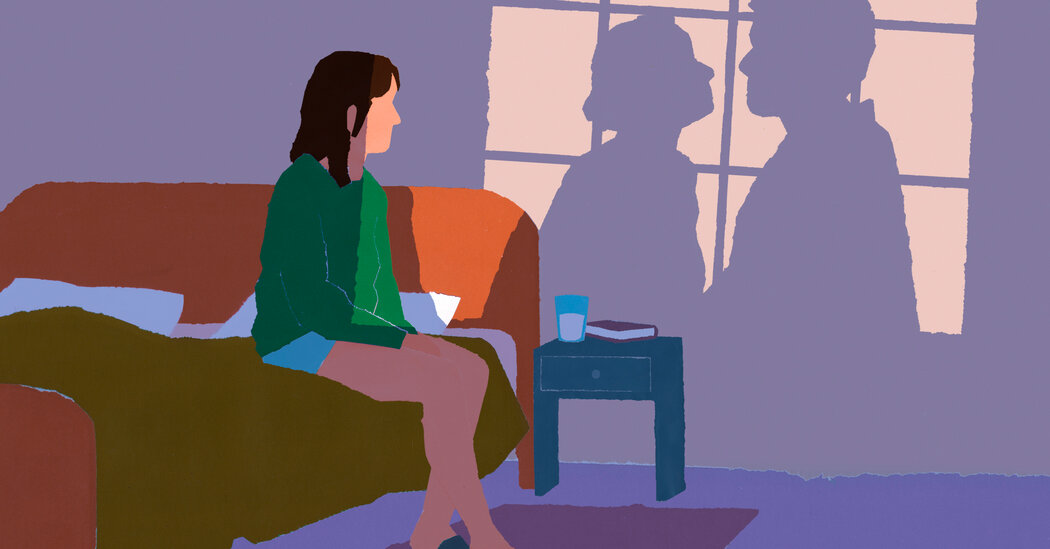
My husband of 10 years has been unfaithful to me on four occasions. These affairs have spanned multiple years but with sporadic, opportunistic contact. After the first disclosure, I was shattered but could see a way through. I could even see the potential of this devastation to give way to something more honest and real between us.
The most recent discovery happened two years ago, shortly after the arrival of our long-awaited second child. Floored by grief, postpartum hormones and sleep deprivation, I decided, again, to stay, but feel none of the conviction about our relationship that I once had. I know I should leave; any fear about being alone or the impact on my children has fallen quiet in relation to my growing certainty that leaving him is the right thing to do.
And yet — I am still here. I feel a sense of apathy that makes me wonder if I could tolerate this forever.
I grew up largely feeling misunderstood and that love was conditional on my grades and being good. My mother grew up experiencing horrific trauma which was never addressed, my dad is emotionally stunted and neither of my parents demonstrated healthy relationships. My dad cheated on my mum (probably also for years), then left her for the woman who is now his second wife when I was in my early 20s. I was the one to discover their affair.
I want to be shaken awake, moved out of inertia and into a new life. Help.
From the Therapist: I understand why you’re confused by the gap between what you believe is the best course of action (leaving) and what you’re actually doing (staying). What’s keeping you mired in inertia is this: You’re not just struggling with whether to leave your marriage; you’re struggling with whether to leave what has felt like home, long before you met your husband.
Here’s what I mean: Our experiences of love are formed in childhood, and given that you chose to share your history with me, I imagine you’re aware of this connection. What might be less apparent is why you would repeat something that caused you pain. Wouldn’t it seem logical that if you felt unsafe, misunderstood and conditionally loved as a child, you would do everything in your power to find a partner with whom you could create a different kind of loving relationship?
The problem is that there’s a part of many of us, outside of our awareness, that is inexorably drawn to the familiar. It’s no coincidence that people who had angry parents often end up choosing angry partners, those who had withdrawn or critical parents find themselves married to spouses who are withdrawn or critical, or those who grew up with betrayal end up choosing partners with a tendency to betray, as well.
Why would people do this to themselves? Because the pull toward that feeling of the familiar makes what they want as adults hard to disentangle from what they experienced as children.
The psychotherapist Terry Real has put it this way: We marry our unfinished business. If we haven’t worked through what hurt us as children, we recreate it in adulthood because our subconscious has a finely tuned radar system for what it recognizes as “home.”
Freud called this “repetition compulsion.” It’s not just that we seek the comfort of the familiar. It’s that we want to master a situation in which we felt helpless as children. Maybe this time, the subconscious imagines, I can go back and heal that wound from long ago by engaging with somebody similar — but new. Of course, by choosing these types of partners, we get the opposite result: We reopen those wounds and feel even more unloved.
This subconscious pull is what leads to your “and yet.” It’s the part that’s working to maintain what you know so well: absorbing, adapting and denying your own needs so the relationship feels like what you’re used to. When love is tied to performance, to being “good,” to not disrupting the emotional equilibrium of the household, you learn to override your own signals. You become skilled at tolerating what doesn’t feel right because when you were a child, your survival depended on it. And even though it no longer does and your adult self finds this situation intolerable, your internal system says: This is survivable. I’ve lived versions of this before — conditional love, emotional absence, betrayal. There’s a terrible comfort in suffering that you recognize.
But once you’re able to bring the underlying conflict into conscious awareness, you’ll realize that your “apathy” isn’t indifference at all. People often mistake numbness for nothingness, but numbness isn’t the absence of feelings; it’s a response to being overwhelmed by too many feelings. Especially postpartum and after repeated injury, the psyche protects itself by dulling everything: grief, anger, sadness, shame. You know all of this is there. You’re just waiting for your nervous system to recalibrate.
While it does that, you might ask yourself: What kind of love feels possible to me — and am I willing to outgrow the version of myself that accepted less?
That’s the work — not convincing yourself to leave (you seem convinced), but excavating the part of you that learned, young, that your desires were secondary and that love required you to be a certain kind of good. It’s realizing that decisions require you to believe that your desires matter enough to act on. It’s understanding how the people who were supposed to model secure, honest relationships instead handed you a blueprint for exactly the relationship you’re in now.
All of this is hard to do alone, and a good therapist can guide you through. With clarity and self-compassion, you’ll begin to take small, manageable steps not just away from this painful marital situation but also from the architecture you inherited.
This is how you will be shaken awake, moved out of inertia and into a new life.
Want to Ask the Therapist? If you have a question, email askthetherapist@nytimes.com. By submitting a query, you agree to our reader submission terms. This column is not a substitute for professional medical advice.

