
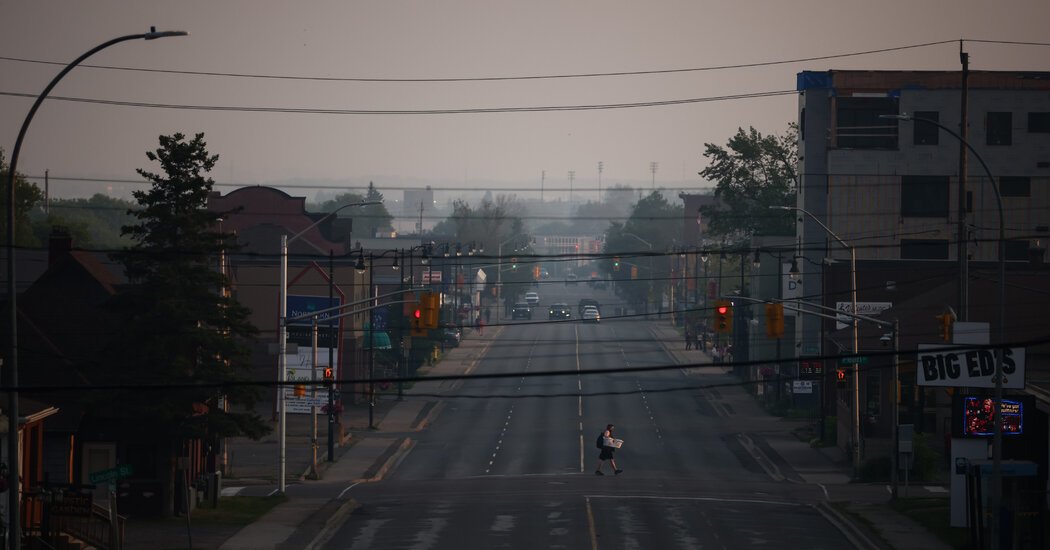
Plumes of wildfire smoke from blazes in the Canadian province of Ontario and in Minnesota continued to choke the skies across parts of the Midwest and Great Lakes region on Monday, while spreading a veil of unhealthy air into portions of the Northeast and the Mid-Atlantic.
The highest concentrations of smoke were expected to remain across the Great Lakes region, where air quality alerts were in effect on Monday. The alerts covered parts of southeastern Minnesota and Ohio, and much of Wisconsin, Illinois, Indiana and Michigan. Eastern Iowa was also under air quality alerts.
The latest round of unhealthy air comes after a prolonged stretch of wildfire smoke has shrouded large areas of the Midwest and the Northeast since early last week. Thick, acrid haze from fires in Canada and Minnesota smothered the region, including cities like Detroit, Minneapolis and Chicago, which all experienced some of the highest concentrations of smoke-filled air.
Parts of the Northeast briefly saw relief on Saturday as thunderstorms helped clear some of the lingering smoke, and winds pushed the remaining haze offshore. On Sunday, however, new plumes of smoke spread back across the Upper Midwest, before reaching portions of the East Coast later in the day. The concentrations in the Northeast were not as high as they were before the weekend.
Another spell of relief was expected later on Monday as a weather system was forecast to move through the Great Lakes and Northeast region overnight, shifting the wind direction and helping to push the smoke away. The change in conditions would “clear things out,” said Brian Hurley, a meteorologist at the Weather Prediction Center.
“Starting with Minnesota, Wisconsin, Michigan late tonight,” he said. “And then early tomorrow morning for Illinois, Indiana and Ohio.”
That improvement, however, could be fleeting, as another shot of smoke was forecast to surge southward from central Canada on Tuesday.
“Even then, I think it’s going to be short-lived,” Mr. Hurley said. “It looks like improving conditions as we go into the middle part of the week.”
Farther east, air quality alerts remained in place across parts of the Northeast and Mid-Atlantic on Monday, including parts of western Pennsylvania and northern West Virginia, though Mr. Hurley said smoke concentrations across these areas were not expected to reach the same high levels as those last week.
“And even these folks will see improving conditions later on Wednesday,” he said.
Here’s what else to know about the wildfires and their smoke:
-
More than 900 wildfires are burning across Canada and some of the most active ones were in Ontario, with the smoke drifting south across the Great Lakes and into the United States. Read more about the Canada fires here. Wildfires in northern Minnesota were also contributing to the smoke, and more about those can be found here.
-
Scientists estimate that wildfire smoke is linked to tens of thousands of deaths a year, and that human-caused climate change is responsible for a growing share of them. Read more ›

