
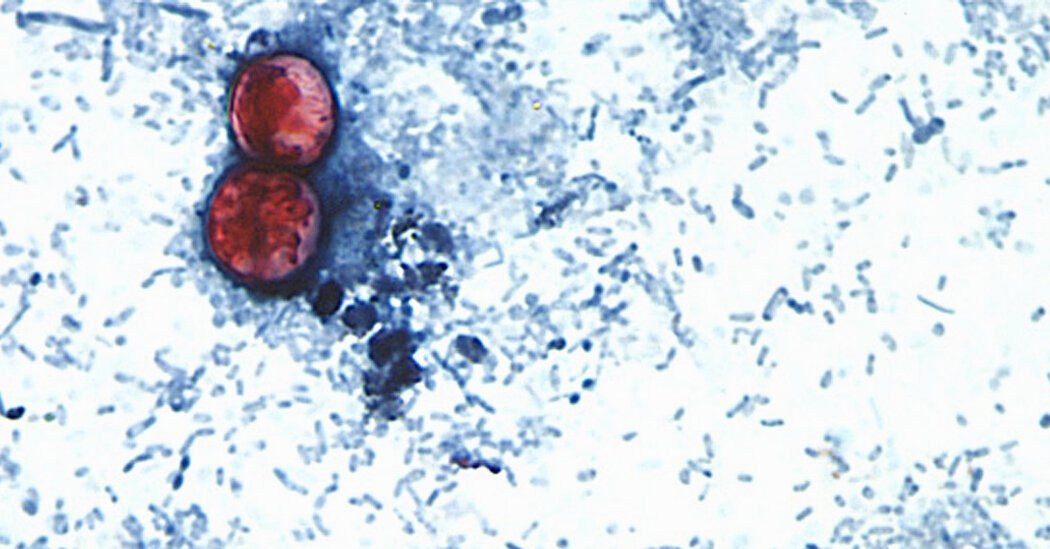
The United States is going through the largest cyclosporiasis outbreak on record. Thousands of people, mostly in the Midwest, have fallen sick with stomach cramps and severe diarrhea. The authorities have linked the food-borne illnesses to lettuce grown in Mexico and served at some Taco Bell locations.
My colleagues on the Well team have been covering the race to trace the source of the outbreak, and it took a twist this week.
On Saturday, the Food and Drug Administration announced that lab tests had confirmed cyclospora contamination in iceberg lettuce from Mexico. The company that runs the operation, Taylor Farms, issued a recall based on other epidemiological evidence and then expanded it after the lab test came in. But then, on Sunday, the F.D.A. said the test had been a false positive. Taylor Farms is still a focus of the investigation, and the recall remains in effect.
It’s still not clear whether climate change played a role in the current outbreak. Cyclospora is a parasite that spreads through human feces, and it’s rare for investigators to pinpoint a precise source of contamination.
But experts say it’s plausible that warming could contribute to an increase in cyclospora illnesses. Don Schaffner, a food microbiologist at Rutgers University, told me that cyclospora tends to grow in the spring and summer, so higher temperatures could extend its season. In previous cyclospora outbreaks, investigators have theorized that heavy rainfall might have somehow caused human waste to seep into irrigation water, contaminating crops.
Whether or not this outbreak was directly linked to climate change, we know that warming is expected to fuel the spread of a wide variety of food-borne pathogens. And the current episode has exposed potential vulnerabilities in public health detection systems at a time when the need for accurate monitoring of the food supply is only growing more important.
Higher temperatures, more illness
According to the World Health Organization, some 600 million people get sick each year from eating food that has been contaminated with bacteria, parasites or viruses. Scientists have predicted that climate change will drive caseloads higher in many parts of the world.
Higher temperatures and more rain tend to correlate with increases in illnesses from pathogens like salmonella and campylobacter. That’s the case in part because germs can multiply faster in hotter weather. Salmonella, for example, is happiest when the temperature is in the 90s Fahrenheit, when it can grow quickly in animals or on food. A 2014 study found that, in Mississippi, a temperature increase of 1 degree Fahrenheit was associated with an increase in salmonella cases.
Warming oceans pose an emerging food safety risk, too. A 2024 paper found that climate change is “undeniably” contributing to the spread and prevalence of a family of bacteria known as Vibrio, the most infamous of which is the flesh-eating bacteria Vibrio vulnificus. People can get Vibrio infections from eating raw seafood or swimming in contaminated water.
Dry summers and heavy rainfall can each also increase pathogen spread. During droughts, more dust can float through the air, spreading bacteria across farms. On the other hand, torrential rain can distribute germs by spreading human and animal waste from one place to another. Tropical storms, which can be intensified by climate change, are associated with big spikes in E. coli infections.
The ‘big concern’ for public health
It’s exceedingly uncommon for the F.D.A. to retract an announcement of a positive lab test. Dr. Schaffner said the agency may have made the statement too early, before it completed confirmation testing.
“Now they’ve got egg on their face, and nobody’s happy,” he said.
In a statement, an F.D.A. spokeswoman, Emily Hilliard, said the Trump Administration has mounted a robust response to the outbreak and has provided Americans with the information they need to protect themselves.
But the back-and-forth has been confusing for people trying to understand which foods to avoid. The retraction didn’t mean the focus of the investigation had shifted away from Taylor Farms or lettuce, but the company issued a statement saying “F.D.A. apologized to us.” The agency said it had not apologized, according to news reports.
“The big concern I have about the flip-flop is also the impact it has on trust,” Dr. Susan Mayne of the Yale School of Public Health told my colleagues. “Changing such an important determination certainly raises questions,” she added.
Federal cuts to health funding may be playing a role in hampering the response to this outbreak. State and local health departments, which rely on federal support to monitor and respond to food-borne illnesses, received less than half the money they requested this year.
Until recently, several states were required to track and report cyclospora cases to a national database. But last year, the Centers for Disease Control and Prevention made this voluntary. Incomplete data may have made it harder for officials monitoring the database to identify the outbreak.
“It certainly doesn’t strengthen our ability to do anything about cyclospora,” Dr. Schaffner said.
Join us for a day of live journalism
This fall, on Wednesday, Sept. 23, we’ll be hosting our annual Climate Forward event, bringing together world leaders, policymakers, executives and activists for a full day of live journalism.
We’ve got another exceptional lineup this year, including Gerard Barron, chief executive of The Metals Company; Katharine Hayhoe, chief scientist at The Nature Conservancy; the comedian and writer Nicole Conlan; and the Indigenous chef Pyet DeSpain.
They’re diving for trash. Literally.
The Old Ladies Against Underwater Garbage was started in 2018 by a retired psychologist who lives on Cape Cod, Mass. The group cleans about 20 ponds a year on the Cape. To date, the women estimate they’ve hauled out about 6,000 pounds of trash.
Members have to be at least 64, and they say the group has reshaped their lives. They’ve grown stronger, because they’ve had to, in order to haul up heavy refuse from the bottom and heave it onto kayaks. And they’ve forged new friendships after relocating or retiring, after becoming widowed or divorced, after losing cancer-ridden breasts.
We joined them for a recent outing on Lovells Pond in Barnstable. The trash never stood a chance. — Cara Buckley

