
One of the defining moments of the season came early in the second quarter of Oregon‘s game at USC , when Trojans linebacker Desman Stephens II delivered a brutal hit to Dante Moore‘s head as the Ducks’ QB slid for a first down.
Oregon went on to win the game handily, but Moore — one of the top QBs in the country — was done for the season.
A week later, with backup QB Dylan Raiola at the helm, Oregon’s offense slumped badly in a loss to UCLA. Two weeks later, after a dalliance with third-stringer Brock Thomas, Oregon lost again, to Illinois. The Ducks season had been marred by what everyone other than USC’s radio guy knew was a dirty hit, but the results were nevertheless damning.
But that wasn’t the end of Oregon’s story.
After those midseason struggles, Raiola — a once-prized prospect — found his form, helping the Ducks to a 34-26 win over then-6-1 Northwestern. AP poll voters, national pundits and even Oregon fans had already written off the Ducks, but the committee looked at wins over Boise State, USC, Nebraska and the Wildcats and slotted Oregon at No. 23 in its initial rankings.
At the time, some fans derided the choice, but it has actually proven to be one of the committee’s most insightful decisions.
In the weeks since, Oregon has rewarded the committee’s confidence by reeling off three more wins, including a 41-28 victory against Ohio State, while Raiola has blossomed into one of November’s top performers.
We are quick to criticize the committee for decisions that defy the metrics, that ignore something as obvious as head-to-head outcomes or require convoluted explanations of reverse engineered data to justify a choice, but Oregon’s journey this season is a perfect example of why human beings are a necessary cog in this system, and leaving all the decisions to Excel spreadsheets and computer algorithms neglects the fact that games aren’t played in a vacuum, and the outcomes of each snap are determined by real people, not data sets.
And yet, even the committee continues to treat the stats like the secret formula for Coke — undeniably perfect and worth protecting at all costs.
After last week’s rankings, College Football Playoff executive director Rich Clark was asked if the committee might one day make public the data it uses to evaluate teams — an act of transparency that seems entirely reasonable given the debate that follows each new set of rankings. His answer was confounding.
“Basically, there’s so many metrics,” Clark said, “that to really give that out publicly with an explanation of them isn’t really feasible now.”
This begs the question: If the data is so complex and bountiful that it would melt the faces of average fans like opening the ark at the end of the first Indiana Jones movie, how is it that a bunch of former football coaches and current ADs have mastered the math like some unremarkable janitor solving graph theories on an MIT blackboard in his free time.
The answer, of course, is they haven’t. They’re given briefings on each data set, then they’re free to use them as the individual members see fit — sometimes reasonably and sometimes by simply writing “No. 3 Alabama” on a cocktail napkin and yelling “How do you like them apples?”
Indeed, handing over reams of data to the committee seems like a necessary step, but it’s also an objectively silly one. Feeding all those statistics into an AI named Chat CFB would make more sense and produce more mathematically justifiable results. Before the playoff era, this is exactly what we did, letting computers sift through the data and come up with a core part of the BCS formula.
But we have a committee of human beings making these decisions for a reason. We opted for this because we didn’t trust the machines to appreciate the intimate context that surrounded each result, to see not just the outcomes but the inputs, to focus on getting the right 25 teams ranked in the right order and not simply chasing down Sarah Conner to ensure the end of humanity.
So when Clark extolls the endless data sets and Hunter Yurachek touts some convoluted explanation for dropping Indiana to No. 14 that invariably involves a tangent into the world of abstract non-sequiturs, they’re doing everyone a disservice. The expertise on the committee isn’t math, it’s football. They understand people, not algorithms. They are good at breaking down Xs and Os, not coding a bunch of ones and zeroes.
Would it help if the rest of us could get a look at the math, too? Sure. But as we move toward the 24-team playoff era, the mathematical distinctions between who’s in and who’s out will become increasingly obscure and convoluted, like a Rube Goldberg machine of football statistics, all of which makes the eye test, the expertise of real ball-knowers and the insight of human beings willing to question the data all that much more relevant.
The math gives No. 17 Oklahoma credit for beating a Mississippi State team a month after No. 23 Missouri lost to the Bulldogs. It’s a big reason to have the Sooners six spots ahead of the Tigers. But humans should understand that Kamario Taylor was on the field for one of those games and not for another, just as they should appreciate that Notre Dame survived BYU because of an officiating error, UCLA lost to Michigan after its quarterback got hurt, and yes, that Oregon could endure a devastating injury to a key player, take a few weeks to figure out a path forward, and regroup to become a real contender.
The problem, of course, is the humans have to know when the data is telling the whole truth or when their guts should overrule the numbers.
On to this week’s Anger Index …


Washington beat Indiana in overtime in Week 12. That win was so impressive that the Huskies, a team that lost to woeful Penn State three weeks ago, are now in the top 25.
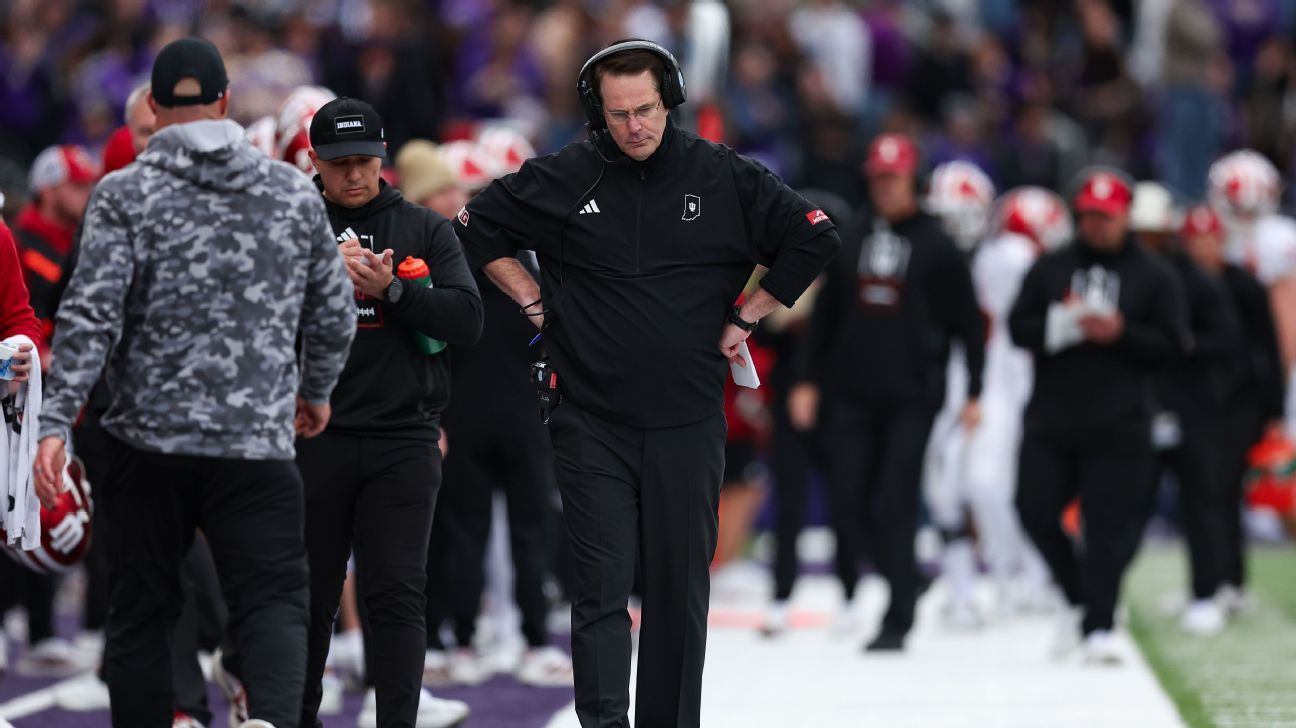
But losing to Washington in overtime with a dinged-up QB was such an egregious defeat for the Hoosiers that they fell six spots in the rankings to No. 14, meaning the defending champs run a real risk of missing the playoff altogether.
And Indiana’s great crimes this season? A loss to a fully healthy Ohio State, because a receiver was six inches out of bounds in the end zone, and an overtime loss because a kicker had a chip shot blocked.
This is not 2025 Indiana, and the Hoosiers don’t deserve any extra benefit of the doubt because of what they did a year ago. And that woeful non-conference scheduling that has underpinned their approach under Curt Cignetti doesn’t look so smart now either. But a week ago, Indiana stomped USC. This week, the Hoosiers are ranked just one spot ahead of the Trojans. It’s an absurd premise on its face.
Indiana has two wins over currently ranked teams. Iowa has none.
Indiana has two losses by a combined seven points. Oregon has three losses by 21 points — two of which are to unranked foes.
Indiana’s strength of record ranks 11th, the AP voters have the Hoosiers eighth, and they’re No. 8 and No. 10 in FPI and SP+, respectively. How does that possibly translate into a No. 14 ranking by the committee?
The only logical explanation is that the committee did not find Cignetti’s “clown” remark particularly funny, and it’s doing a whole “Joe Pesci in ‘Goodfellas'” thing in response. We’re funny? Like clowns? Now Indiana needs to get its shine box.

That the Tide were ever ranked third is hard to justify, but the fact is that a week ago, Yurichek lauded a tough road win at Vanderbilt to prop up Alabama and this week — after a 47-0 win against Chattanooga — the Tide tumbled all the way to sixth.
What was it that changed the committee members’ minds about Alabama?
Was it Texas looking so impressive against … Arkansas?
Was it Notre Dame putting together a ho-hum home win against … SMU?
Was it Tennessee‘s 105 passing yards in a win over … five-loss LSU ?
Again, the notion that Tennessee — which has an emphatic head-to-head win over Alabama — was ever ranked six spots behind the Tide was a gross oversight that needed to be rectified. But absolutely nothing in Week 12 justifies making that change now. And this has been an ongoing issue with this committee, which famously under-ranked Miami last year before twisting itself into knots to correct the mistake without admitting it screwed up.
Is it all forgivable if the committee got to the right place eventually? Something tells us the fine folks in Tuscaloosa aren’t nodding their heads and noting this is why pencils have erasers.

3. Oregon Ducks (8-3, No. 12)
As we noted at the top, Oregon’s story is a complicated one. It’s tough to overlook the loss to Oklahoma State in Week 2, well before Moore’s injury. And it’s not like the committee can completely absolve Oregon of that Illinois loss, even if it feels less indicative of the real Ducks team each week. And while the loss to UCLA came by just two points a week after Moore went down, head-to-head still has to count for something, particularly when the Bruins have two fewer losses, too.
Still, the committee’s primary metric all year has been “big wins,” and Oregon’s got ’em. The Ducks have six wins vs. FPI top-40 opponents, tied with No. 1 Georgia for the most in the country and twice as many as No. 10 BYU. Heck, Oregon’s wins over Ohio State, Nebraska and USC look a heck of a lot better than Alabama’s résumé, which features exactly two victories over opponents with seven wins or more: Kentucky and East Carolina.
And, of course, the Ducks have the ultimate asterisk because of Moore’s injury, followed by ample evidence that they’ve turned the page. Raiola has 10 touchdowns and no turnovers with a 79.7 Total QBR in his past four, all wins. Who’s the Big Ten team you’d least like to face in the postseason? Any answer other than Oregon is a lie.
Still, the Ducks check in at No. 12 — the first team out of the playoff at this juncture.
 4. Four-loss SEC teams besides Oklahoma Sooners
 4. Four-loss SEC teams besides Oklahoma Sooners
Let’s start with a little blind résumé.
Team A: 7-4, No. 20 strength of record, best win vs. SP+ No. 4, losses to SP+ Nos. 1, 40, 44 and 49 by a combined 60 points.
Team B: 7-4, No. 21 strength of record, best win vs. SP+ No. 1, losses to SP+ Nos. 9, 13, 20 and 43 by a combined 66 points.
They look pretty similar, though Team B has the better win and markedly better losses. They have a couple of common opponents, and those are split decisions, too. In the end, there’s not a whole lot separating the two.
In the rankings though? There’s at least eight spots separating Team A (Oklahoma at No. 17) from Team B (an unranked Auburn).
Then recall that Ole Miss and Florida have better strength of record metrics than the Sooners, too, despite being ranked behind them. And note that unranked Kentucky beat Oklahoma head-to-head by 8 points. And, of course, there’s the fact that SP+ ranks Oklahoma No. 35 — well behind Missouri.
So, how did Oklahoma get the nod as the relatively clear-cut best of the SEC’s middle class?
The most logical explanation is that every time the Sooners’ offense takes the field, committee members nod off, and wake up 20 minutes later to see the Sooners’ defense doing something awesome after a three-and-out.

There’s no Group of 6 team in the top 25, but Boise State remains the committee’s choice for a playoff berth at the moment, despite last week’s loss to San Diego State.
Based upon strength of record, that’s the right call. The Broncos check in at No. 26, the highest of any team outside the Power 4.
But Louisiana Tech isn’t far off at No. 31, both of its losses came to Power 4 schools (LSU and Baylor), and the Bulldogs have won their past six all by at least 15 points. No bad losses, dominant wins, a reasonably tough schedule — isn’t that the best-case scenario for a team outside the Power 4 at this point? Plus, it’d be nice to reward a team from Louisiana that isn’t on the brink of being kicked out of its own conference.
Look at the other contenders. UTSA gave up 60 to FAU. Liberty‘s best win came against 11 dudes it met at a YMCA. New Mexico‘s offense has been a snooze for nearly two months. North Dakota State, Air Force, Toledo? They’re not exactly flirting with greatness either.
Yes, Boise State may well be the best the Group of 6 has to offer, but it’s worth at least digging in a little deeper at this point. Unfortunately, the committee gets to call it quits after Team No. 25, so we’ll never really know how close things are for Louisiana Tech and others.
Also angry: Arizona Wildcats (8-3, No. 16 despite all three losses coming to teams currently in the playoff field), Louisville Cardinals (8-3, No. 19), Liberty Flames (10-1, unranked but No. 20 in AP poll), the guy who had to call Trev Alberts and explain he wasn’t getting the Michigan job.


