
CHESTER, Penn. — The United States women’s national team has always been known for its fight at the most important moments. Dramatic comeback wins fill the history of the four-time FIFA Women’s World Cup winners and five-time Olympic champions.
Some of that identity had seemingly faded in recent years, but Tuesday’s draw with Spain at Subaru Park could prove to be an inflection point for a new group of Americans on the road to next year’s World Cup in Brazil.
On Tuesday, a group that is still figuring out how to land its best punches battled back from another 2-0 half-time deficit against Spain, this time to record a 2-2 draw. The result of the friendly wasn’t going to matter in any formal way — USWNT head coach Emma Hayes stressed that in the build-up to the match — but the response the Americans put forth on Tuesday was crucial after losing 2-0 to Spain three days earlier. There were wider messages to be sent to the world in a match between the top two teams on the planet.
– Player ratings: Sanchez, Swanson get 9s in USWNT’s comeback draw
– Clinical Spain show USWNT what it takes to be world champions
– Kassouf: Is the USWNT’s talent pipeline at risk of running dry?
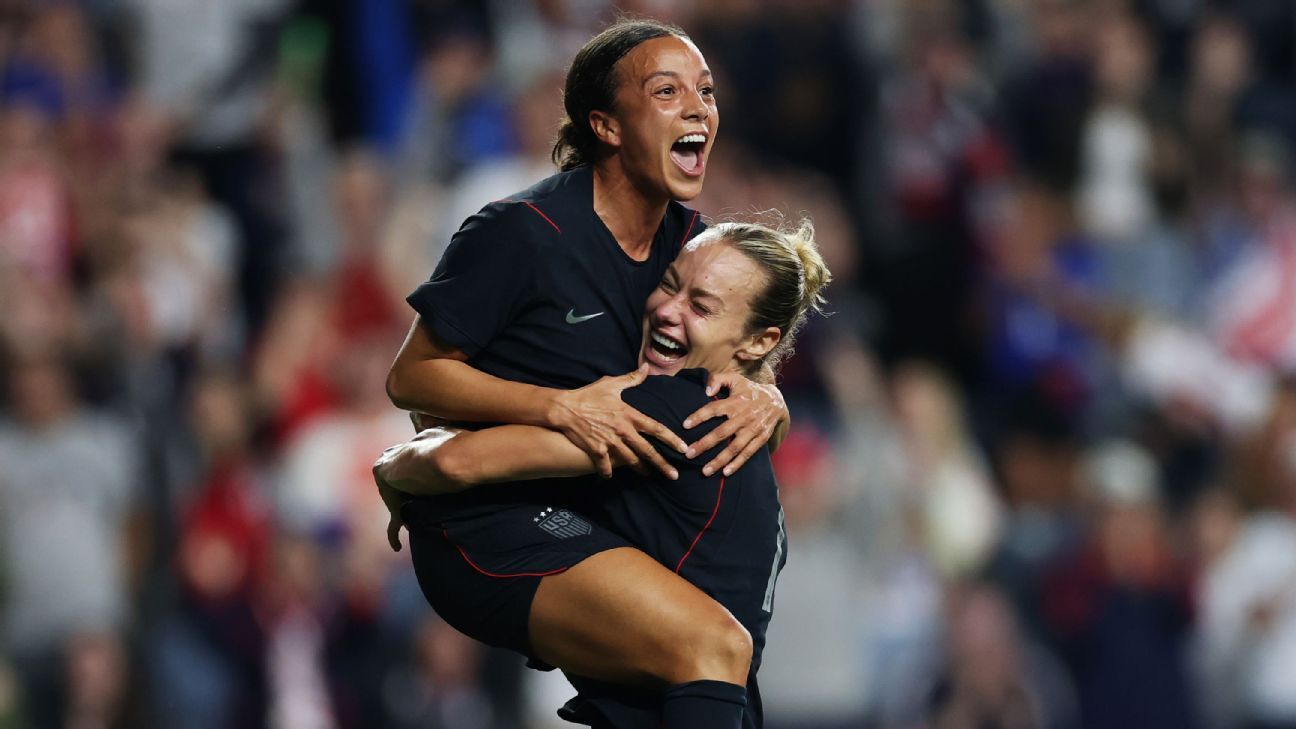
Tuesday’s match started out ugly and ominous for the Americans, who garnered up a paltry 0.21 expected goals. Second half goals from Ashley Sanchez and Mallory Swanson — each scoring for the first time in several years under very different circumstances — saved the result, and it might be the kick-start that this relatively inexperienced United States team needed.
“The one thing about this team is you never want to give up,” Swanson said. “That’s what I’ve always learned wearing this crest. Just being able to keep pushing no matter what comes our way. That’s just the DNA that this team embodies, since the ’99ers to now.”
Swanson and Hayes both said they thought the U.S. could have won the game had it gone on slightly longer. They nearly did in stoppage-time, but Spain goalkeeper Misa Rodríguez got low to swat away U.S. midfielder Lily Yohannes‘ shot and preserve the draw.
There was a distinct, almost nostalgic feeling around Subaru Park as the Americans pushed forward. This is the same U.S. program that fought from behind in epic battles like the 2011 World Cup quarterfinal against Brazil, and the 2012 Olympic semifinal against Canada.
Mentality alone is no longer a great advantage for the U.S. women as it once was in decades past, but it is still a “non-negotiable” for anyone in the program, veteran defender Tierna Davidson, a 2019 World Cup winner, said after Tuesday’s match. Davidson is one of the players who have been through the ringer of a World Cup. But this current iteration of the United States is composed largely of players whose only World Cup experience was the heartbreak of a round of 16 exit in 2023, or those who have never been to a major tournament at all.
Nine players entered Tuesday’s match with 11 caps or fewer. Two — defender Kate Del Fava and midfielder Pietra Tordin — made their debuts. Forty-six players have now appeared for the U.S. this year, the most in a calendar year in the program’s 41-year history.
Without doubt, the U.S. must continue to evolve tactically as a group. Players must evolve technically as individuals. But somewhere along the way over these past few years, as the past generation of two-time World Cup winners retired and the new guard entered the stage to take their place, that tenacity felt missing. It was certainly missing at the 2023 World Cup, among other problems the U.S. had at that tournament.
So, yes, the United States must figure out how to consistently play well. They did not do that in the first half on Tuesday, when they conceded first on a mistake in defensive duties and then on an errant clearance by goalkeeper Phallon Tullis-Joyce. But Hayes made a tactical shift to a 3-5-2 at halftime, followed by a rare quintuple-change around the hour mark. She made three more subs in the 80th minute and called that second-half group of players “fearless.”
They needed to be against a Spain team that, even without several star players of their own due to injury, proved again how clinical it can be with the opportunities they were presented.
Four months ago, this young group of U.S. players went to Brazil for a pair of friendlies and walked into a street fight. They were shellshocked in the first match and responded in the second one by hitting back (sometimes too literally in an instantly infamous game that featured eight red cards, all to Brazil).
A different sort of fight was required against Spain in this two-game window. For many of these players who will be part of the World Cup roster next year, these games against Spain and, previously, Brazil, are the best possible simulation of the challenges they will face.
“I think it’s really great experience,” Davidson said. “Especially going into tournaments, to be able to feel a bit of that pressure, a bit of those momentum shifts, a bit of that, ‘OK we have to come from behind, we have to rally, we have to find a way.’
“But I think, again, that’s something that this team has always been good at. [It] has always been in our DNA, a fight to the very last minute.”
Hayes has spoken frequently about that DNA as she has overhauled the player pool and evolved the team’s style of play. They cannot lose their famous ability to play directly, she has said, but they must learn to keep possession. They showed flashes of that in Saturday’s loss.
On Tuesday, that identity was about something more than stats, which did not favor the U.S. as they had three days earlier. For the U.S. women, the game was about finding something inside themselves as individuals and as a collective. It was about the never-say-die USA mentality of old. Hayes turned to the bench with two fists clenched, passionately celebrating after Swanson scored the equalizer. The U.S. coach had pushed back at the idea that results in these games meant anything, but it was clear just how much a result meant to the United States in those final chaotic, raucous moments at Subaru Park on Tuesday.
Come June, the U.S. women must be more consistent, durable, attentive defensively and clinical offensively if they are going to unseat Spain as world champions. They are also going to need to show resolve.
On Tuesday, as questions mounted and moods began dampening around Subaru Park at another early 2-0 deficit, the U.S. answered the bell.


