
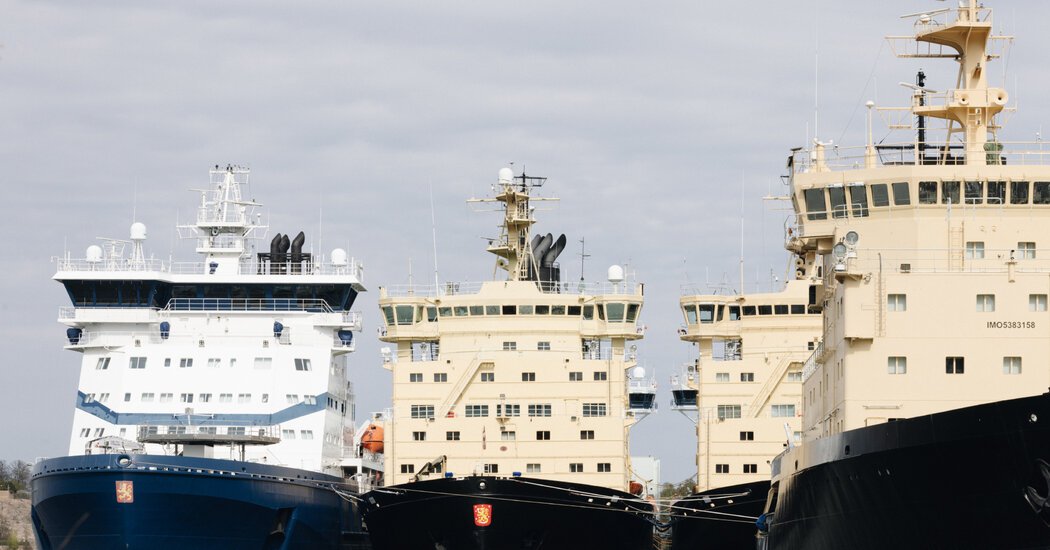
Late one night last August, Alexander Stubb, the president of Finland, was at his summer residence two hours west of Helsinki when his phone rang. On the other end of the line was President Trump, calling with a request.
He wanted to buy a fleet of massive ships designed to cut through Arctic ice.
Mr. Trump had long fixated on these hulking vessels, known as polar icebreakers. He viewed them as crucial to dominating the Arctic, where rising temperatures have put key shipping lanes and vast mineral wealth up for grabs. And he was incensed that the United States possessed far fewer than Russia.
Two months later, Mr. Trump and Mr. Stubb were sitting in the Oval Office to announce a deal for 11 icebreakers, worth almost $7 billion, to be built by shipyards in both countries.
The arrangement was unusual in various ways.
The number was twice as many as the Coast Guard, which manages America’s fleet, had said it needed. The contracts for building the ships would be awarded without competitive bids. And while seven of the ships are expected to be built in the United States, the first four would be built in Finland, requiring Mr. Trump to waive a law prohibiting the construction of national security vessels overseas.
At that moment, though, none of that mattered. Mr. Trump wanted more icebreakers, and he wanted them from Finland.
“Other countries have more than we do,” Mr. Trump proclaimed as he sat with the Finnish leader, “and we’re buying the finest icebreakers in the world.”
The story behind Mr. Trump’s personal intervention in Coast Guard ships provides new insights into how his administration has cut corners and flouted rules in pursuit of projects that suit the president’s desires, regardless of whether they fit any broader strategic rationale.
The reliance on no-bid contracts, usually reserved for highly specialized or urgent needs, mirrors other recent Trump-driven projects — ranging in scale from renovations to the Lincoln Memorial Reflecting Pool to a $1.3 billion deal to build a migrant detention center.
A New York Times examination of the Coast Guard deal found it relied on personal appeals from Finland’s president and Mr. Trump’s own view of what constitutes national greatness, along with a fascination with polar icebreakers dating back to a chance encounter in Finland long before he would ever run for president.
It also came with no plan to pay for the infrastructure required to support the 11 new ships or the crews to sail them. Those costs are likely to reach into the billions, according to Coast Guard documents.
Much of the funding is set to come from money set aside for border security in the Republicans’ spending law passed last year, the “One Big Beautiful Bill,” which gave the administration wide latitude to pour billions into its priorities with little oversight.
To justify no-bid contracts for icebreakers, the Trump administration invoked a rarely used exemption claiming the awards are in the “public interest” — allowing the government to skip competition while saying little publicly about its rationale.
“We haven’t seen any information or analysis to justify the 11 or to assess the long-term affordability of these decisions,” said Shelby S. Oakley, director of contracting and national security acquisitions for the nonpartisan U.S. Government Accountability Office.
The Coast Guard, she said, risks ending up “like a lottery winner who spends all their money buying the mansion, and then goes broke once they realize they don’t have the money to maintain it.”
Administration officials broadly defended the ships as essential for national security. Polar icebreakers allow the Coast Guard to maintain what it calls “presence” in the Arctic — monitoring foreign vessels operating in the region’s increasingly strategic waterways.
“President Trump is restoring America’s status as a great Arctic power after previous administrations allowed our ships and Arctic capacity to rust and decay,” Allie McCandless, a spokeswoman for the White House Office of Management and Budget, said in a statement.
The commandant of the Coast Guard, Admiral Kevin E. Lunday, said the service abided by laws and regulations “to ensure appropriate stewardship of taxpayer dollars.”
“The number 11 came directly from the president,” Admiral Lunday told The Times. He said the Coast Guard provided input, but added: “This was the president’s number and the president’s decision.”
The president has bragged about the deal.
“I’m gonna be there at the dedication,” he told graduates at the United States Coast Guard Academy in May. “They have been trying to get icebreakers for years and years, and no president was able to provide them with what you need to get it done.”
A Golf Game, and a Gift
Mr. Trump’s interest in Finnish icebreakers can be traced back more than 30 years.
The future president, then a hotel and casino mogul facing bankruptcies in New York and Atlantic City, flew to Helsinki in 1992 to look for new ways to make money.
Mr. Trump was interested in buying a ship to turn into a floating casino, according to Juha Wiskari, a Finnish shipping executive who met with Mr. Trump and gave him a tour of one of his company’s vessels. Mr. Trump dropped the idea, Mr. Wiskari said in an interview, once he realized the cost of operating the ship would make it hard to turn a profit.
But the visit proved significant for another reason. Mr. Trump had seen Finnish icebreakers docked nearby and wondered what they were, another shipping executive, Martin Saarikangas, later told Finland’s public broadcaster. He recalled telling Mr. Trump that Finland had built about 60 percent of the world’s icebreakers.
“A positive seed about Finland had been planted in his mind,” Mr. Wiskari said.
After becoming president a quarter-century later, Mr. Trump expressed his reverence for icebreakers. No other branch of the military, he said during 2017 remarks at the Coast Guard Academy, “has the power to break through 21 feet of rock-solid Arctic ice.”
He talked to Finland’s leaders about buying or leasing an icebreaker, but couldn’t close the deal before the end of his first term, according to people familiar with those conversations.
After his re-election, Mr. Trump again began trying to buy icebreakers. Coast Guard officials held meetings with U.S. shipbuilders to gauge their interest.
Then a game of golf changed everything.
On a Saturday in March 2025, Mr. Trump played in a tournament at one of his golf courses in Florida. Joining him was Mr. Stubb, the Finnish president. Mr. Stubb had played golf for the Finnish national team, and went to Furman University in South Carolina on a golf scholarship. According to Mr. Trump, the two men won the tournament.
Mr. Stubb presented Mr. Trump with a picture of an icebreaker, in what one person described as a handsome golden frame. Shipbuilding is a vital industry in Finland, and the country’s leaders had long sought to persuade the U.S. government to buy vessels from its yards.
Finland’s reasons for courting Mr. Trump went beyond securing a deal for icebreakers, according to people familiar with the two countries’ interactions. Keeping a close relationship allows Mr. Stubb to try to persuade Mr. Trump of the importance of the NATO alliance and maintaining pressure on Russia.
Mr. Trump wrote on social media that Mr. Stubb was “a very good player,” and said Mr. Stubb had praised him for making America strong again.
Mr. Trump added the words that Finland had long sought to hear: “President Stubb and I look forward to strengthening the partnership between the United States and Finland, and that includes the purchase and development of a large number of badly needed icebreakers for the U.S.”
A senior Coast Guard official called, texted and met with Republican lawmakers through the spring and early summer to push for funding, describing icebreakers as a top White House priority, according to two people with knowledge of the outreach.
The pressure worked. Last July, in the Republicans’ spending law, Congress provided $3.5 billion for the ships. But Mr. Trump and his advisers wanted to buy more icebreakers than $3.5 billion would pay for.
The administration at the time had been considering two “very, very good proposals” for icebreakers, the White House budget director, Russell T. Vought, told The Times.
One shipbuilder had offered to build five icebreakers, based on a design originally developed for Russia; another proposal offered six ships, using a design for the Canadian Coast Guard.
“We ultimately didn’t want to have to choose between them,” Mr. Vought said.
In the end, they didn’t have to. “The One Big Beautiful Bill had given us an opportunity to do both,” he added.
The additional icebreaker money — another $3.5 billion — came from a separate fund in the bill intended for what lawmakers called “border support,” according to Troy Edgar, deputy secretary at the Department of Homeland Security, which oversees the Coast Guard.
Mr. Trump placed the late-night call to President Stubb in August, not long after the bill was passed.
The two leaders had been negotiating for months about the United States purchasing a used icebreaker from Finland, and perhaps a handful of new vessels. Now, armed with billions in new funding, Mr. Trump wanted to go bigger.
“I’m not going to buy the used one, because it’s too old,” Mr. Trump said, according to an account Mr. Stubb later gave to Finnish journalists. “I want more new ones instead.”
A spokeswoman for Mr. Stubb declined to respond to questions from The Times about Mr. Stubb’s account.
‘Russia Has 40’
Experts say Mr. Trump’s actions reflect a very real problem: The United States needs more polar icebreakers.
The question, the experts say, is how many the United States really needs. Mr. Trump’s public comments suggest his interest reflects a frustration that other countries have more icebreakers, rather than any review of strategic requirements.
“We only have one,” Mr. Trump complained to military leaders in 2020, somewhat undercounting the American fleet. “Russia has 40.” Russia now has 56 polar icebreakers, the Coast Guard told Congress this past April, while China has five.
Mr. Trump’s focus on Russia’s icebreakers ignores crucial differences between the two countries, according to Ronald O’Rourke, who analyzed the Coast Guard’s icebreaker program for the nonpartisan Congressional Research Service for 18 years until retiring this year.
More than two million Russians live in Arctic communities, and the Russian government needs icebreakers to keep ports and shipping lines open. Fewer than 20,000 Americans live in the Alaskan Arctic, census data show.
The last time the Coast Guard prepared a formal assessment of what vessels it needs, in 2023, the service said it required four or five of the type of icebreakers the Trump administration is buying. It’s not clear what the Coast Guard would do with 11 such vessels, Mr. O’Rourke said — even if the United States took control of Greenland, as Mr. Trump has urged.
Mr. O’Rourke assessed the president’s views on Russian icebreakers by way of an analogy about misplaced car envy.
“My neighbors have a lot of kids, so they bought a minivan,” Mr. O’Rourke said. “Does that mean that my wife and I, who have no kids, also need to buy a minivan?”
The administration’s goal is to obtain the first icebreakers before Mr. Trump leaves office. To meet that timeline, the Coast Guard bypassed the usual process of requesting and reviewing competing bids.
By using the public interest exemption, the provision that allowed the Trump administration to avoid seeking competitive offers, the Coast Guard did not have to prove that the work was urgent, or that only one company could do it. Instead, the agency simply needed to send Congress a letter informing lawmakers of the plan to award a no-bid contract before signing the deal.
By the time the letter arrived, the White House already had announced the deal and the companies had publicly touted their selection.
The proposals accepted by the administration resulted in contracts with three companies.
To be politically defensible, the White House determined that the program should include at least one U.S. shipbuilder, according to people with knowledge of those discussions who spoke on condition of anonymity to describe private deliberations.
The Coast Guard turned to Bollinger Shipyards, a Louisiana-based shipbuilder with a history of government contracts, including an earlier deal for an icebreaker that has yet to be completed.
Bollinger’s C.E.O., Ben Bordelon, and his wife have donated about $1.7 million to Republican candidates and committees within the past decade, far outpacing what they gave to Democrats, federal elections data show.
A spokesman for Bollinger, TJ Tatum, said the company received the contract to build additional icebreakers because of its four decades building ships for the Coast Guard. He said the donations by Mr. Bordelon have gone to lawmakers who sit on committees that oversee shipbuilding and other policy areas important to the company, and the couple have not given money to Mr. Trump.
‘Nobody Makes Them Like Finland’
Mr. Trump’s vision for Arctic dominance is already taking shape. Inside a cavernous hall at the western edge of Finland, Rauma workers could be seen earlier this year constructing the hull of the deal’s first foreign-made icebreaker.
The trick of an icebreaker is in the curve of its bow. As powerful propellers at the front and back of the ship thrust the vessel forward, that curve lets the hull slide up onto the ice, like a 9,000-ton sea lion hauling out of the water. The weight of the hull then knuckles into the ice, bending it down and outward, leaving a trail of open water in its wake.
Finns say theirs is the only country in the world where every harbor ices up in winter, so their shipyards became adept at building icebreakers.
Republican officials have celebrated the deal as a win for American industry.
At a recent groundbreaking ceremony in Galveston, under watch of armed Coast Guard boats bobbing in the harbor, Gov. Greg Abbott of Texas and Senator Ted Cruz took turns feting Mr. Trump at the shipyard where three icebreakers are slated to be built.
A casual listener could be forgiven for thinking all the new icebreakers would be constructed in America.
“I was very proud when President Trump announced that $3.5 billion was going to Davie Defense to build five Arctic Security Cutters, and to build them here in the Texas Gulf Coast,” Mr. Cruz said to cheers and applause. The first two will in fact be built in Finland.
In an interview afterward, Mr. Cruz offered his own take on Mr. Trump’s decision to buy 11 icebreakers.
He invoked the 1984 Rob Reiner film “This Is Spinal Tap,” about a fictional heavy metal band whose aging members try to forestall irrelevance by embracing excess. The band’s philosophy is captured by its guitarist, who brags that while the volume knobs on other amplifiers stop at 10, his amplifier turns all the way to 11.
“As a child of the ’80s, I have to admit, my own personal theory is the ‘Spinal Tap’ theory: Ours goes to 11,” Mr. Cruz said.
“Although I doubt that was the president’s motivation,” he quickly added.
Reporting was contributed by Jeff Adelson, Alexandra Berzon, Adam Entous, Jeffrey Gettleman, Kate Kelly, Johanna Lemola and Dustin Volz. Research was contributed by Susan C. Beachy, Kitty Bennett, Alain Delaquérière, Georgia Gee, Sheelagh McNeill and Kirsten Noyes.

