
The Trump administration has directed national recreation areas, seashores, wildlife refuges and other public lands to immediately lift dozens of restrictions on hunting and trapping, internal Interior Department documents show.
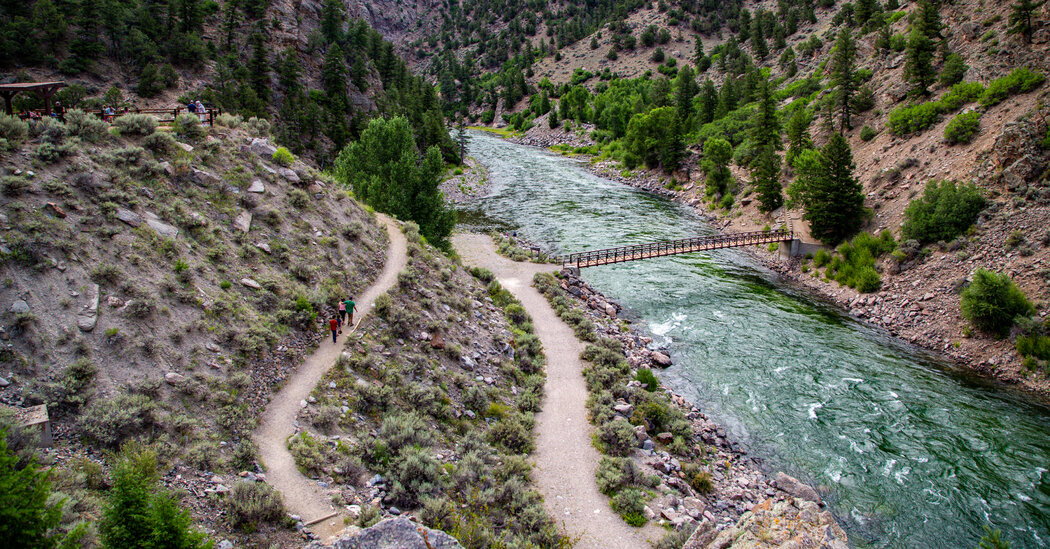
The order, which takes effect on Monday, applies to some 76 federal lands that allow hunting but have rules to protect habitats or people. Curecanti National Recreation Area in Colorado had prohibited firing weapons from, toward or across trails. At Lake Meredith National Recreation Area in Texas, hunters had been barred from cleaning and processing game animals in restrooms. And at the Ozark National Scenic Riverways in Missouri, hunting dogs were required to have tags for safety.
Those and many other requirements are now deleted.
Interior Secretary Doug Burgum ordered the changes, according to an April 21 memo to park officials and a spreadsheet of changes at individual parks, both of which were reviewed by The New York Times.
“Closures and restrictions not required by law must be the minimum necessary for public safety or resource protection,” the memo said.
Major national parks like Yellowstone, the Everglades and the Grand Canyon are permanently closed to hunting by statute and will not be affected by the order.
Critics said the changes were made without studies or wide consultation about how they might affect public lands. They warned of unintended consequences for animals and habitats. The Interior Department said in a statement that each change had been carefully reviewed and that any restrictions necessary for public safety or legal compliance would not be lifted.
Mr. Burgum has shown an eagerness to expand hunting and fishing on federal lands. Last year, the Interior Department allowed hunting across 87,000 new acres at national wildlife refuges and hatcheries. And in January, Mr. Burgum issued a secretarial order directing the National Park Service, the Fish and Wildlife Service, the Bureau of Land Management and the Bureau of Reclamation to review “outdated” restrictions that may pose an “unnecessary regulatory burden.”
Aubrie Spady, a spokeswoman for the Interior Department, said in a statement that Mr. Burgum’s order was a common-sense approach to managing public lands and said the agency was expanding access to hunting and fishing where it can be done safely and responsibly.
“For decades, sportsmen and women have been some of the strongest stewards of our public lands, and this order ensures their access is not unnecessarily restricted by outdated or overly broad limitations that are not required by law,” Ms. Spady said. She added that the agency does not comment on leaked or unofficial documents, but said internal deliberative materials did not reflect how the decisions were made.
According to the spreadsheet of changes that the Trump administration has requested at specific locations, park officials have pushed back in some places.
For example, Cape Cod National Seashore in Massachusetts said it could not allow hunting or carrying loaded weapons near trails and certain buildings because about 4 million people visit the park each year. And at New River Gorge National River in West Virginia, officials said they were not planning to change prohibitions on discharging firearms within 500 feet of visitors centers and campgrounds, calling it “a basic safety measure.”
But parks have already made dozens of other changes. Several have agreed to repeal restrictions on the use of artificial lights when hunting and allow permanent hunting stands. Conservation groups have argued that lights may affect wildlife and that stands can harm vegetation.
Other changes include an end to restrictions on transporting wildlife as well as rules restricting where animal carcasses can be left.
And in some cases, compendiums — the written compilation of closures, permit requirements and other restrictions at parks — have already been altered. For example, as of May 1, the Jean Lafitte National Historical Park and Preserve in Louisiana eliminated a section that declared that all reptile species, including turtles and alligators, are protected in the park.
Compendiums have typically been designed at the discretionary authority of park superintendents.
“Those things were put into place by park superintendents over a period of time for very good reasons,” said Daniel Wenk, the former National Park Service superintendent of Yellowstone National Park, said of the changes, adding, “this is very concerning.”
Advocates for park protection who were shown the memo said they supported hunting in parks where Congress has authorized the activity. But some accused the Trump administration of acting irresponsibly and imposing a one-size-fits-all deregulatory agenda on parks with specific needs. Many said the administration was rushing through changes that could put hikers and campers in danger or harm vulnerable wildlife.
Several said the move appeared to violate the 1916 Organic Act, which created the National Park Service. It allows hunting where federally mandated but also directs the agency to conserve park resources so they are “unimpaired” for the enjoyment of future generations.
“What we’re really concerned about is, that memo didn’t say, ‘do analysis,’” said Stephanie Adams, who leads the wildlife program at the National Parks Conservation Association, a nonprofit group.
“It didn’t say ‘engage the public,’ and it didn’t say to be sure to focus on that key part of the Organic Act, which is to manage in a way that leaves the parks unimpaired for the enjoyment of future generation,” Ms. Adams said.
Hunting and outdoor sporting groups have praised the Trump administration’s efforts so far.
Aaron Kindle, the director of sporting advocacy at the National Wildlife Federation, a conservation nonprofit that supports hunting, said wildlife refuges often have different regulations than the states, creating confusion for hunters.
Rob Sexton, the senior vice president of the Sportsmen Alliance, a hunting advocacy group, said national park sites have had a “closed until open” attitude toward hunting that needs to be reversed. He said restrictions that are not grounded in state law or “compelling scientific evidence” showing harm to wildlife and habitat should be eliminated to help encourage more hunting and fishing.
Both Mr. Kindle and Mr. Sexton declined to comment on specific rules because they had not seen the documents.
“The number one reason why people give up hunting and fishing is the lack of opportunity and access,” Mr. Sexton said.
Federal land managed by the Bureau of Indian Affairs inside reservations also is expected to be unaffected by the order.

