
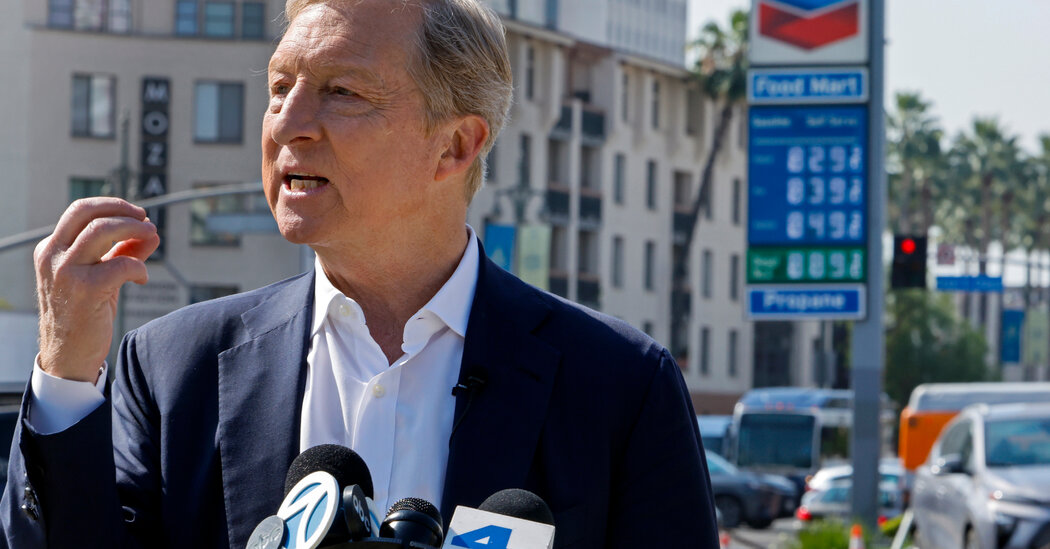
At a moment when few politicians are speaking out about climate change, Tom Steyer has thrust the issue to the center of the California governor’s race.
Steyer, a hedge fund billionaire and Democrat, is a major climate donor and investor, and a former presidential candidate. In this campaign, though, his green message has been rooted in economics more than than romantic environmentalism, which marks a larger shift in climate politics.
He says California voters’ top concern is affordability, and the fastest way to lower their bills is by embracing clean energy.
Steyer has a raft of policy proposals he says would help, including overhauling utilities, offering more generous state tax credits for electric vehicle purchases, expanding bond financing for clean energy projects and making it easier to build and add renewable power sources to the grid.
California has historically been a climate leader in developing regulations, but it’s notoriously hard to build clean energy projects in the state and its electricity prices are among the highest in the nation. In a chaotic race, Steyer’s focus on climate, and a hefty dose of his own money, has placed him among the top Democratic candidates in most polls. The state’s nonpartisan primary is June 2, and the top two finishers will advance to the fall’s general election.
I called Steyer yesterday and asked him about the campaign, the Trump administration and his former hedge fund’s investment in coal, the dirtiest fossil fuel. This conversation has been condensed and edited for clarity.
Your rivals are trying to make the race a referendum on billionaires like yourself, but you’re trying to make it a referendum on climate. Is that connecting with voters?
The issue that’s going to resonate with voters is affordability, and it just turns out that at this point in the energy transition, doing the right thing is cheaper.
Even before Iran, it was very obvious which way the world was going. Solar and wind don’t have to go through the Strait of Hormuz.
But now, anyone who’s not a blind fool knows that fossil fuels are expensive and untrustworthy. Therefore, all around the world, the rate at which people are buying solar panels in soaring.
It’s hard to build large-scale clean energy projects in California. So what are you actually proposing that would allow Californians to have rapid access to these technologies?
What I’m saying is we’re going to have local competition. We’re going to put solar on the flat roofs. We’re going to use batteries that are going to allow local grids and micro grids. We can do it pretty damn fast. I also said I would triple the tax credit for E.V.s. Let’s get people into E.V.s.
You’ve also proposed breaking up PG&E, California’s biggest utility.
They are a legal monopoly that is preventing us from adopting cheap, clean energy and batteries. They’re charging us twice as much for electricity as the national average. Farmers in the Central Valley pay three times as much to move water for irrigation as the farmers in Texas. That’s crazy.
Your 2024 book, “Cheaper, Faster, Better,” argued that it made economic sense to build renewables. But the Trump administration is making it harder to build wind and solar. Does your argument still hold?
Take a look around the world and you’ll notice how much electricity is being built in Africa, in Pakistan, in Asia. People are building solar panels left, right, and center. Chinese E.V.s are cheaper, but we’re not allowed to buy them.
The Trump administration is trying to support their oil and gas cronies, absolutely. But it’s not going to work. The only thing it can do is ruin the United States and make us unable to compete around the world.
My colleagues last week wrote an article about your investments and your former hedge fund’s ties to the coal industry.
It’s categorically false that I have any investments in oil and gas. I had divested from all that stuff in Farallon 14 years ago.
If you are governor, you will have to work with the Trump administration. Do you see a path toward a more moderate, collaborative approach with the president?
He has been trying to hurt Californians all the time. He is not paying our FEMA bills. He’s throwing people off Medi-Cal. He is spending our money in a war halfway around the world and driving up our gasoline prices. He is sending in ICE agents to terrorize our citizens.
I’m going to stand up for the people of California. If he is treating us fairly, I am more than happy to cooperate with him. If he’s treating us unfairly, I intend to stand for California. If he tries to cheat in the election, I intend stand up for free elections. If he tries interfering in the economy, I stand up or free competition.
California has historically been a leader on climate issues, but that’s gotten harder in recent years. Does the state still have the ability to lead on climate?
We should be make decisions based on the economics and the science, and the economics and the science dictate moving toward clean sustainable energy that’s cheaper.
I’m a business person. These businesses are exploding all over the world. Why not here? We are the people who come up with the technology, lets us build and succeed and hire a whole bunch of people and show we can do it. I just want us to have a chance for California to lead the world.
The Trump administration
Trump nominates ousted FEMA leader to run the agency again
President Trump on Monday nominated Cameron Hamilton, a former member of the Navy SEALs, as administrator of the Federal Emergency Management Agency, seeking to install the organization’s first permanent leader of the president’s second term.
If confirmed by the Senate, Hamilton would rejoin the agency a year after serving a brief stint as its acting administrator. He was ousted from that role days after he testified to Congress that FEMA should not be eliminated, an idea that Trump and Kristi Noem, then the homeland security secretary, had floated early last year.
It’s the Trump administration’s latest step toward an overhaul of FEMA that could shift significant responsibility for disaster response back to state and local governments, though officials have backed away from eliminating the agency. — Scott Dance
Related: Trump panel calls for FEMA overhaul
Number of the day
9 percent more mercury
Coal-fired power plants across the United States released 9 percent more mercury emissions last year as power demand surged, Irena Hwang and Hiroko Tabuchi report. The Trump administration has launched a series of moves that experts say may make those emissions climb even higher this year and beyond.
Mercury is a potent neurotoxin that settles into waterways and accumulates in the food chain, particularly in fish, mercury can cause premature cardiovascular mortality in adults. In children and fetuses, it can cause developmental delays and permanent I.Q. deficits.
Mercury emissions from coal plants in the United States had been on a decline since 2018, the earliest year for which complete data was available.
In case you missed it
Greenpeace suffers another blow in court fight with pipeline giant
Greenpeace International, the global coordinating body of the environmental organization, suffered an unusual setback last week when the North Dakota Supreme Court said the organization should not be allowed to pursue a lawsuit in the Netherlands, where it is based. It’s rare for a court in one country to try to block a lawsuit in another country.
The ruling is the latest twist in the long-running legal fight between Greenpeace and the pipeline company Energy Transfer. Last year, Energy Transfer won a verdict totaling hundreds of millions of dollars in damages in its claim that several separate Greenpeace organizations had played a major role in protests against the Dakota Access Pipeline a decade ago.
The U.S.-based branch of the environmental group, Greenpeace USA, has said it may need to file for bankruptcy because of the size of the damages. But its Amsterdam-based counterpart, Greenpeace International, has countersued under Dutch law. — Karen Zraick
“I can’t just abandon this work. This is important to my community partners. This is important to other schools. And this is important to all of the kids who gave us their time, all the parents who allowed us to do research with their kids. There’s a moral imperative to continue the work, albeit slowly.”
Kirsten Beyer, a health geographer at the Medical College of Wisconsin, was assessing the benefits of improving school playgrounds in Milwaukee under a three-year study, funded by the Environmental Protection Agency, focused on environmental health among children. Her grant was canceled last year.
Read more from our Lost Science series on cuts to the scientific community under the Trump administration.
More climate news from around the web:
-
China exported more E.V.s and plug-in vehicles than gasoline or diesel cars for the first time in April, The Wall Street Journal reports.
-
Top solar companies, banks and insurers have stopped doing business with at least a half-dozen recently built solar panel factories in the U.S., Reuters reports. That’s coming because of concerns that ties to China could disqualify the factories from clean energy subsidies under new Trump administration rules.
-
Economic inequality adds more than 100,000 to the annual toll of heat and cold in deaths Europe, according to a new study described by The Guardian. “Cutting levels of inequality to match that of Europe’s most equal region, Slovenia,” they write, “would reduce temperature-related mortality by as much as 30 percent.”
Read past editions of the newsletter here.
If you’re enjoying what you’re reading, please consider recommending it to others. They can sign up here.
Follow The New York Times on Instagram, Threads, Facebook and TikTok at @nytimes.
Reach us at climateforward@nytimes.com. We read every message, and reply to many!

