
Outside the building in rural Vermont where a company called Lost Lantern blends whiskey sits a gray Prius V with more than 120,000 miles on the odometer.
It was brand-new when Lost Lantern’s owners, Nora Ganley-Roper and Adam Polonski, bought it in 2018. They had just quit their jobs in Manhattan (he was a drinks writer and editor, she was a sales manager for Astor Wines & Spirits), put their belongings in storage, founded a whiskey company and taken off for eight months. They visited 60-plus distilleries in 32 states on the first of what would be many road trips.
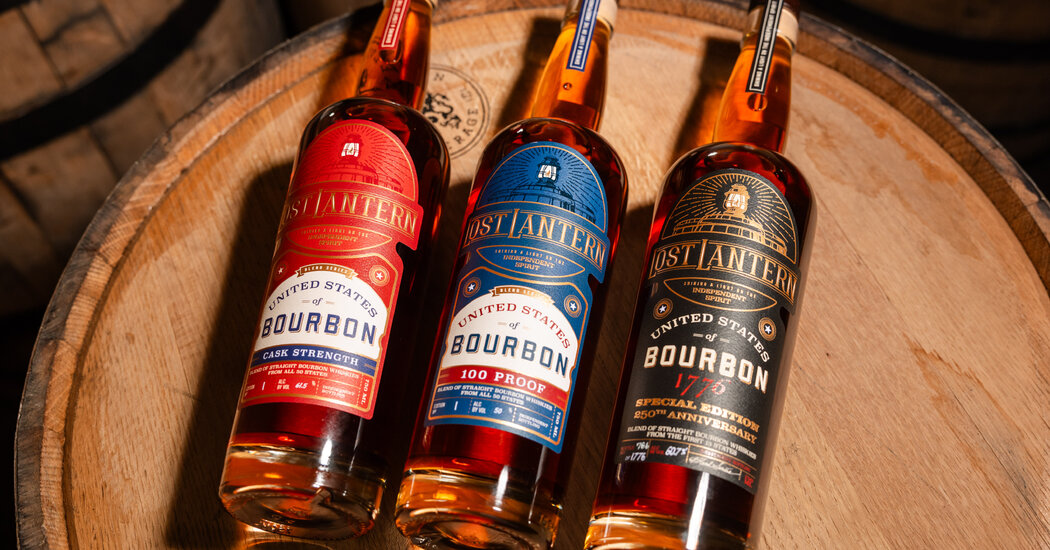
On Monday, 20 national park visits, hundreds of hotel overnights, one overheated engine, one marriage and one baby later, they are releasing the result: United States of Bourbon, a blend of 50 bourbons, one from each state, to mark America’s 250th birthday.
While most whiskeys are identified by their age or grains or barrels used for aging, this one could be measured in miles. To buy barrels of the component whiskeys, Mr. Polonski visited several distilleries in each state and selected one bourbon to represent that state in the mix. (His wife joined him when she wasn’t in Vermont blending whiskeys.) The label lists all 50 producers.
The American whiskey industry is in a deep slump, but several distillers have stepped up to mark the nation’s semiquincentennial. On June 1, Maker’s Mark released a limited edition bottle of its classic bourbon with a commemorative red, white and blue wax seal. Heaven Hill has issued three special versions of its Evan Williams bourbon.
In March, Horse Soldier Bourbon, a Kentucky distiller, released Liberty Edition, a commemorative 13-year-old bourbon. And Tenmile Distillery, in the Hudson Valley, has created the Semiquincentennial Set, a series of 12 whiskeys released monthly throughout the year. Each honors a different battle of the Revolutionary War.
“Bourbon has long been the cornerstone of America’s distilled spirits industry and an important part of the U.S. economy, dating back to early America when George Washington was a commercial distiller,” said Lisa Hawkins, chief of communications for the Distilled Spirits Council of the United States.
Lost Lantern began as an effort to find, bottle and sometimes blend American whiskeys — bourbon, rye and single malt — from small distilleries around the country. The company is an independent bottler, a business model with deep roots in Scotland, where merchants have historically bought barrels of single-malt Scotch from distilleries, then sold them under their own labels, sometimes after blending them.
Since 2020, the couple have released 126 whiskeys. Visiting so many distilleries across so many regions gave them a deep understanding of how differences in climate and geography impact the whiskey.
“The Southeast is going to have bourbons with the most amazing, kind of rich — almost viscous — texture, and ones from the Midwest are softer,” Mr. Polonski said. “Texas makes bold, powerful, oak-driven stuff. The Northeast is more delicate.”
Early on in their travels, they started toying with the idea of creating the 50-state blend, which they call U.S.B. But that was merely a fantasy at the time. There weren’t distilleries in every state yet, let alone ones that produced bourbon old enough to be released — or any bourbon at all.
But then products from craft distilleries started to come of age. Today there are more than 2,200 distilleries in the country, up from 1,835 in 2018, according to the American Craft Spirits Association.
“We got really excited about the possibility of doing U.S.B. once we realized that well-made bourbon from places outside Kentucky tastes very different from Kentucky bourbon,” Ms. Ganley-Roper said on a recent Saturday in Lost Lantern’s blending room, in an old milk-processing plant about 25 miles south of Burlington, Vt.
Hundreds of small bottles of whiskey lined a metal shelf. The couple’s infant son, Owen, younger than the youngest barrel of bourbon in the room by several years, snoozed in a carrier.
Ms. Ganley-Roper developed the United States of Bourbon over about a month by creating combinations of a few products at a time, then blending them together.
“Some bourbons have a real intense flavor in one direction — a primary flavor note, like salt or pepper or spice. Others are more subtle,” she said. “I built the whiskey off of the more subtle ones, then used more intense whiskeys like you would use salt and pepper in a recipe to enhance the flavor.”
As they traveled the country to buy bourbon, the couple had the awards and relationships to establish their credibility in the industry, so distillers didn’t need convincing that United States of Bourbon wasn’t just a vanity project.
Still, they hit some logistical snags. Some distillers didn’t have enough old barrels to sell, or thought they could make more money bottling and selling it themselves.
The bigger challenge for the couple, however, was shaking off their New York City ways. They tried camping in Wyoming, but headed to a hotel after signs of bear activity. They started putting snow chains on their tires during a storm en route to Lake Tahoe from Reno, Nev., but ended up paying a good Samaritan the only $62 they had in cash to help. In South Dakota, they drove down gravel roads that elude Google Maps in their compact city car.
They have produced two styles of the United States of Bourbon, which will be rereleased annually.: a 100-proof version ($80) and a brawnier cask-strength expression ($100). Their 1776 Edition ($200), a one-time release, is a blend of bourbons from distilleries in the original 13 states.
Whiskey experts were reluctant to comment on the bourbon before tasting it, but some questioned its appeal for collectors in an already glutted market.
“People buy story, but there’s just so much American craft whiskey right now,” said Bill Thomas, owner of the Jack Rose Dining Saloon in Washington, D.C.
And what about the average whiskey lover?
“You’re going to have people who say it’s a gimmick, but it’s not something a corporate marketing department can just cook up. Look at the years of work it took to put it together,” said Ryan Maloney, the owner of Julio’s Liquors in Westborough, Mass., who selects and bottles more than 100 barrels of whiskey each year for his store.
“I think it’ll have broad appeal, especially to people who love history or are feeling patriotic about the 250th, not just the bourbon geeks of the world.”

