
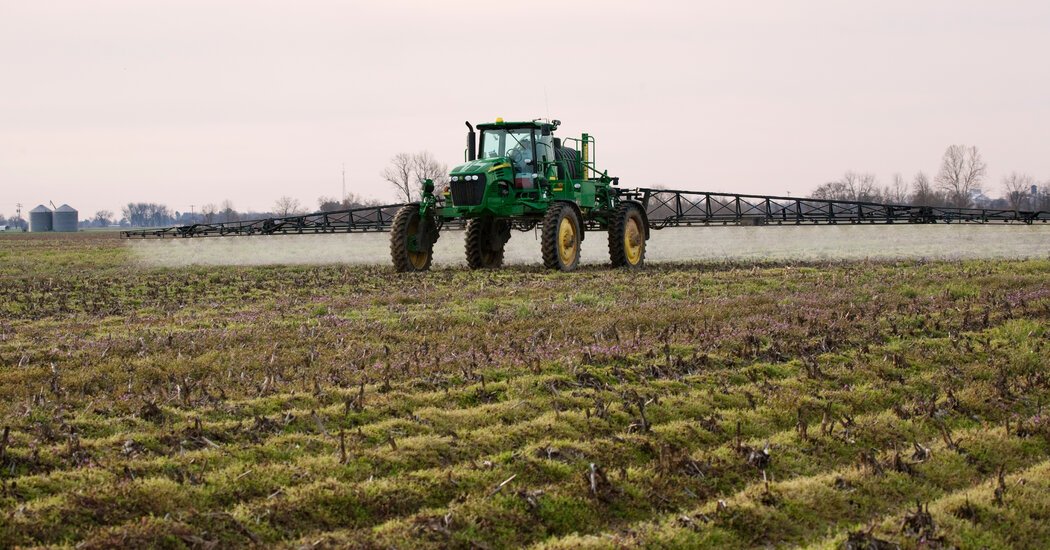
California’s pesticide regulator announced on Monday the state would phase out the herbicide paraquat, which studies increasingly associate with Parkinson’s disease and other health problems.
The action by the country’s largest agricultural state highlights the growing concerns over the chemical’s health effects, even as American farmers say it is an essential tool and continue to spray millions of pounds of it on crops each year.
In March, following lawsuits from thousands of people who blame paraquat for their illnesses, the agrochemical company Syngenta announced it would stop producing the chemical, leaving generic manufacturers to fill the void.
A company spokesperson said that the claims made in the lawsuits were meritless.
In May, Vermont became the first state to ban paraquat, and in June, two congresswomen from opposite ideological camps — Representative Chellie Pingree, Democrat of Maine, and Representative Anna Paulina Luna, Republican of Florida — introduced a bill to prohibit it nationwide.
For now, federal regulators have declined to act. Environmental advocates say this reflects how unwieldy the country’s pesticide laws are, and how difficult it is to eliminate a chemical that some farmers say they can’t do without.
Commercialized in the 1960s, paraquat quickly became one of the world’s most popular weedkillers. It works by snatching electrons from other molecules and releasing free radicals to kill nearby cells. Within hours of applying it to weeds, farmers see them wilt and brown.
Chris Goodman, whose family has been farming in Tift County, Ga., since the 1850s, said he uses hundreds of gallons of paraquat each year, mainly to kill pigweed that springs up before he can sow cotton and peanuts. Without it, he said, he would need to till his fields between harvests and would lose more of the topsoil.
He takes the precaution of wearing gloves, but was not concerned about health risks. “I’ve been spraying paraquat since I was 10,” he said, “and I don’t have Parkinson’s.”
In contrast, Stephanie Johnson can’t say for certain whether her husband, Rick, was exposed to paraquat during years as a Wisconsin dairy inspector, but she lost him to Parkinson’s disease in 2023, three months before she got the same diagnosis herself. She has since advocated to outlaw the pesticide. “I don’t understand why we have not banned it in this country,” she said.
For decades, paraquat was not thought to cross the blood-brain barrier in humans exposed to it. But studies in the early 2000s began to show that not only could the chemical access the brain, but also once there, it affected dopamine-producing neurons targeted by Parkinson’s disease.
Dr. Donato Di Monte, an author of some of the studies, said paraquat also promoted the accumulation of a protein associated with Parkinson’s. “We don’t have the killer with the gun in his hand,” he said, “but we do have a lot of clues that, put together, make us rather concerned.”
Dr. Caroline Tanner, a professor of neurology at the University of California, San Francisco, went further. Fifteen years ago, she led a study that sent teams of neurologists onto farms across Iowa and North Carolina to examine aging pesticide applicators; those who had used paraquat were about two and a half times as likely to have the disease. “Paraquat is definitely associated with an increased risk for developing Parkinson’s,” she said.
Researchers with Imperial Chemical Industries and Chevron Chemical, Syngenta’s predecessor companies, themselves noted paraquat’s adverse effects on brain tissue as early as the 1970s, according to corporate records disclosed as part of litigation and obtained in 2022 by The New Lede, a news website that is a project of the Environmental Working Group.
About 70 countries have banned the substance, including the European Union, Brazil and China. Some did so because the pesticide became a leading means of suicide among agricultural workers and their families, because of its extreme lethality. In India, where a paraquat ban is under consideration but the substance is still available, scientists estimate it is implicated in 10,000 to 20,000 suicide deaths per year.
American farmers spray millions of pounds of it on crops each year, though experts could not say precisely how much. When The New York Times requested public records on paraquat manufacturers and importers, the Environmental Protection Agency withheld how much paraquat each imported or produced. Published government data show its use more than doubled from 2008 to 2018, partly because weeds were developing resistance to other pesticides.
In 2021, the E.P.A. concluded that the evidence was insufficient to establish that paraquat causes Parkinson’s disease. Rather than banning the pesticide, the agency limited access to certified users and required special safety equipment.
But in 2024, Syngenta submitted a study to the agency showing paraquat turns to vapor more than 4,000 times as readily as previously thought, and could spread much further through the air. In the Biden administration’s final days, the agency withdrew its earlier conclusion and asked the company to run years of further field studies, which are ongoing.
Syngenta maintains that paraquat is “essentially nonvolatile under field conditions,” a company spokesperson said.
The federal law governing pesticide regulation — the Federal Insecticide, Fungicide and Rodenticide Act — generally requires regulators to weigh a chemical’s risks against its benefits to agriculture, which makes outright bans difficult. And when the E.P.A. does act, the courts can intervene: When the agency restricted another pesticide, chlorpyrifos, from use on food crops, a federal appeals court threw out the decision.
“Our pesticide laws are broken, and our pesticide regulator is culturally biased in favor of defending the status quo,” said Scott Faber, a senior vice president at the Environmental Working Group.
Jim Jones, who oversaw the E.P.A.’s pesticides program from 2011 to 2017, said the agency’s view during his tenure was that imposing strict safety requirements for paraquat was enough to prevent exposure. But as the science shifted and accidental exposures continued, he came to regret that view, he said. He recently joined seven other former E.P.A. officials in a letter calling for a ban.
“I think paraquat should be removed from the market,” he said.
Litigation is also changing the financial outlook for manufacturers. In 2021, Syngenta reportedly paid $187.5 million to settle a lawsuit brought in Illinois state court by about 300 people who had developed Parkinson’s after exposure to the chemical, despite having no family history of the disease.
This year, the company settled another lawsuit brought in Philadelphia by a retired landscaper who blamed paraquat for his Parkinson’s. And a federal court in Southern Illinois overseeing more than 6,600 claims approved a fund to administer a proposed global settlement — but the terms remain sealed and as of June, many plaintiffs had opted out.
The Supreme Court narrowed the avenues to seek redress when it sided with the manufacturer of the weedkiller Roundup to overturn a jury verdict for a Missouri man who alleged the product had caused his cancer. The justices ruled he could not sue the manufacturer in state court for failing to warn customers about the product’s risks because it carried the warning label the federal government approved. If the E.P.A. eventually concludes paraquat is not associated with Parkinson’s disease, it will foreclose state lawsuits of this type against the manufacturer.
Critics of paraquat have pushed states to ban its use. California’s phaseout sprang from legislative action in 2024, when lawmakers passed a law requiring the state pesticide regulator to re-evaluate paraquat. The department’s preliminary findings, released later that year, flagged possible links to thyroid effects and birth defects — though not, notably, to Parkinson’s disease. It then asked the manufacturers to generate new safety data to keep their products registered, and they chose not to do so.
Representative Pingree, who has been an organic farmer in her Maine district for decades and cosponsored a federal bill to permanently cancel the pesticide’s registration, said that the converging interests of environmentalists and Make America Healthy Again activists was creating opportunities. “There is a Republican-Democratic coalition that we should tap into to try to get more restrictions on some of the toxic chemicals,” she said.
Paraquat manufacturers and buyers are not slowing down. The Chinese company Nanjing Red Sun, which is registered to sell three paraquat-based pesticides in the United States, said it imports about 5,000 tons annually.
In Georgia, Mr. Goodman had relied on Syngenta’s products, but now that the company has discontinued paraquat, he said he’d probably seek out a generic manufacturer. “There’s nothing to replace it.”

