
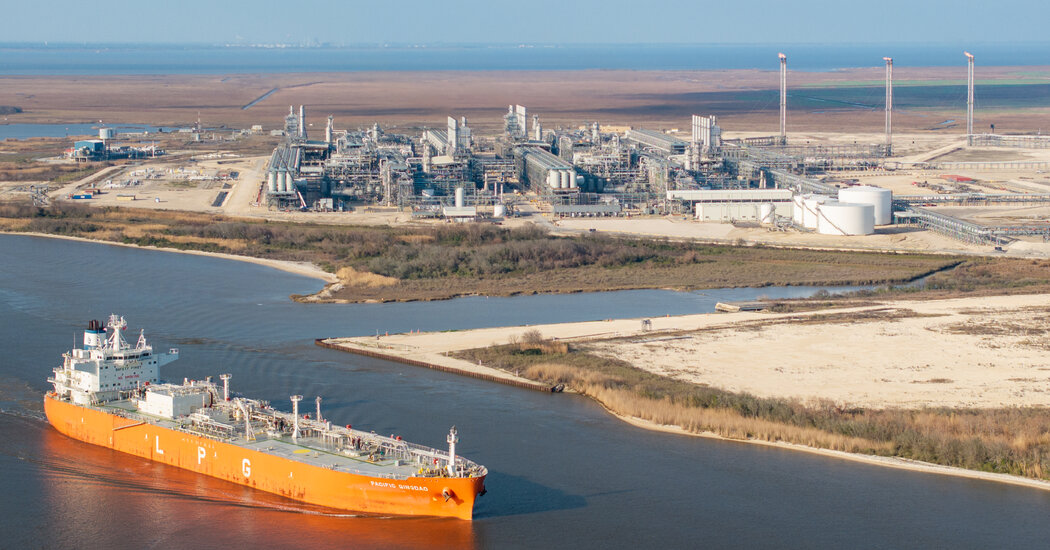
The closure of the Strait of Hormuz has cut off a significant source of liquefied natural gas, but the United States, the biggest exporter of the fuel, is unlikely to pick up that slack because it has no spare capacity.
A two-month pause on L.N.G. shipments from Qatar, a Persian Gulf country near the strait, has caused prices to surge across Europe and Asia. That is spreading significant economic pain because places like Italy, Taiwan and South Korea depend on the fuel to produce electricity, heat homes and run industrial plants.
This is the second time in less than five years that global natural gas markets have been severely disrupted. In 2022, Russia began choking off the piped gas it used to send to European countries around the time of its invasion of Ukraine.
U.S. companies went to Europe’s rescue and are expected to bring new L.N.G. capacity online in the coming months and years. But analysts said those efforts would not nearly be sufficient to make up for the loss of Qatari gas if the strait did not reopen soon, forcing importers to ration and turn to other sources of energy.
“All of the L.N.G. that is exported from the U.S., it’s at full capacity,” said Massimo Di Odoardo, vice president of gas and L.N.G. research at Wood MacKenzie, an energy research firm.
Since the war in Iran began on Feb. 28, prices for L.N.G. shipped to Europe and Asia have climbed to as much as six times the price of natural gas in the United States. In the months before the war, they were less than four times as high.
The United States is building several export terminals where natural gas is chilled to minus 260 degrees Fahrenheit, turning it into liquid that can be loaded onto oceangoing tankers. But these projects, most of them in Texas and Louisiana, cost billions of dollars and take several years to complete.
Natural gas supplies roughly a quarter of global energy, according of the International Energy Agency. Demand had been climbing worldwide alongside the use of electricity, driven in part by data centers used for the development of artificial intelligence. Some countries are also using natural gas, which is mostly composed of methane, to replace coal and provide power when there is insufficient solar or wind energy.
But importing liquefied natural gas is expensive even in good times. Countries have to build terminals to turn it back into gas and pipelines to get it from coasts to power plants, homes and factories.
Now the war is making reliance on the fuel much more expensive.
The United States and Iran remain in a standoff over the Strait of Hormuz, where the U.S. military is blockading ships linked to Iran and Iran is effectively stalling ships carrying oil, L.N.G. and other goods from the Persian Gulf to the rest of the world.
The war caused Qatar to stop making L.N.G. at its Ras Laffan plant, one of the most important energy assets in the region. Missiles later damaged 17 percent of the plant’s capacity.
Gas executives say they are optimistic that new capacity under construction will eventually ease the strain. But analysts caution that an extended closure of the strait — through which 20 percent of all L.N.G. passes — and yearslong repairs to Ras Laffan could keep gas prices high for a long time.
In addition, the damage to Qatar’s gas export operations could delay by at least two years the growth of L.N.G. supply that was expected before the war, the International Energy Agency said on Friday.
North America broadly has been driving the global growth in L.N.G., providing three-quarters of the increase in supply last year, according to the energy agency. Australia is another big exporter.
Energy companies have been on the hunt for more gas reserves around the world. Shell, based in London, announced on Monday a $16.4 billion acquisition of ARC Resources, a Canadian company that produces natural gas in Alberta and British Columbia. Some of that gas is exported as L.N.G. from a terminal on the coast of British Columbia.
U.S. terminals exported almost 18 billion cubic feet a day in March, close to the record set in December, according to the Energy Information Administration. The terminals cannot easily export much more without deferring regular maintenance and more quickly starting new projects.
U.S. exports are projected to increase 18 percent this year and 10 percent next year, the Energy Information Administration estimates. Five new L.N.G. terminals plan to start operations by the end of next year.
Industry executives contend that U.S. investment in natural gas has positioned the country for a long period of low domestic prices even as exports rise. Some projections indicate that U.S. natural gas prices could remain in the range of $3 to $4 per million British thermal units for decades.
“From the U.S. natural gas industry’s perspective, we’re in a really good place today, tomorrow and far into the distant future,” said Karen Harbert, president and chief executive of the American Gas Association.
But some analysts say prices in the United States could increase to as much as $5 per million British thermal units if energy companies build all of the export capacity they are planning to.
“I would say that in the long run, there isn’t enough supply at the current price point to accommodate all the build-out of L.N.G. capacity and gas-for-power demand from data centers,” Mathieu Utting, lead L.N.G. and natural gas analyst at Rystad Energy, a research and consulting firm.
If natural gas prices rise in the United States and the rest of the world, some countries may decide they are better off investing more in renewable energy and large batteries. A report by Ember Energy, a nonprofit research group, says China exported record numbers of solar panels in March, suggesting some countries are already moving in that direction.
The disruptions caused by the war have prompted some Asian countries to switch to other fuels, International Energy Agency said. And preliminary data suggests that Europe’s use of natural gas in March fell about 4 percent from a year earlier. The region’s power sector used less gas as it enjoyed a relatively strong increase in wind and hydroelectric production.
“Every single country dependent on L.N.G. today is absolutely assessing that relationship,” Julie McNamara, director of federal energy policy for the Union of Concerned Scientists. “This is such a vulnerable place to be for any given country.”

