
Andrew here. George Clooney, Rande Gerber and Mike Meldman walk into a bar … It sounds like the start of a joke, but we’ve got a fun exclusive today on their latest venture, a nonalcoholic beer brand. Given how well their last beverage company worked out, keep an eye on this one.
We’re also looking at the new battle between the F.C.C. and Disney as well as at the latest in the Elon Musk-OpenAI trial.
The F.C.C. strikes Disney again
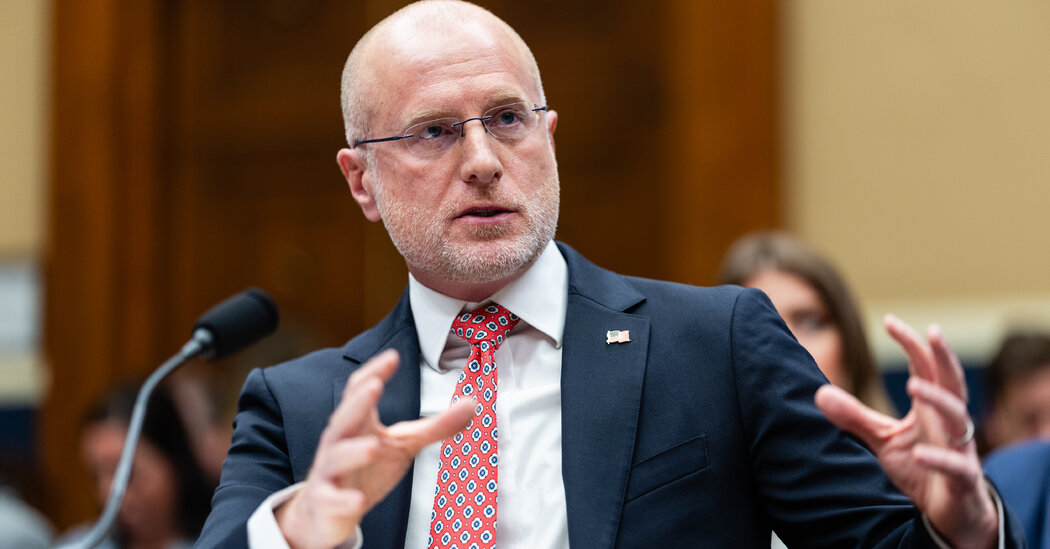
The Trump administration has threatened to essentially crack down on programming that displeases President Trump. Now it seems to be making good on that.
The F.C.C.’s extraordinary move to review ABC’s broadcast TV licenses may face long odds in court. But it’s another warning to corporate giants — like Disney, which owns ABC — that perceived slights against the administration could be costly.
What’s happening: The F.C.C. is looking into Disney’s fitness to hold licenses for eight TV stations, including in markets like New York and Los Angeles. The licenses are not actually up for renewal until 2028 at the earliest, but the F.C.C. can legally demand a review at any time.
The move came up amid a fight between President Trump and Jimmy Kimmel over a joke the late-night host made before the shooting over the weekend at the White House correspondents’ dinner.
The chances of success for the F.C.C. are probably small:
-
Revoking a license requires showing a pattern of repeated serious violations. And the law forbids the F.C.C. from using its regulatory powers to censor.
-
The last time the agency picked a fight with Disney — also over Kimmel — didn’t go over well, even with some Republicans.
Disney can continue to operate the stations while the regulatory process plays out, and it can appeal any adverse ruling.
But the message may be what counts. Brendan Carr, the chairman of the F.C.C., has made clear that he won’t stop scrutinizing media companies over what he perceives as biased coverage. That threat previously drove two major television station owners, Nexstar and Sinclair, to temporarily suspend airing Kimmel’s show. (So far, it doesn’t look like that’s happening this time.)
That said, the administration is still demonstrating across multiple industries that it can make life more painful for those out of its graces. Some companies appear to be actively trying to stay on Trump’s good side, especially if they have important business before regulators.
It’s a test for Disney’s new C.E.O., Josh D’Amaro. He has faced several challenges since taking the reins six weeks ago. But this one will test whether he’s as politically savvy as Bob Iger, his predecessor.
So far, D’Amaro appears to have the backing of Disney’s board. But the latest crisis may force him to make tough choices about the company’s businesses, including whether owning television operations still makes sense.
HERE’S WHAT’S HAPPENING
The Trump administration is said to be close to a truce with Anthropic. Officials are drafting guidance that would let government agencies use the company’s tools, including its Claude Mythos Preview model, Axios reports. (Months ago, some in the administration declared the artificial intelligence lab “woke.”) It’s unclear what will happen to Anthropic’s fight with the Pentagon, which is playing out in federal court.
Bill Ackman raises $5 billion in an I.P.O. The deal, priced at the low end of its expected range, will take public two of the financier’s entities: the management company for his Pershing Square Capital Management hedge fund and for a new closed-end investment fund. It fulfills a long-held goal for Ackman, who has said he wants to create a modern-day Berkshire Hathaway.
Foreign carmakers are said to threaten to withhold cheap models from the U.S. The Wall Street Journal reports that the threat is tied to calls by companies like Nissan to amend or renew the U.S.-Mexico-Canada free trade agreement, which President Trump has weighed killing. Elsewhere, cheap Chinese cars are a hit a few miles from Texas’ border with Mexico.
Exclusive: George Clooney’s beer brand raises $15 million
Casamigos, the last beverage company founded by George Clooney, Rande Gerber and Mike Meldman, led to a blockbuster takeover by Diageo. Now, investors are betting on the friend group’s next endeavor — on the opposite end of the alcohol spectrum.
Their new company, the nonalcoholic beer brand Crazy Mountain, plans to announce on Wednesday that it has raised $15 million in seed funding, Michael de la Merced is first to report.
The backstory: Crazy Mountain was introduced last month as the latest venture for Clooney and Gerber, a hospitality impresario married to Cindy Crawford, and Meldman, a real estate mogul.
Their last venture together was Casamigos, which by their telling started out as a house tequila for a Clooney-Gerber vacation home in Mexico. It eventually became a hugely popular spirit brand that Diageo bought in 2017 for a minimum of $700 million in cash upfront; if Casamigos hits certain sales targets by next year, Diageo will pay an extra $300 million.
Crazy Mountain is a bet on the boom in nonalcoholic beverages. Consumers are drinking less booze — sales of beer, wine and spirits have fallen in recent years — amid concerns over health, cost and more. Nonalcoholic drinks remain a small share of the overall drinks category, but analysts and industry executives are paying attention.
“We’re building Crazy Mountain for the way we live today, keeping the ritual and camaraderie of drinking a cold one, just without the alcohol,” Gerber said in a statement.
It’s now sold in more than 25 states and online.
The deal details: Crazy Mountain’s round was led by CAVU Consumer Partners, a consumer-focused investment firm. Also participating were Coatue Management and Meldman’s Discovery Land Company, both of which helped incubate the business.
“Nonalcoholic beer is one of the most compelling growth categories in beverage, and it’s still early,” said Ben Schwerin, a general partner at Coatue and a Crazy Mountain board member. “The founding team,” he added, is “the right group to build the defining mainstream brand in this space.”
Clooney isn’t the only actor to get into the nonalcoholic beer business. Tom Holland, the star of Marvel’s recent Spider-Man movies, introduced the BERO brand in 2024. It has since reportedly raised money from investors at a valuation above $100 million.
OpenAI’s fights in and out of court
The courtroom phase of the Elon Musk-OpenAI fight has begun, and so, too, have the latest verbal fusillades between the world’s richest man and the artificial intelligence lab he helped start in 2015.
But this isn’t OpenAI’s only battle right now — and the one outside federal court might be the more pressing.
“This lawsuit is very simple: It is not OK to steal a charity,” Musk said on Tuesday on the witness stand. The billionaire accused two other OpenAI co-founders, Sam Altman and Greg Brockman, of trying to improperly get rich from what was founded as a nonprofit A.I. research lab.
(Judge Yvonne Gonzalez Rogers told the jury that Musk’s perspective had “no legal value whatsoever.”)
Musk said his lawsuit was altruistic. He said he had helped create OpenAI as a counterweight to Google. But Altman and Brockman wanted to turn OpenAI into a commercial enterprise, and he left in 2018 after a power struggle.
One of Musk’s aims is to unwind OpenAI’s transformation into a for-profit company — along with $150 billion in damages, which he has said he would donate to OpenAI’s charitable arm.
The fight was a case of “sour grapes,” argued Bill Savitt, OpenAI’s lawyer. Musk had sought unsuccessfully to have Tesla buy OpenAI, and left soon after.
Moreover, according to Savitt, Musk didn’t seem to care about OpenAI until 2022, when ChatGPT became a hit. (Musk later created xAI, which his company SpaceX bought this year at a $250 billion valuation.)
Muzzling Musk and Altman: The judge asked them to avoid disparaging each other on social media during the trial. “How can we get things done without you making things worse outside the courtroom?” she asked Musk.
Both agreed to a truce on social media.
OpenAI was fighting another front. Shares in companies linked to the A.I. lab fell Tuesday on a Wall Street Journal report that said the start-up had failed to meet internal business targets; those in Oracle tumbled 4 percent, while those in CoreWeave, a data center rental operator, fell 5.8 percent.
OpenAI defended its financial health, saying that its businesses were “firing on all cylinders” and that it still planned to spend big on data centers. (It didn’t deny missing user growth or revenue targets, however.)
-
Alphabet, Amazon, Meta and Microsoft report earnings after the bell on Wednesday. Investors will want new details about their A.I. spending and whether it’s paying off yet.
Picture of the day
President Trump hosted a state dinner for King Charles III at the White House last night, with business moguls, Supreme Court justices and Trump allies and administration officials in attendance. The king delivered some memorable jokes and a “TRUMP” emblazoned bell.
On the guest list: Jeff Bezos, Amazon’s founder; Tim Cook, Apple’s departing C.E.O.; David Ellison, the head of Paramount; and Steve Schwarzman, a founder of Blackstone.
OPEC disrupted
Oil prices are rising again on Wednesday as Washington and Tehran remain in a standoff over the Strait of Hormuz. The stalemate appears likely to last, as President Trump reportedly seems to favor a lengthy blockade of Iranian ports.
But longer-lasting changes to the oil market are in the offing, after the United Arab Emirates said it would leave OPEC, potentially shattering the oil cartel’s ability to set global crude prices. And it may scramble the power dynamic in the Persian Gulf for decades to come.
The latest in the oil markets:
-
Brent crude, the international benchmark for oil, was trading above $114 on Wednesday, and has climbed more than 25 percent over the past eight trading sessions.
-
The average price of gasoline in the U.S. has risen to $4.23 a gallon, according to AAA.
The potential fallout from the Emirates’ move: The country’s exit could eventually lead to a price war, Javier Blas of Bloomberg Opinion argues.
“The world needs more energy, the world needs more resources and U.A.E. wanted to be unconstrained by any groups,” Suhail Al Mazrouei, the country’s energy minister, told The Times on Tuesday.
It may accelerate a redrawing of the region’s balance of power. An Emirates unrestrained by OPEC could be bad news for Saudi Arabia, whose dominant say over the cartel’s production quotas has rankled Abu Dhabi in the past. “It is an Emirati declaration of independence,” Kristin Diwan, a senior resident scholar at the Arab Gulf States Institute, a research organization in Washington, told The Times.
The move also raises questions about how Washington and Beijing might seek to court the Emirates as a more powerful player in the Gulf. Abu Dhabi is considered a close ally of the U.S., but it also counts China as an important trading partner.
THE SPEED READ
Deals
-
Talks to combine Pernod Ricard and Brown-Forman, the maker of Jack Daniel’s, have collapsed; Sazerac may now swoop in to acquire Brown-Forman. (NYT)
-
Citi announced its hiring of Vis Raghavan, a senior banker, as a major coup. Three days before, JPMorgan Chase reportedly told him he was out of a job. (FT)
Politics, policy and regulation
Best of the rest
We’d like your feedback! Please email thoughts and suggestions to dealbook@nytimes.com.

