
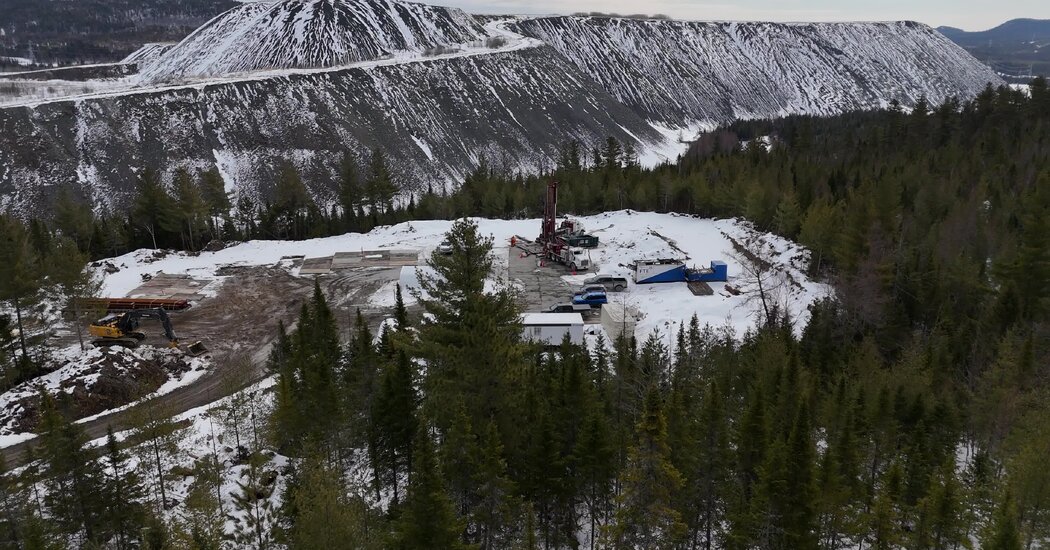
Outside the city of Thetford Mines, Quebec, in a region that once supplied the world with asbestos, workers are drilling underground in search of an unusual and potentially vast new source of clean energy.
A start-up called Vema Hydrogen has drilled two test wells into the bedrock, each 1,000 feet deep, and is starting to inject treated water into the iron-rich rocks below. The goal is to trigger a special type of chemical reaction that could eventually produce large quantities of hydrogen, a clean-burning fuel that may one day play a vital role in tackling climate change.
“The potential is massive,” said Pierre Levin, the chief executive of Vema, as he watched a drilling crew at work on a bright, bitterly cold spring day. “You can find rocks like this all over the world, enough to produce billions of tons of hydrogen.”
The dream of clean hydrogen has tantalized energy experts for decades. When burned, hydrogen emits only water vapor. It could theoretically be used instead of fossil fuels in ships, airplanes, steel mills or chemical plants, all industries where it’s difficult to find viable alternatives for oil, gas and coal and cut planet-warming emissions.
The problem has always been making that hydrogen.
Most of the hydrogen the world uses today — mainly for fertilizer and refining — is produced using natural gas in a process that creates lots of emissions. In recent years, the United States and other countries have invested billions of dollars trying to make “green” hydrogen with wind and solar power, but it has proved difficult and expensive.
Now a growing number of companies think a better answer could lie underground. Dozens of start-ups are trying to find large reservoirs of natural hydrogen thought to exist below the surface. Others, like Vema, are trying to stimulate the processes that generate that hydrogen, without any emissions. It’s a field often referred to as “geologic hydrogen.”
“This could be transformational if we can figure it out,” said Madeline Schomburg, a vice president at the Energy Futures Initiative, a nonprofit research organization. “Even if the likelihood of success is low, the potential rewards are so high that it’s worth exploring.”
An underground discovery
Hydrogen is the most abundant element in the universe, and it gets made naturally in the Earth’s crust when certain iron-rich minerals react with water and rust. This process, known as serpentinization, often leaves behind rocks with a mottled green color.
For a long time, many geologists believed that any natural hydrogen produced this way was unlikely to accumulate in large underground deposits because the tiny molecules would slip away through cracks in rocks.
Lately, that conventional wisdom has been upended. In 1987, workers in Mali were digging a well that appeared dry until a man peered too close with a lit cigarette, setting off an explosion. It was a natural hydrogen reservoir, which has since been harnessed to generate electricity for a nearby village.
By the 2020s, scientists were publishing papers estimating that natural hydrogen deposits underground could supply the world’s needs for hundreds of years. One promising location was North America’s Midcontinent Rift, an enormous formation of iron-rich basalt that stretches 1,200 miles from Kansas to Michigan.
“When I first started looking into this, I had serious doubts,” said Geoffrey Ellis, a geochemist at the U.S. Geological Survey. “Now I’m convinced there’s plenty of hydrogen down there. It’s just a question of whether we can find accumulations that can be produced economically.”
The Energy Department has estimated that geologic hydrogen could be produced for less than $1 per kilogram. That would be cheaper than hydrogen made from fossil fuels and one-sixth the current cost of making hydrogen from wind and solar power.
Companies are racing to find the fuel. One of the best-funded start-ups, Koloma, has raised $400 million from investors including Amazon and United Airlines and has drilled exploratory wells in Iowa. HyTerra, an Australian firm, is searching for hydrogen and helium in Kansas and Nebraska.
Riley Kemp, HyTerra’s chief executive, said his company is finding hydrogen in its early wells, but needs to run tests to see if the gas will flow at high enough rates to make production worthwhile. He compared the search to the early days of oil exploration, when companies drilled numerous wells before finding gushers.
The hurdles remain high. While scientists have identified broad areas that are likely to be favorable for geologic hydrogen, there’s no way to know for sure what’s down there without drilling, which can be expensive and carries a risk of failure.
The work to map and analyze potential deposits is still nascent, with some of the best geological data being collected by companies that want to keep the information secret. That could slow discoveries, experts said, as could difficulties in obtaining permits for exploration or unforeseen environmental side effects.
“In my mind, if we want to do this quickly, we’d have to work together and share data,” said Dr. Ellis. “Otherwise, at the rate we’re going, it’s going to take many decades.”
Policymakers are starting to notice. In January, Gov. Gretchen Whitmer, Democrat of Michigan, ordered state agencies to study geologic hydrogen and identify barriers to development. The U.S. Air Force is exploring geologic hydrogen as a potential energy source for its bases. Some lawmakers in Congress have proposed funding, though the technology still gets almost no federal support, unlike other ways of making clean hydrogen.
‘We are very ambitious’
Not everyone thinks the best strategy is to search for natural deposits underground. A better idea, some say, is to create them.
In Quebec, Vema plans to spend the rest of the year injecting water into its underground test wells to see if it can speed up the process of serpentinization that creates natural hydrogen underground. On a recent spring day, a drilling crew near Thetford Mines was inserting pipe into a well while geologists scrutinized rock cores that had been pulled from the ground.
The rock formations here, known as ophiolites, were created more than 400 million years ago when a large chunk of Earth’s oceanic crust was thrust upward. These formations are rich in asbestos, and Thetford Mines was once known as the asbestos capital of the world, until the health risks of the material became well known and the mines shut down.
They might also be rich in hydrogen.
Carl Hinds, Vema’s operations engineer, held a handful of wet rock cuttings that had come out of one well. They were dark green, showing signs of serpentinization.
“That’s the reaction,” Mr. Hinds said. “We’re just trying to accelerate it.”
It’s not easy. Vema’s researchers have spent years in the lab experimenting with the precise combinations of water, temperature, pressure and chemical catalysts to produce the best hydrogen-producing reactions in different types of rocks underground. Mr. Levin, the company’s co-founder, calls it Vema’s “special sauce.”
The company also needs to find the right type of rocks underground. They need to be partly serpentinized, so that water can flow through, but not so fractured that the hydrogen escapes.
Outside experts say efforts to engineer hydrogen underground are plausible but not yet proven. The hydrogen could leak out of the ground. Or unseen microbes might devour the gas before it can be used. Injecting water into rocks can also cause them to swell, creating the risk of surface deformations or earthquakes.
Mr. Levin, who was trained as a mining engineer and geologist, says the company is prepared for challenges as it moves from the lab to the field. “Anyone who works in the subsurface knows that if you expect things are going to work by the book on the first try, it’s not happening,” he said.
In 2021, Mr. Levin had founded a company that searched for underground hydrogen deposits. But he came to believe that approach left too much to chance, and three years later founded Vema with Florian Osselin, a French geochemist who had been pioneering methods to stimulate natural hydrogen production.
Vema hopes to start full-scale production in 2028, with a goal of producing hydrogen that can eventually be cheaper than traditional forms.
If it works, the question is what to do with the fuel. While hydrogen could potentially be used for almost anything, whether powering cars or generating electricity, it is notoriously difficult to transport and store. That means any geologic hydrogen likely needs to be used as close to the production site as possible.
One proposal is to convert the gas into a clean liquid fuel for ships known as methanol. In recent years, governments have pressured shipping companies to cut their use of oil-based fuels and reduce their planet-warming emissions. Since it is hard to run hulking container ships on batteries, many companies are looking at using green methanol made from hydrogen and recycled carbon. But finding cheap hydrogen is tough.
“Cost matters, and people can only absorb so much premium for clean fuels,” said Judson Whiteside, the chief executive of StormFisher Hydrogen, a company that plans to produce green methanol in Varennes, Quebec. While StormFisher currently intends to generate its hydrogen with renewable electricity, it is one of three local methanol producers following Vema’s approach to see if that proves cheaper.
Other ideas include using hydrogen to make sustainable fuels for airplanes, produce greener fertilizers, create low-carbon steel mills or power local data centers. Perhaps the most ambitious plan would be to use geologic hydrogen to create a synthetic type of methane that could replace conventional natural gas for industry or heat.
“That would be the Holy Grail, because then you’re talking about millions of tons per year,” Mr. Levin said. “But we are very ambitious, and at some point we want to be ready to compete with fossil fuels.”
Vema has already raised $15 million and is working to raise more. There are ophiolites all over the Earth, including a ridge stretching from Costa Rica to Alaska, and the company is looking at sites in Oregon and California as well. Other start-ups, including one out of M.I.T. called GeoRedox, are developing their own approaches.
“Two years ago, this all felt very hypothetical,” said Alexis Templeton, a professor of geochemistry and geobiology at the University of Colorado, Boulder, who is conducting research on engineering hydrogen in Oman, home to the world’s largest ophiolite.
“Today we know you can definitely make hydrogen underground — the only question is whether we can make it economic,” she said. “That’s what everyone’s going to be working on.”

