
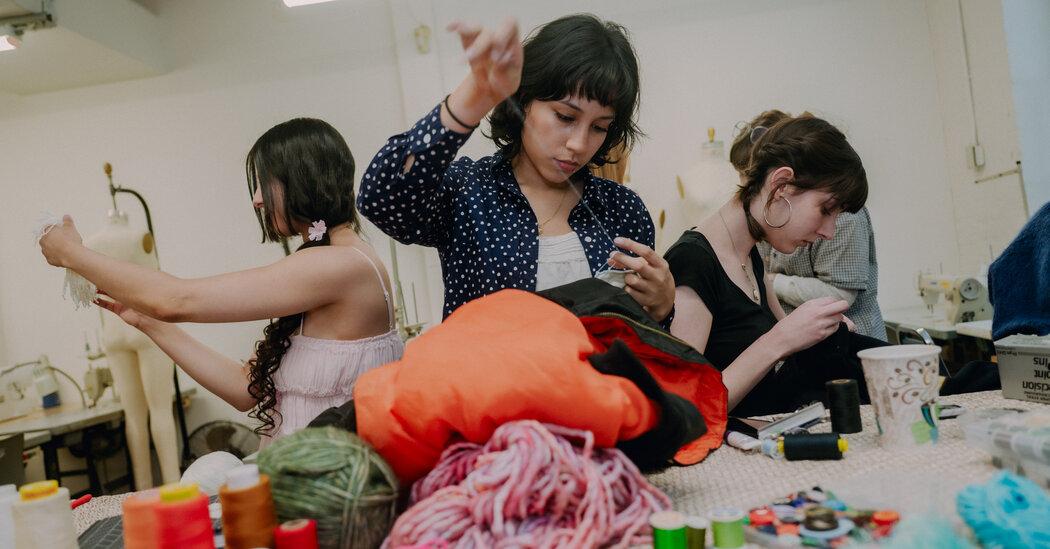
Aria Hannah sat in a second-floor studio at the Pratt Institute in Brooklyn, surrounded by garments that had seen better days. There were jeans with crotch holes and a T-shirt that was disintegrating at the collar. A pair of polka-dot socks were practically begging to be darned.
“A moth hole is such a beautiful thing to have,” said Hannah, 20, a junior studying fashion design. “It’s just an opportunity for something new.”
She and the dozen or so other students in the room make up Pratt’s Mending Circle, a group of young people that convenes twice a month to sip bergamot tea and reinforce pocket linings. For a little over a year, its members have brought well-worn clothes from their closets — and sometimes their classmates’, too — and stitched them back into circulation.
Hannah used a needle and thread to close up a hole in the navy blue wool coat she had been wearing all winter. She was next to Gianna Breinig, 21, the club’s president, who pinned a patch of cobalt fabric to a threadbare section of a friend’s pants. (In return, he had promised her a free tattoo.)
“I love being able to help people repair things that otherwise maybe they’d just throw out,” said Breinig, a junior from Gilbert, Ariz. “Like, let me show you how to fix that.”
Sewing circles have existed for generations, including groups organized through local churches in the 19th century, Abolitionist sewing circles and those that sprang up in response to textile-rationing efforts in World War II. But mending skills have experienced a modest resurgence in recent years, and sewing and other hands-on hobbies are taking off among some members of Gen Z.
The mending circle at Pratt draws mostly fashion design students who treat each distressed T-shirt as a creative prompt: How might a frayed hem be transformed with eye-catching embroidery?
The club grew out of a series of meet-ups organized by Brooke Garner, 36, an assistant professor of fashion design at Pratt. She hoped to offer an environment in which students could decompress while working on clothing that had nothing to do with their schoolwork.
“I see it so clearly as an act of resistance against all these negative forces that we’re up against, whether it’s consumerist fast fashion or just this pressure to always be producing and making something new,” Garner said.
She gathered skeins of yarn, spools of thread, embroidery hoops and old T-shirts to use as fabric scraps. (Many supplies came from a neighborhood “Buy Nothing” group on Facebook.) Only two or three students showed up at first, but eventually, word of the mending circle spread. “Everybody has a pile of clothes that need to be repaired, right?” Garner said.
During a mending session in late April, Garner put on a playlist of gentle piano music. Students filed in, chatting about the projects they needed to get done before the end of the semester.
Jacob Jenkins, 20, said he saw clothing repair as a practical necessity for his generation. “I think we’re at a time where we can’t buy new clothes — we don’t have the money,” he said. He had big plans to embroider the canvas of a pair of worn-out Converse.
Theo Goldman, 21, cut a laundry bag into patches that he was stitching to a pair of jeans. He is a fan of sashiko, a Japanese form of needlework that is both decorative and fortifying. With the technique, a piece of clothing “can be even stronger than it used to be,” he said.
When students wanted a break, they added embellishment to a fabric quilt that belongs to the whole group. Auguste DuBois, 22, wove a blue-and-green cord with a two-pronged tool called a lucet. Camila Terreros, 21, repaired a hole in the pocket of her bomber jacket.
Elena Scherer, 20, knitted the sleeve of a cardigan from a lightweight Icelandic wool. What did she think was drawing people her age to mending?
“Honestly, there could be a deeper answer about climate change or whatever, but I think people think that it looks cool,” Scherer said. Visible mending techniques create clothes that are not just newly wearable, she added, they are one of a kind.
Most of the group’s regulars said their mending skills had come a long way since they started showing up. Their work did not always come out looking perfect, but perfection was not the point, said Alma Rosado, 22, who wore a pair of her father’s pants that she had repaired herself.
“I’ve learned more techniques,” she said, “but also more patience.”

