
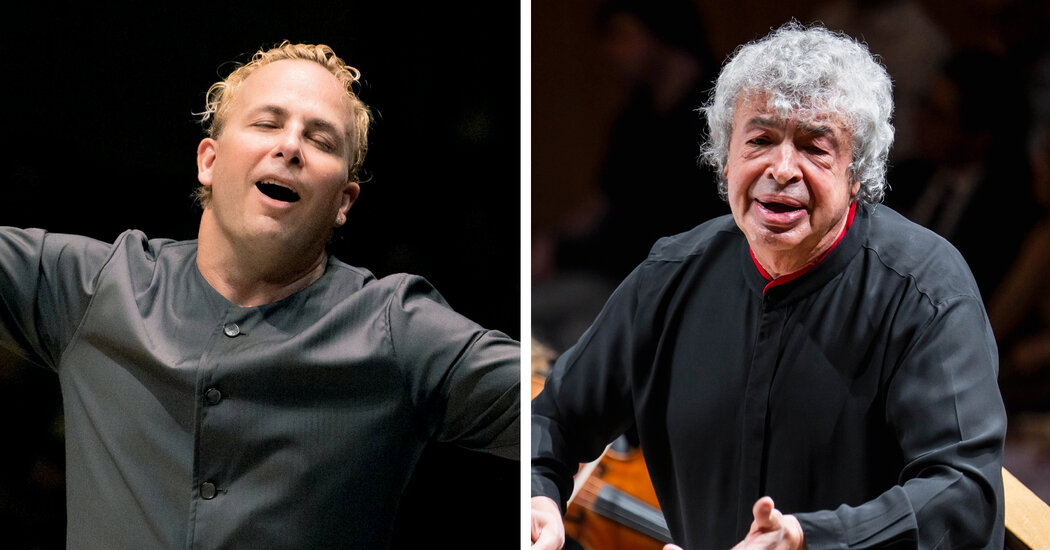
Bychkov is an expressive conductor but also a judiciously measured one; he will occasionally contort his face with emotion and whip his arms in a flourish, but at the end of a concert, he just gives the audience a small smile and bow. Nézet-Séguin, the Met’s music director, seems to perform the idea of conducting as much as he does the work of it. If you didn’t know a cymbal crash was coming in the Adagio, you could sense it as he wound up the moment with prolonged choreography. When the Finale was done, he knelt toward the orchestra in a demonstration of humility that, whether intended or not, drew attention to himself.
The two conductors’ visions of the symphony were, of course, filtered by the character of each orchestra. At the Philharmonic, Bychkov was most successful in rendering the symphony’s sudden shifts shocking yet natural, like a tectonic clash giving way to rocky mountains. He adopted a brisk tempo for the first three movements, then slowed down the Finale to heighten its grandeur, ending with the oppressively majestic atmosphere of Wagner’s entrance to Valhalla in “Das Rheingold.”
But the Philharmonic, appearing a little weary and without enough unity in the violins, wasn’t equipped for the task. It was an odd way to end a season that was on the whole good for the orchestra; the house frequently looked full, and there is palpable optimism and energy over the arrival of Gustavo Dudamel as music and artistic director this fall. (He will be conducting that Carnegie Hall “Tosca.”)
The mood is less sunny at the Met, whose season was a roller coaster of financial precarity. Still, the company has maintained a high level of artistic quality that can be easy to take for granted: above all, in the skill of its treasured orchestra.
But even that seems unsure these days. On Thursday, the Met Orchestra was still a fine group but more difficult to grasp as a true ensemble. Nézet-Séguin hasn’t proven to be much of an orchestra builder; he has led the Orchestre Métropolitain in Montreal since 2000, but it remains perplexingly unevolved. Nearly eight years into his tenure in New York, and with the orchestra still rebuilding from pandemic-era vacancies, the Met players have yet to develop any clear identity beyond a belief, borrowed from their leader and often leading to imbalances, that volume can be a substitute for expression.
This past week, neither the Philharmonic’s nor the Met Orchestra’s approach to Bruckner was unequivocally better: the Philharmonic’s interpretively wise but lacking the commitment to carry through, the Met’s fully committed but interpretively thin. As battles go, this one was a draw. See you again for Round 2 this fall.

