
“Mo Money Mo Problems” might be a reference lost on some of the youngest fans that the NWSL covets, but the growing league is dealing with its own notorious issue: A flood of investment that has brought new complications and shone a spotlight on longstanding tensions.
The buildup to Saturday’s NWSL Championship, the league’s 13th in its history, has been marred by layers of stadium problems that led to one semifinal being played on a field marked for American football, and another played in a 5,000-seat amateur stadium.
All but one NWSL team took on new ownership over the past six years; billionaires have replaced millionaires and built training facilities and, in rare cases, stadiums.
Yet, for the NWSL to become the league it wishes to be — a major league with more fans, full stadiums and exhaustive coverage — more money is required, still. From stadiums to player contracts and travel accommodations, the NWSL is now in a place where the only way to improve is to spend.
What are the NWSL’s recurring issues?
Problems with stadium availability and field quality during this year’s playoffs laid bare one of the major issues that is not going away. NWSL teams are tenants in their “home” stadiums in all but a few circumstances. Most NWSL teams are beholden to their landlords, fellow billionaires who operate men’s sports teams that will always be the priority in their buildings.
Gotham FC played its semifinal at the 5,000-seat Icahn Stadium on Sunday because it deemed the field conditions at Sports Illustrated Stadium, which is operated by MLS’ Red Bull New York, to be unsafe and unfit for their players — especially for a semifinal.
The Red Bulls showed where its priorities stand by scheduling a rugby doubleheader two days before Gotham’s season finale, as well as an exhibition match that overlapped one of the two possible NWSL semifinal dates.
Even as Gotham FC and the NWSL investigated solutions to repair the field at Sports Illustrated Stadium at their own cost, that exhibition was a roadblock because the Red Bulls could not be assured that the repaired field would be ready for its game.
It is not like those dates were a surprise: the NWSL announced its schedule 11 months ago, Gotham was the defending champion, and it moved to the top of the table in July and never let go of pole position. The Red Bulls’ friendly against Liga MX club Club América was announced on Oct. 5.
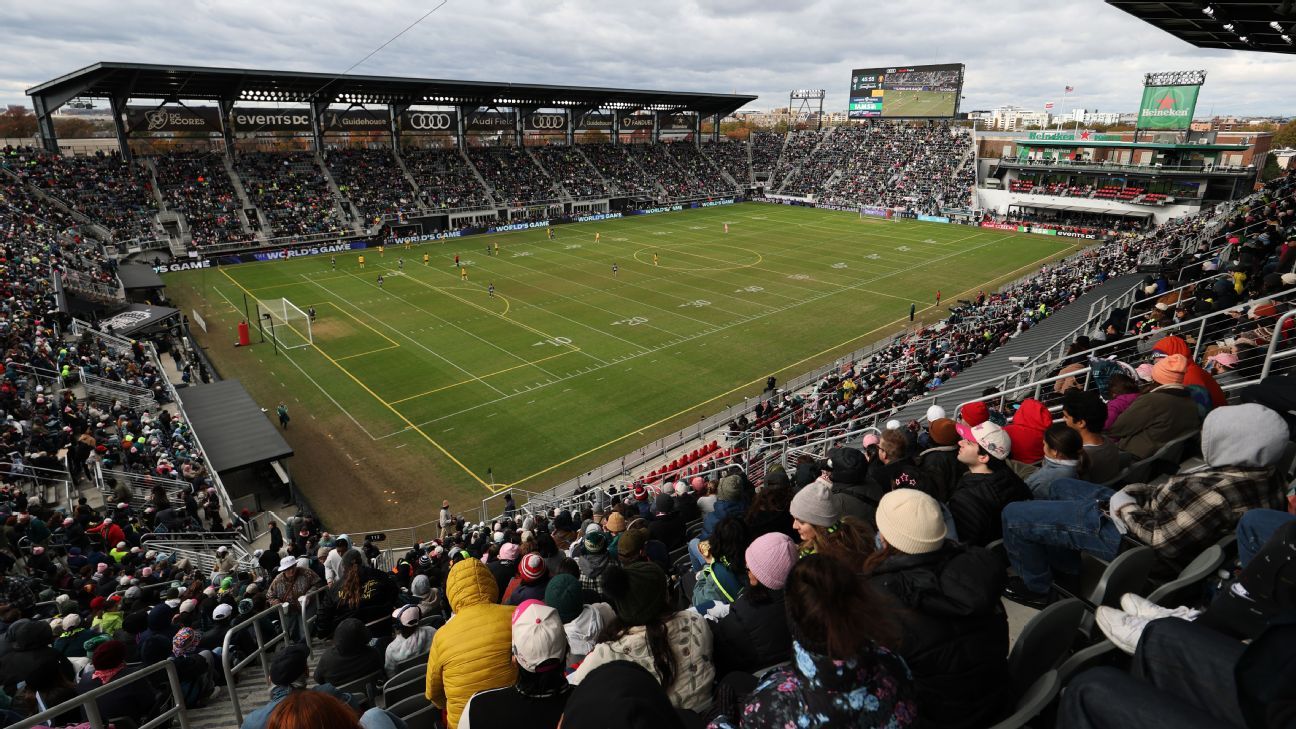
Down I-95, the Washington Spirit was supposed to play its semifinal at an NFL stadium where it had never played (the Washington Commanders’ Northwest Stadium), rather than arguably the best environment in the NWSL at Audi Field, due to an NCAA Division III football game taking place last weekend. MLS’ D.C. United, the operator of Audi Field, scheduled that game.
D.C. United and the Spirit came to an 11th-hour agreement to create a doubleheader — at a six-figure cost to the Spirit, paid by a team sponsor — but it meant playing Saturday’s NWSL semifinal with yellow soccer lines on top of white football lines.
Regardless of when that football game was scheduled, the NWSL’s postseason has taken place on the same November weekends for years. Saturday will be the Spirit’s third straight appearance in the NWSL Championship. What the field will look like remains to be seen.
In each case, the men’s team in charge of the stadium showed exactly where the women’s team stands as a tenant. Those problems are not unique; Angel City FC had to reschedule a home opener in 2025 not even because BMO Stadium itself was booked, but because of an event on the adjacent grounds.
The NWSL’s decisions to admit Atlanta and Columbus as 2028 expansion teams were at least partly informed by solving the league’s infrastructure issue. In each case, the NWSL team will share ownership with an MLS team that controls their venue, ostensibly meaning the men’s and women’s teams will cohabitate equally.
Building a stadium is really the only other solution for an NWSL team. That process costs hundreds of millions of dollars and takes years or decades to come to fruition. For some markets facing political roadblocks and shortages of appealing real estate locations, it will not happen, period.
And how does it fix them?
At just about every turn, “more money” is the answer to a problem in the NWSL.
The league wants to maintain its claim to being the best in the world. It continues to compete against at least a handful of top European clubs for the world’s best players, but those European clubs do not have a salary cap like the NWSL. If the league wants world-class players, it needs to pay all-world salaries — and to more than just one player.
The new High Impact Player rule — which allows teams to pay top players up to $1 million over the salary cap — is a start to that process, but one that many general managers recently told ESPN would not be sufficient.
Expansion teams continue to enter the league at a rapid rate and, with them, more money thanks to increasing expansion fees (Columbus paid $205 million, 100 times more than the expansion fee paid six years ago.)
As travel increases and the demands of the schedule pile up, the need for charter flights becomes more pressing. MLS and the WNBA already switched to charters only; the NWSL still only allows limited charter travel to complement commercial travel. General managers almost unanimously told ESPN in recent months that charter travel has become a necessity.
Switching to charter travel will require major investment, up to $50 million in the short term if the WNBA’s initial two-year estimate is to be used as an example. It also becomes necessary if the rest of the product continues to inflate alongside it. Does the NWSL want million-dollar athletes with increasing celebrity sitting in economy on commercial flights?
Even a few years ago, NWSL players were told to accept these things. A 5,000-seat stadium for a semifinal? Not ideal, but in the NWSL’s recent past, Icahn would have been a charming spot for a game, and everyone would have been happy to see the stands full.
Commercial flights? Hey, that’s reality. Minimum salaries of $6,000 for the year? In 2013, players felt like they had to accept those numbers if they wanted a professional league.
Now, however, ambitions are greater. The NWSL and its teams want to be the best in the world; they want to be considered on par with the great U.S. sports leagues. Billionaire owners have entered the boardroom to make those goals become reality.
If the NWSL wants to be a big-time league, there are bigger bills ahead that need to be paid: new stadiums or better leases, rising player salaries and transfer fees, charter flights and more.
This is the NWSL’s Diderot effect: As it spends more on one thing, it must continue to spend on everything else around it. If not, the same challenges will persist — and with greater scrutiny as the league’s visibility increases.


