
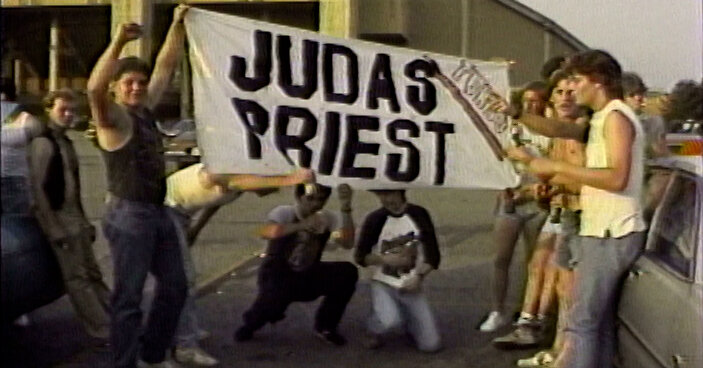
It’s hard to argue with that assessment. On the other hand, the film’s feel-good ridiculousness risks obscuring the fact that Judas Priest had more depth than the Budweiser-chugging teens rocking out to party-and-rebellion anthems like “Living After Midnight” and “You’ve Got Another Thing Comin’” might have fully appreciated.
“Electric Eye,” from the band’s 1982 album “Screaming for Vengeance,” took on mass surveillance in the name of keeping “the country clean.” While “Breaking the Law” hits incredibly hard, it was as much an acknowledgment of the economic pain gripping parts of the United Kingdom in the late ’70s as it was a teenager-approved ode to anarchy. And in 1998, Halford became one of the few figures in pop — let alone heavy metal — to come out as gay during that era. Watching “Heavy Metal Parking Lot” today, this adds a level of irony to the tailgating scene’s aggressively heterosexual vibe.
Others have noticed these contradictions. In February, a new documentary on the band, “The Gospel of Judas Priest,” premiered at the Berlin Film Festival. Co-directed by the Rage Against the Machine guitarist Tom Morello and the veteran metal documentarian Sam Dunn, it is meant as something of a correction, reminding modern viewers just how immense the band’s influence was on rock music and culture.
After unknowingly conquering their slice of the underground, Krulik and Heyn tried to leverage the popularity of “Heavy Metal Parking Lot” into more mainstream projects, with mixed success. In the early 2000s, the Trio TV network produced a short-lived series they created called “Parking Lot.” Episodes included “Dolly Parton Parking Lot,” “Yanni Parking Lot,” “Cher Parking Lot” and “Cat Show Parking Lot” — “although a lot of them didn’t actually take place in a parking lot,” Krulik, 65, said in a video interview. “They were a little liberal with the approach.”
In 2001, after interest from Hollywood, the pair co-wrote a feature film script titled “Heavy Metal Parking Lot: The Movie,” but it was never picked up.
Ultimately, they’ve seen very little money from the documentary. Which may be just as well, since they never secured a music license from Judas Priest or releases from their interview subjects, making their claim to ownership over the film legally murky.
But whatever Krulik and Heyn lack in profit, they’ve made up for in appreciation of their timeless tribute to teenage foolishness and freedom. “It’s lightning in a bottle,” Jorgensen said, adding, “All there was to do back then was to hang out with your friends, smoke cigarettes, drink beer, have sex, listen to music and go to work.”

