
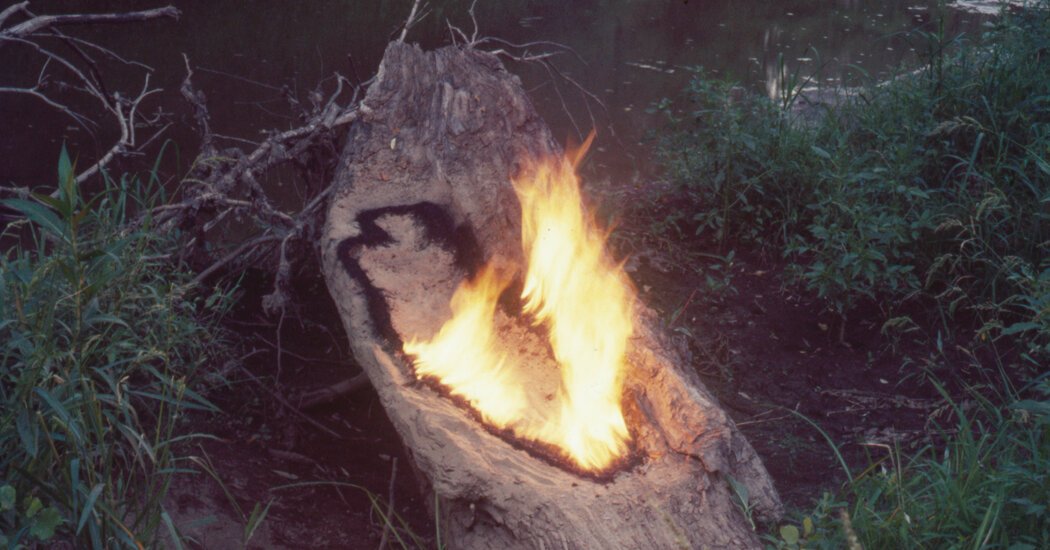
At the exhibition’s opening on Monday evening, another work was recreated: “Anima, Silueta de Cohetes (Firework Piece)” (1976), for which the artist, traveling in Mexico, hired an Oaxacan firework maker to create the outline of her silhouette. Mounted on a pole, when lit it would flame and burn, then fade and flicker, leaving the heart to flame last.
Previously, this work would have been experienced only by Mendieta herself, as one of her “Siluetas” — actions performed alone in the landscape, in which she recorded an ephemeral presence of her own outline. She also called them “earth-body works.”
This might be a kind of additive process, in which a body is made of berries, shells, flowers, cloth, sticks, ice, rocks, moss, red pigment; or a subtractive one, with a body dug, burned, exploded, carved, washed away at a shoreline.
In each case, Mendieta would preserve the “Silueta,” destined to fade and disappear with time, on photographic Super 8 or 16-millimeter film, an image of an image, an action of an action that would then exist in a different form in a gallery space — a work at once permanent and impermanent.
Many of these are on display at Tate, including a handful of films seen for the first time in Britain since the Mendieta estate remastered them. In a section called “The River,” five films that span 1973 to 1978 highlight how enigmatic and unusual, confident and muscular the artist’s practice was.

