
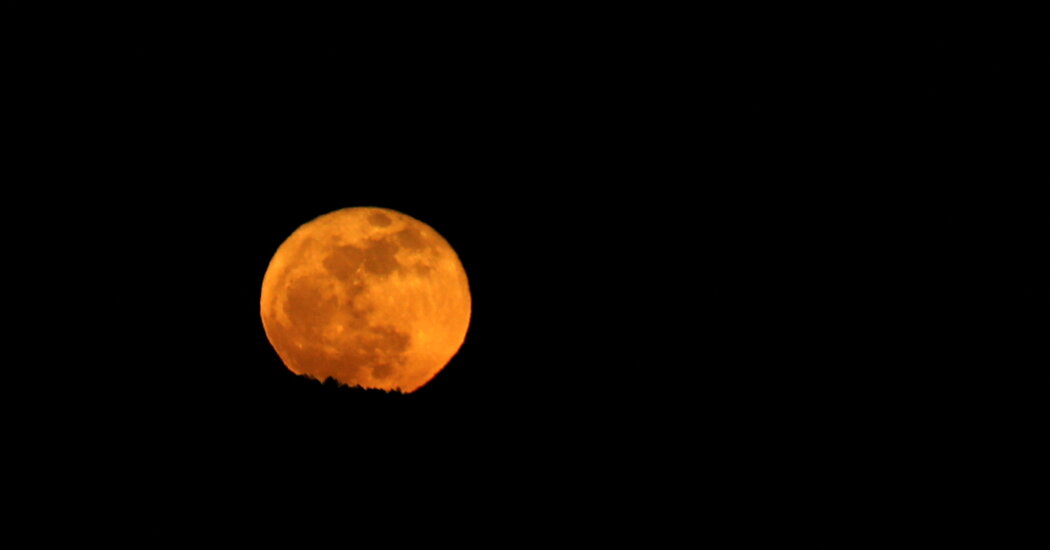
A celestial rarity known as a blue micromoon will grace the night sky this weekend. It arises from the coinciding of two lunar effects.
When there are two full moons in a single calendar month, the second one is referred to as a blue moon. This month, the first full moon was on May 1, and a second one will occur early Sunday morning. May’s blue moon is also a micromoon: It will look smaller and dimmer than usual because our lunar companion is farther away from Earth.
“The difference in size isn’t really dramatic,” said Nick Anderson, an astronomer at the Cleveland Museum of Natural History. “But it is going to appear fainter than an average full moon.”
The moon will appear full all night. But according to the U.S. Naval Observatory, the exact time of the blue micromoon is 4:45 a.m. Eastern time on Sunday.
What causes a blue micromoon?
Each month usually has only one full moon, but every two to three years a month has two — hence the phrase “once in a blue moon.”
This occurs because the lunar cycle is 29.5 days long, just short of the length of most calendar months. This difference means that some months see two full moons.
A micromoon occurs when the full moon phase of the lunar cycle occurs close to apogee, or when the moon is at its farthest distance from Earth. This is because the moon’s orbit around Earth is elliptical, rather than perfectly circular: Sometimes it is closer to us, and sometimes it is farther away.
According to NASA, the moon is about 226,000 miles away at its closest. (This point in its orbit is known as perigee.) At apogee, the moon is about 251,000 miles away.
“The farther away the moon is from us in its orbit, the smaller it’s going to appear, and the fainter it will look,” Mr. Anderson said.
Micromoons, which are sometimes called minimoons, happen a few times a year. They appear about 7 percent smaller and 15 percent fainter than an average full moon.
That change “maybe isn’t going to be pleasing for moon fans,” Mr. Anderson said. “But it’s pretty nice for stargazing,” he added, because the brightness of the moon often shrouds other celestial objects from view.
Will the moon actually look blue?
No, the moon will appear its usual pearly gray. But a blue-tinted moon can sometimes occur, though it is rare. According to NASA, when particles of smoke or dust — arising from phenomena like wildfires or volcanic eruptions — end up in our atmosphere, they can scatter red light, leaving the moon with a blue hue.
The term “blue moon” traditionally refers to the third full moon in a season that had four full moons. But the newer, more popular definition — the second full moon in a month — was coined by the magazine Sky & Telescope in 1946.
How can I see the blue micromoon?
Everyone experiences the same phases of the lunar cycle at night, so the moon will be visible everywhere, as long as clouds don’t obscure the view. Though it will be smaller than usual, the moon is still one of the brightest objects in our sky, so the blue micromoon can be seen with the naked eye even in urban areas with lots of light pollution.
“You won’t miss it, as long as the skies are clear,” Mr. Anderson said.
On Saturday evening, the moon will rise in the eastern sky, around the same time the sun is setting in the west. It will be fullest at 4:45 a.m. Eastern time, early on Sunday morning, before setting around sunrise.
Binoculars or a small telescope can enhance the view, allowing stargazers to see more of the moon’s features.
Is it worth the view?
The blue micromoon will not be as spectacular as the blue supermoon of 2023, which appeared bigger and brighter than usual. But for Mr. Anderson, it’s another opportunity to gaze at the cosmos.
“There’s some beautiful things to see in the sky,” he said, and the moon is “one of the prettiest.”
The blue micromoon will appear near Antares, a huge star of the type known as a red supergiant that is among the brightest in the sky. Venus and Jupiter will also appear close to each other in the western sky on Saturday evening and will be visible with the naked eye.
What other lunar events are happening this year?
Another micromoon will occur at the end of June. The next blue moon, however, won’t occur until December 2028.
But moongazers can look forward to two supermoons occurring later this year, on Nov. 24 and Dec. 23. There will also be a partial lunar eclipse at the end of August.

