
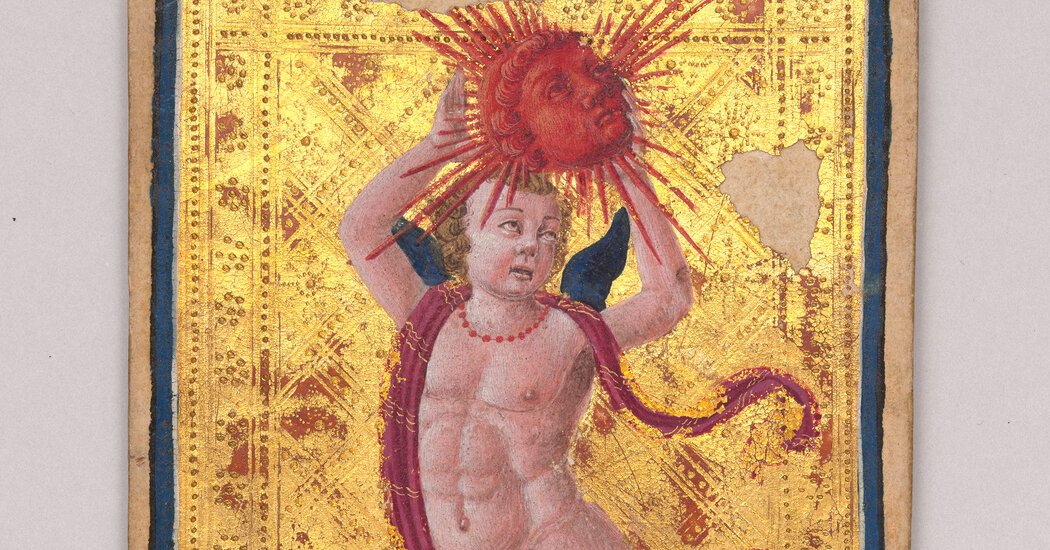
Waite was a leading figure in the Modernist occult movement known as the Golden Dawn, whose adherents included the poet William Butler Yeats and Bram Stoker, the author of “Dracula.” The key thinker behind the tarot occultist movement was Aleister Crowley, the English magician and author, who made his own deck, the Thoth Tarot.
Gilman said that it was probably Smith’s evocative illustrations, which seem to offer an enchanting range of narrative interpretations, that led to the continuing appeal of tarot in modern times.
“This deck has had a hold on people’s imaginations,” Gilman said.
Most sets today contain 78 cards, including what’s known as Major Arcana — character cards like the Magician, the Hanged Man and the Devil — and Minor Arcana cards including numbered suits, like cups, swords, pikes and pentacles (or coins).
Some people still play tarot as a card game, but others are drawn to the sets as a visual lexicon that invites imaginative narration, in part, Gilman said, because its symbols touch on universal themes.
“Maybe all of these cards apply to all of us, like the World card, or the Death card, and they’re open enough that you can find ways that you connect to them, and you find what you need to in them,” she said.
Tarot! Renaissance Symbols, Modern Visions
The Morgan Library & Museum. 225 Madison Avenue, Manhattan; 212-685-0008, themorgan.org.

