
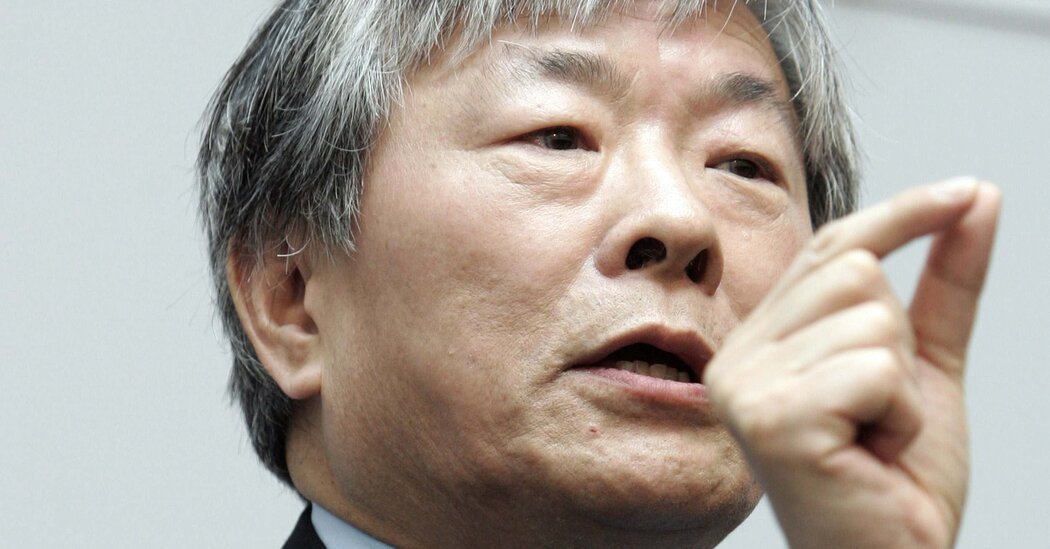
Susumu Tonegawa, a Japanese molecular biologist who won the Nobel Prize in 1987 for figuring out how the body can produce sufficient antibodies to combat a multitude of infections, and who later advanced the understanding of how the brain works by discovering how memories are stored, died on July 11 at his home in San Mateo, Calif. He was 86.
The Massachusetts Institute of Technology, where Dr. Tonegawa was a professor, announced his death.
“Few scientists have reshaped our understanding of biology as profoundly,” Myriam Heiman, the director of M.I.T.’s Picower Institute for Learning and Memory, which Dr. Tonegawa founded in 1994, said in a statement. “His intellectual fearlessness, extraordinary creativity and relentless pursuit of fundamental questions opened entirely new frontiers in both immunology and neuroscience.”
For decades, scientists were confounded by the antibodies created in the white blood cells known as B lymphocytes.
Those antibodies, which fight disease, are shaped like Y’s, with two long and two short symmetrical chains of proteins built from amino acids, all bound together by bridges of sulfur atoms. Most of the long proteins and some of the short ones are considered constants because they are the same in all antibodies.
At the end of each strand are variable amino acids that allow the antibodies to bind to antigens on an array of infections, disabling them. A common analogy is that the constant amino acids are like the shaft of a key, and the variable ones are the notches that turn the lock. As with a key, each combination of notches is unique.
Even so, scientists were puzzled by how the antibodies could create enough combinations to fight millions of infections.
One suggestion was that it was an evolutionary adaptation, passed down from generation to generation in the genes, or what is known as the germ line. But the human body has only about 20,000 genes, so it seemed unlikely that there would be enough to create all the permutations required to fight so many diseases.
Another theory was that the body developed its defenses in somatic cells — in other words, that there were a limited number of antibody genes at birth, but the body was capable of diversifying and building up its defenses over time by modifying those genes.
For a long time, scientists lacked the technology to do the kind of experiments that might have helped them solve the puzzle.
In 1974, while Dr. Tonegawa was working at the Basel Institute for Immunology in Switzerland, he decided to tackle the problem.
In a labor-intensive process that took months, he and an assistant made hybrid probes of messenger RNA — the single-stranded molecule that conveys the genetic information of DNA to other genes — to examine both the DNA of the cancer known as myeloma and that of the embryo tissue of mice. The probes bonded with complementary pieces of DNA, allowing the scientists to identify specific DNA sequences in the tissues they were analyzing. With that information, they were able to graph and compare the patterns in the myeloma and embryo tissues.
The results, which were entirely different, allowed them to see that antibodies were made by combining some of the variable amino acids, often in conjunction with constant amino acids, to create new amino acids. In creating some of the new amino acids, parts of the coding in the DNA strands had been altered; in some cases, the coding had been removed altogether.
Antibodies, they finally understood, could be created in a variety of ways, which is vital given the number of foreign antigens the body must confront.
The debate was over: The somaticeans, as Dr. Tonegawa called them, had won.
In 1976, he published the first in a series of influential papers on his findings. He continued to advance his research, working with others at the Basel lab, and in 1987 became the first Japanese scientist to win the Nobel Prize in Physiology or Medicine, “for his discovery of the genetic principle for generation of antibody diversity.”
The applications of Dr. Tonegawa’s discovery, the Nobel committee noted, could include making vaccines more effective, developing immunological therapies and figuring out how to combat autoimmune diseases that occur when antibodies begin attacking healthy cells.
In 1994, as a professor at M.I.T., Dr. Tonegawa turned his attention to a new subject: neuroscience. After founding the M.I.T. Center for Learning and Memory (now the Picower Institute), he focused on understanding how memories are stored in the brain.
Using state-of-the-art technology, he looked at a group of cells known as engrams, in the hippocampus — the part of the brain responsible for integrating new information into memory — and elsewhere. Dr. Tonegawa discovered that memories are created in the engram cells from a variety of elements, including experiences and perceptions of space, time and the physical characteristics of objects.
In an interview, Li-Huei Tsai, a neuroscientist who succeeded Dr. Tonegawa as the director of the Center for Learning and Memory, equated the process to the way an orchestra combines multiple instruments to produce a piece of music.
In testing on mice, Dr. Tonegawa supplied engram cells with novel information, creating create new and distinct memories.
Those experiments with altering memory, Dr. Heiman said, may eventually be useful in treating PTSD and degenerative brain diseases like Alzheimer’s by modifying or even suppressing negative memories.
Susumu Tonegawa was born on Sept. 5, 1939, in Nagoya, Japan, the second son of Tsutomu and Miyoko Tonegawa. His father was an engineer for a textiles company, and the family moved frequently for his job.
At Kyoto University, Susumu became fascinated with molecular biology. After graduating in 1963, he spent a couple of months working in the laboratory of Itaru Watanabe, at the university’s Institute for Virus Research.
At Dr. Watanabe’s suggestion, he left to study at the University of California San Diego, which had a new doctoral program in molecular biology. He earned his Ph.D. in 1968 and then did postdoctoral work at the nearby Salk Institute for Biological Studies, in the laboratory of Renato Dulbecco, a future Nobel laureate in medicine.
In 1971, Dr. Tonegawa went to work at the Basel Institute for Immunology. He was recruited to M.I.T. in 1981 by Salvador E. Luria, who had shared the Nobel in 1969 for his work on viruses.
Dr. Tonegawa’s first marriage, to Kyoko Sakita, ended in divorce. He married Mayumi Yoshinari in 1985. She survives him, along with two children, Hidde and Hanna. A third child, Satto, died in 2011.
At a conference of Nobel winners in Tokyo in 2017, Dr. Tonegawa was asked to define creativity. “I don’t feel I am a very creative scientist. I wish I could be more creative,” he replied, to laughter.
“But if you force me to think about it,” he added, “I can come up with three simple concepts. One is you have to be very curious about something. No. 2, you have to have an unfailing urge to address the question you have. No. 3, I think it helps to try to combine knowledge in at least two different fields where people don’t necessarily interact.”

