
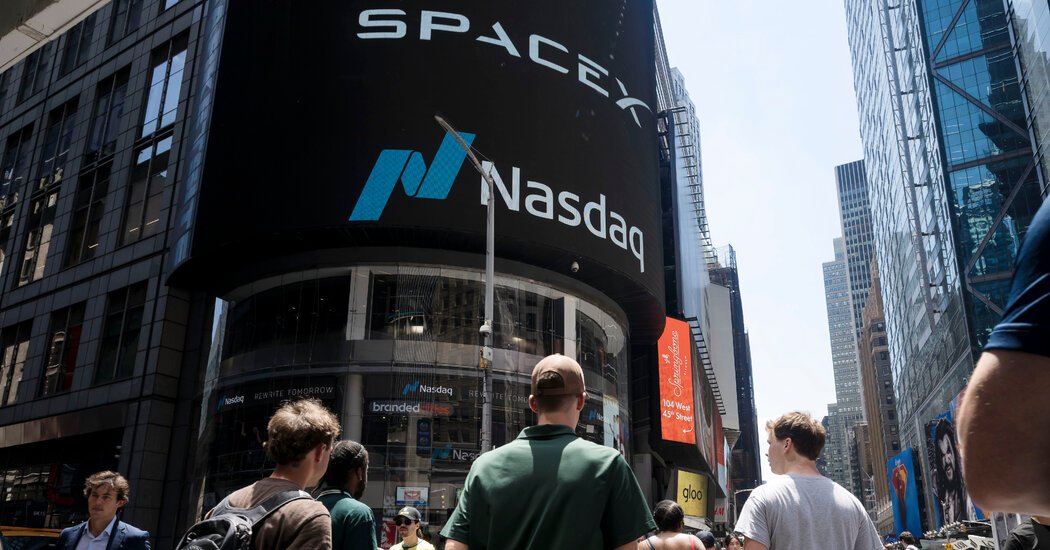
SpaceX went public in June in the largest-ever initial public offering, turning its founder Elon Musk into the world’s first trillionaire.
Since then, the rocket maker has had a rocky ride in the stock market, and Mr. Musk has returned to mere billionaire status, amid questions about the company’s spending on artificial intelligence and whether it can achieve its ambitious ideas, such as launching A.I. data centers into space and building a rocket powerful enough to reach Mars.
On Tuesday, SpaceX showed just how much it was investing to hit those goals.
In its first earnings report as a public company, SpaceX said its capital expenditures jumped to $18.4 billion in the second quarter, up nearly seven times from $2.8 billion a year ago. The spending overshadowed a 92 percent increase in revenue to $7.8 billion. SpaceX also posted a quarterly loss of $541 million, narrower than the $1 billion loss in the same period a year ago.
In an investor call, Mr. Musk, who has often made predictions that he does not achieve, doubled down on his bold claims for SpaceX, indicating that the spending was not about to end. He said his company would launch data centers into space starting next year and hastened his timeline for when SpaceX would generate $1 trillion in revenue.
“Our internal projects for achieving $1 trillion in revenue have moved up from 2031 to 2030,” he said.
The results and Mr. Musk’s comments sent SpaceX’s shares down more than 10 percent in after-hours trading, underlining how drumming up excitement for the company’s public offering may have been easier than keeping that excitement going. SpaceX is trying to balance displaying near-term financial progress while spending on its expensive, long-term aspirations of building orbital data centers, factories on the moon and sending humans to Mars.
How SpaceX fares on the stock market may affect the A.I. start-ups Anthropic and OpenAI, which have also filed to go public. So far, the rocket company may not be inspiring confidence. In recent weeks, its stock has fallen below its I.P.O. price. More bumpiness may be ahead, when insiders are released on Thursday from a “lockup” period that prevented them from selling their shares, potentially flooding the market with more of the stock.
SpaceX is one of several tech giants that are ramping up A.I. spending. This year and next, Amazon, Google, Meta and Microsoft are projected to spend a staggering $1.5 trillion building data centers and stuffing them with advanced chips, according to Wall Street estimates compiled by FactSet. And from April through June, those four companies’ capital expenditures totaled $170 billion, up 72 percent from a year earlier.
Paul Golding, an analyst at Macquarie, cautioned that people should not read too much into SpaceX’s stock performance or its short-term financial results. The focal point, he said, should be on the company’s outlook for its cutting-edge A.I. models, orbital data centers, its satellite internet service Starlink, and Starship, its largest-ever rocket that completed a largely successful test flight last month.
With investments in rockets, satellite internet and A.I. infrastructure, SpaceX has a “moat” that leaves it “uniquely positioned to achieve these big-picture goals,” Mr. Golding said.
On Tuesday, SpaceX showed it had made progress in some of its businesses. Starlink increased subscribers to 12 million, up from 6 million in the same period last year. Its revenue rose 66 percent to $4.3 billion.
On the investor call, Mr. Musk predicted that Starlink would “deliver the majority of the world’s internet” in “less than 10 years.” Gwynne Shotwell, SpaceX’s president and chief operating officer, said she expected Starlink’s business with companies and governments to grow substantially, adding, “It really feels like we’re just getting started all over again.”
Revenue from space launches grew nearly 29 percent to $962 million, though losses in that business widened to $542 million.
The payoff from SpaceX’s A.I. spending is less certain. The company faces stiff competition for its A.I. products, such as its Grok chatbot. In June, it announced a $60 billion deal to buy Cursor, a start-up that develops A.I. tools for writing computer code, as rivals like Anthropic have already pressed ahead with such products. That transaction is expected to close in the current quarter.
More recently, SpaceX has developed a business renting out A.I. computing power from data centers it built for its own A.I. efforts. The company has signed deals to lease excess computing capacity to Google, Anthropic and others.
Mr. Golding said he expected those deals, which could total in the tens of billions of dollars over the next three years, to be reflected in future earnings. Anthropic, which is paying SpaceX $1.25 billion a month until May 2029 for computing power, started using SpaceX’s data centers in May for a reduced fee. Google’s deal begins in October.
Mr. Musk marveled in the investor call at the rapid rate of A.I. development. He called the engineering problems of land-based data centers “trivial” when compared to the issues faced by his workers building rockets.
“By the end of next year, it’s not clear to me that there’s anything digital that A.I. won’t be able to do based on the current rate of improvement,” he said.

