
Lost Science is an ongoing series of accounts from scientists who have lost their jobs or funding after cuts by the Trump administration. The conversations have been edited for clarity and length. Here’s why we’re doing this.
Amy McGovern: I like to tell people I was doing A.I. before A.I. was cool. But really, I always knew I wanted to use artificial intelligence to make a difference in the real world.
Back in 2005, when I first moved to Oklahoma and became a professor, I began studying how A.I. could be used to improve weather forecasts. Specifically, my research tries to improve predictions about extreme weather, like hurricanes, heat waves and snowstorms.
It’s a really hard problem that goes beyond whether or not you need to bring a coat or an umbrella today. It’s about whether or not you should evacuate from a tornado coming down your street in the next five minutes or the next 15 minutes. These are very high-stakes decision-making moments with a lot of uncertainty.
But it’s a perfect problem for A.I. because there is a lot of weather data out there, and data is what A.I. is really good at making sense of. It reveals patterns that humans aren’t able to see and finds useful connections between different weather models.
In the last 20 years, what we can do with A.I. and forecasts has substantially changed. Now A.I. is actually informing forecasts made by government agencies and private sector companies, like the Weather Company, and the results are showing up on people’s phones.
In 2019, I and my collaborators were awarded a $20 million grant from the National Science Foundation to start an A.I. institute dedicated to weather forecasting. The funding supported 24 faculty members, 35 researchers, 46 graduate students and 83 undergraduates. It’s the kind of work you can’t do with smaller, more typical grants.
We could predict when a cold snap would hit ocean waters near South Texas with enough time for animal rescuers to save sea turtles. We improved hail warnings to give people 60 minutes to protect their cars, farming equipment and aircraft, instead of the 15-minute warnings that were possible previously. We improved hurricane forecasts so that meteorologists could reliably estimate a tropical cyclone’s intensity every five minutes, instead of just once or twice a day.
There was so much more we wanted to do. But then, last summer, we found out our funding was ending instead of being renewed as we expected.
The U.S. Office of Management and Budget told NPR that our program wasted taxpayer funds with “climate change hysteria.” The official title of our institute, chosen by the National Science Foundation, did include the word “climate,” but our focus was on extreme weather. Climate and weather are different things.
We’ve been trying to find other grants, but it’s rough out there right now. Without our institute and research efforts like ours, progress in this field will slow down.
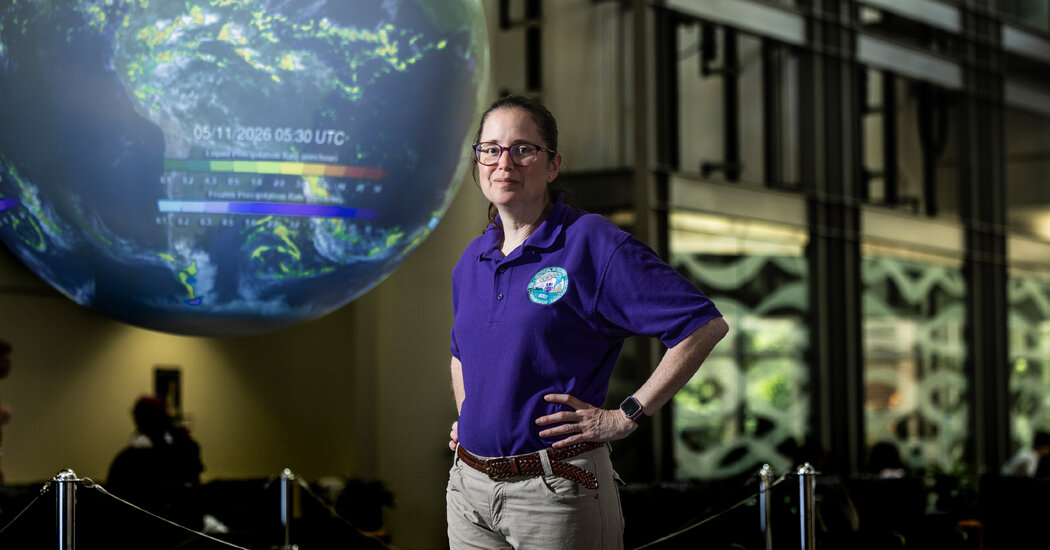
Amy McGovern is a professor in the School of Meteorology and the School of Computer Science at the University of Oklahoma.

