
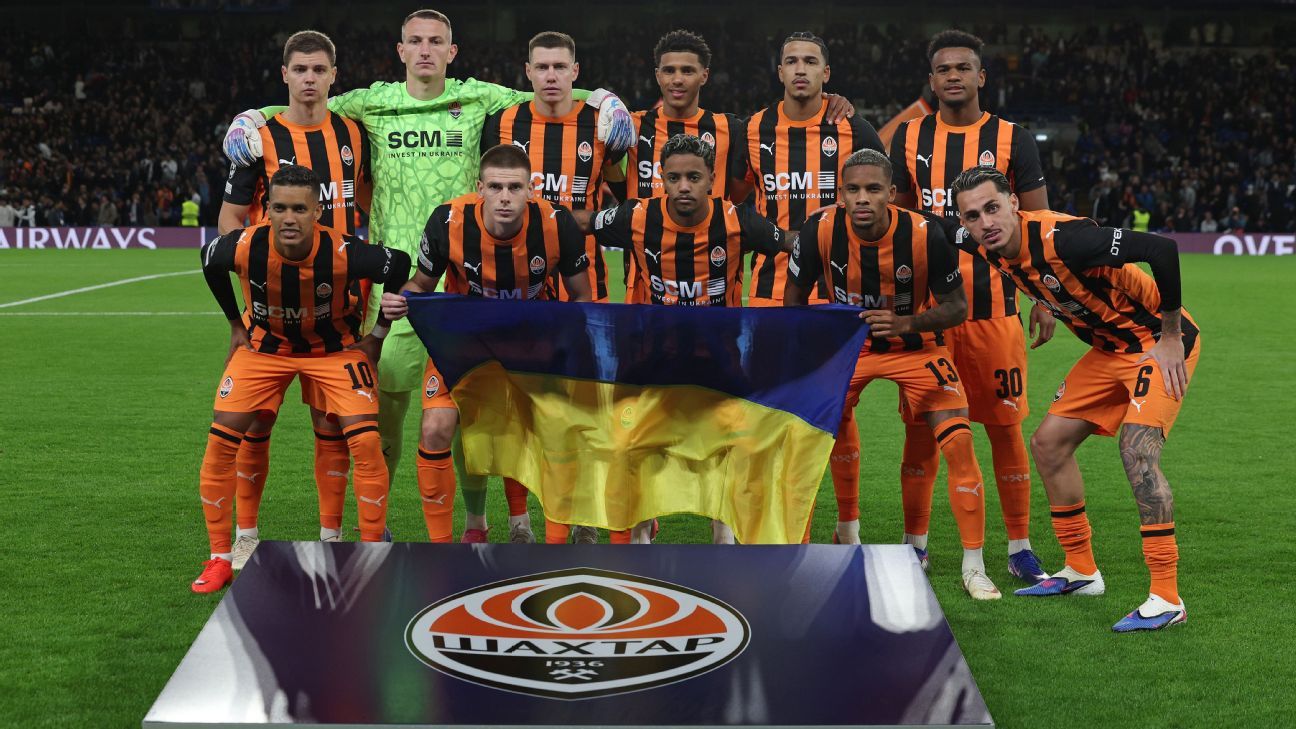
LONDON — Take a step back and revel in the absurdity for a minute. Shakhtar Donetsk, a Ukrainian team from the Russian-speaking part of the country, are playing a Greek team, AEK Athens, in London, at Chelsea‘s Stamford Bridge. Technically, it’s a “home game,” but that concept has become rather meaningless.
Shakhtar haven’t played at their home, the Donbas Arena, since May 2014, some 650 weeks ago. They turn up wherever someone will host them: Odessa, Kyiv, Kharkiv and Lviv for Ukrainian league games; Warsaw, Hamburg, Gelsenkirchen, Krakow, Ljubljana and now London for matches in European competition. Why? Because their opponents can’t (or won’t) travel to Ukraine, where none of the civilian airports are open, air raid sirens go off a dozen times a day, and where drones and bombs can’t be trusted to distinguish between a military captain and the captain of a soccer team.
It’s pretty obvious that in those circumstances, you’re more than a club — you’re a symbol of defiance, an attempt to maintain some sort of normality in the face of a war that has taken more than half a million lives and displaced tens of millions more.
“We are playing for people from Ukraine all over the world,” sporting director Dario Srna said. “Everywhere we’ve gone, they’ve come [to see us]. We represent Ukraine in the center of the world: we’re not just playing for us. [We are] a Ukrainian team, we are not just Shakhtar.”
But, of course, nothing is normal. Everything is messed up, and their mere presence in the Champions League constitutes a political dimension.
Wednesday night, Shakhtar were at Stamford Bridge, the home of Chelsea. Resourceful as ever, street vendors outside the ground hawked their off-brand scarves, except rather than “Cole Palmer,” “João Pedro” and “John Terry,” the names read “Pedrinho,” “[Mykola] Matviyenko” and “[Valeriy] Bondar.” Watching over them was a life-size cardboard cutout of Dwayne Johnson, aka The Rock, only his face was replaced by that of Ukrainian President Vladimir Zelenskyy.
Inside, visiting AEK fans — who turned the Shed End into a two-tier wall of tifo, flags and noise — outsing, if not outnumber, the “home” support.
Because yes, this is Shakhtar’s home for the Champions League this season, a move made possible by the London club’s failure to qualify for European competitions (and, probably, a need to rake in some extra rent on those empty weeknights). Ironically, Chelsea’s previous owner, Roman Abramovich, was forced by the U.K. government to sell the club after the invasion of Ukraine in February 2022, because of his ties to Russian President Vladimir Putin. Abramovich holds passports from Portugal, Israel and Russia. His yachts are moored in Turkey.
Abramovich, whose mother is Ukrainian, is a complicated figure. So is Shakhtar’s version of Abramovich, Rinat Akhmetov.
An ethnic Russian, but Donetsk-born and bred, Akhmetov’s huge wealth from mining and energy bankrolled the club’s rise to prominence prewar — lest we forget, the likes of Willian and Fernandinho, Henrikh Mkiytaryan and Douglas Costa are all Shakhtar alums — and keeps it alive and very much kicking today. Forbes estimates his wealth at nearly $8 billion and like most folks of that ilk, Akhmetov could easily have made different choices, decamping abroad. When the war broke out, he chose to stay, and that was not something to take for granted, given that he had previously clashed with Zelenskyy and, in the 2000s, served in parliament in the party of former pro-Russian Ukrainian President Viktor Yanukovych, whom he also backed financially.
Akhmetov broke with Yanukovych in 2014 and while his pro-Ukrainian words today are loud, his actions — from staying in the country to tirelessly campaigning to his efforts with Shakhtar — speak even louder.
“He can’t leave Ukraine, not after seeing what he has seen,” Srna says of Akhmetov. “It’s impossible. He’s devoted himself to this, helping the economy, helping the people. All while sleeping each night under bombs.”
Many Ukrainians have no choice, which makes the actions of those who could be elsewhere all the more remarkable. It takes an unconventional type of person.
Most of Shakhtar’s players are Brazilian — lured by money, sure, but also the opportunity to showcase their talent. The coach, former Atletico Madrid and Barcelona standout Arda Turan, is Turkish. Even if you don’t remember what he was like as a player, watching him prowl the technical area during the AEK game, fists clenched and eyes wild, you come to understand how this is the same guy who once got into an altercation with a pop star in an Istanbul hospital, a brawl that ended in him firing a gun into the floor.
Srna himself is Croatian, but has been at the club — first as a player then as sporting director — for 23 years. He too could have left umpteen times and, in fact, he says he even turned down the chance to take over Barcelona’s recruitment a decade ago.
“Ukraine and Shakhtar are in my blood,” he says. “If I leave now, I couldn’t live with myself.”
In some ways, Srna has been here before. He was eight years old when civil war broke out in the former Yugoslavia in March 1991. The conflict that would rage for 4½ years, ripped apart communities along ethnic lines. Neighbors took up arms against neighbors. His own father woke up every day supplying baked goods for the military. If you’ve seen the ESPN 30 for 30 documentary “Once Brothers” about the relationship between Drazen Petrovic and Vlade Divac, well … he lived it. Twice. Maybe that’s why he soldiers on, numb to what he is experiencing.
“I have this feeling inside myself,” he says. “It’s a feeling I felt before [as a child experiencing war in Croatia]. But when you feel that pain and it comes back to you again, well, you’re not going to have the same pain twice. I know this pain. I know this feeling …”
Srna trails off as he searches for the right words of history — the worst parts — repeating itself with him in the middle of it. But then he flickers back with righteous anger.
“This is unbelievable, I can’t explain it,” he says. “Four-and-a-half years [this war has continued]. Bombing each other, destroying everything … for what? For f—ing what? People die, families are destroyed, children are traumatized and grow up with psychological problems …”
On this Wednesday night, even as Shakhtar emerge as 3-1 victors over AEK, you’re reminded once again of the difficulties. The team were up at 6 a.m. on Thursday to catch a 10 o’clock flight on a plane they chartered from a budget airline taking them back to Rzeszow in Poland. They’ll then board a bus back across the border into Ukraine, arriving — best-case scenario — at 9 p.m. local time. All this not knowing whether they’ll have power and heat when they arrive, or whether they’ll be making regular trips into the air raid shelter.
You want to end on a note of hope. Srna does his best to offer it, but he clearly isn’t going to lie to you or to himself.
“We [Croatians] have more or less an OK relationship now with Serbia,” he says. “Time [30 years have passed] is helping, generations change, it’s different people. We take a step back and understand what was good, what was not good. We can’t say all Serbian people are bad … But in this moment, it’s not possible to be friends with a Russian person. In time, maybe a few years, maybe many years, I don’t know … right now though, it’s impossible.”
Certainly more impossible than a club without a home in a country at war defying logic and competing in the Champions League against the likes of Real Madrid, who visit Stamford Bridge on Jan. 27.
One of the side effects of war is the normalization of the horrific and the absurd. Shakhtar’s plight has, by necessity, normalized the absurd, in an effort to stave off the horrific.


