
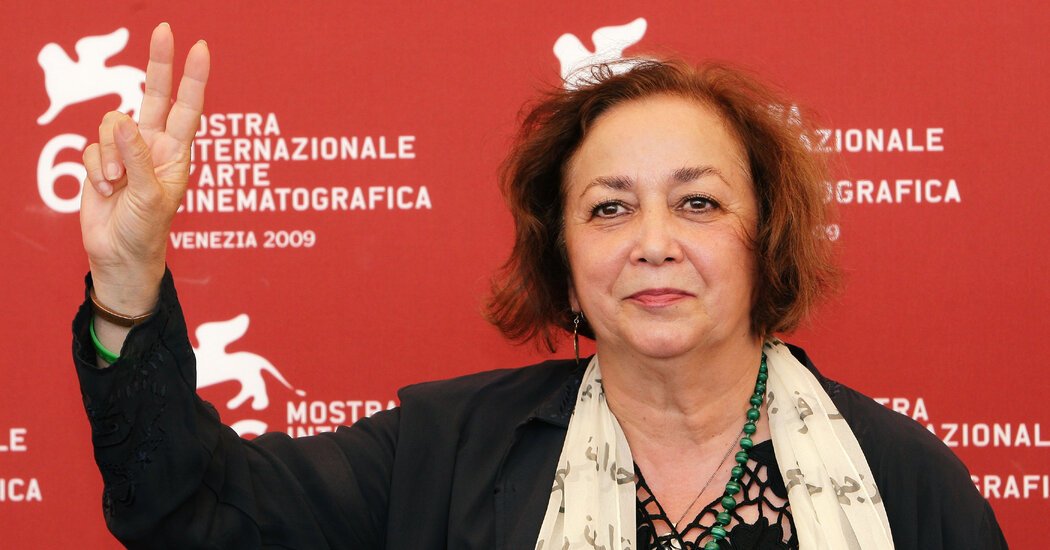
Shahrnush Parsipur, whose novels and stories about the struggles of women in Iran before and after the 1979 Islamic Revolution made her one of the country’s most renowned writers of her generation, and earned her several terms in prison, died on July 3 in San Francisco. She was 80 and had lived in exile in the United States since 1994.
Her son, the artist Ali Taghvai, said her death, in a hospital, was caused by a stroke.
Ms. Parsipur wrote her best-known work, a collection of linked stories called “Women Without Men,” in the late 1970s, but did not publish it until 1989. The book focuses on five women who seek refuge in a Tehran garden during a 1953 coup that strengthened the rule of the Shah, each having struggled, suffered or even died (thanks to a dose of magical realism) at the hands of the country’s oppressive patriarchy.
Though the Iranian censors initially approved the book’s publication, the wife of a high government official complained that its frank discussions of female sexuality violated the Islamic regime’s strict moral codes, and the book was banned. Ms. Parsipur was subsequently jailed twice for trying to keep it in print.
The book took on a second life among the country’s literary underground, and was translated into — and published in — several languages. In 2009, the Iranian artist Shirin Neshat adapted it into a feature film, with Ms. Parsipur playing a cameo role.
“Women Without Men” was originally published in English in 1998, then retranslated and published again in English earlier this year. In February, the new translation, by Faridoun Farrokh, was longlisted for the International Booker Prize.
“There’s a sense of glee, where suffering goes out the other side and comes back as exuberance, throughout,” the critic John Self wrote in The Times of London in March. “‘Women Without Men’ is not just enlightening but entertaining.”
Ms. Parsipur did not align herself with dissident movements under either the Shah or the Islamic republic, and she did not consider herself a feminist. But she insisted that her responsibility as a writer was to illuminate injustices.
“The role of literature is quite clear,” she said in a 2019 interview for the Louisiana Museum of Modern Art in Denmark. “We must address these realities and write about how to solve them.”
Shahrnush Parsipur was born on Feb. 17, 1946, in Khorramshahr, a city in western Iran. Her father, Ali Parsipur, was a lawyer, and her mother, Samilah Fakhr al-Moluk Vala, managed the home.
At 13, she began writing stories, and by the time she had enrolled at the University of Tehran, she was regularly publishing them in Iranian literary journals. Her first book, a children’s story called “The Little Red Ball,” came out in 1969.
After graduating with a degree in sociology in 1973, she went to work for the Iranian state broadcaster, producing radio programs and writing book reviews that she read on the air.
She quit in 1974 to protest the execution of two prominent writers and the imprisonment of four more by the Iranian government under Shah Mohammed Reza Pahlavi.
Soon, she was arrested and charged with opposing the government. She wrote her first novel, “The Dog and the Long Winter,” in 1974. It was one of the first works of fiction by a woman to be published in modern Iran.
In 1967, she married the filmmaker Nasser Taghvai; they divorced in 1974. Along with her son, she is survived by a brother, Shahbaz Parsipur, and a sister, Miryam Parsipur.
Ms. Parsipur spent the late 1970s in Paris, studying Chinese language and history at the Sorbonne. She returned to Iran following the 1979 revolution.
In 1981, she was arrested again, this time for having illegal papers in her car. Though she was later able to prove that the papers were not illegal, she spent four and a half years in prison. For months at a time, she was kept in a solitary cell and forced to endure religious lectures.
In prison, she began a new novel, “Touba and the Meaning of Night,” a sweeping story of a woman’s life set against the backdrop of 20th-century Iran. Guards confiscated the draft and insisted she make changes to it; instead, she destroyed it.
She was released in 1986 and immediately went back to work on “Touba.” It was published in 1989, the same year as “Women Without Men.” She also translated several works from Chinese into Persian, including the I Ching.
Ms. Parsipur spent several months in 1993 lecturing in the United States and Europe. She returned briefly to Iran, but realized that she would be unable to continue publishing under the Islamic regime.
The next year, she moved permanently to the United States. She taught at Brown in the early 2000s and then settled in Richmond, Calif., north of Berkeley, on San Francisco Bay.
She continued to write, including a prison memoir, “Kissing the Sword” (1996 in Persian, 2013 in English), and a nearly 1,000-page science fiction novel, “Shiva” (1999), which has not yet been translated.
The freedom she found in the United States, she admitted, drained her of some of the energy that had motivated her writing in Iran, under the political repression of both the Shah and the Islamic republic.
“The thoughts and ideas I had are fading,” she told The Guardian in March. “I’m not in Iran, so I can’t write something new. I’ve written all my stories already. I can’t write a California story.”

