
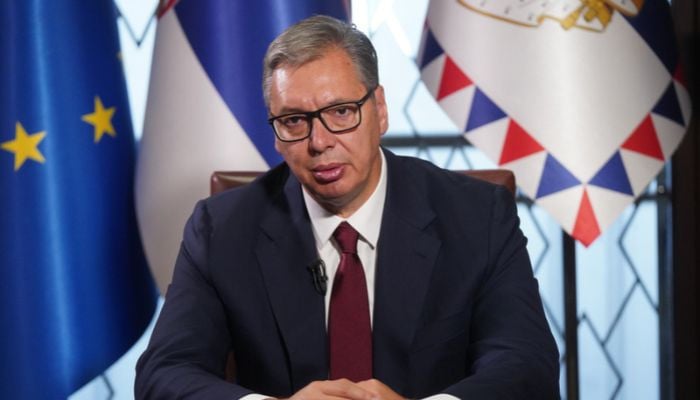
Powerful Serbian President Aleksander Vucic’s 14-year rule has come to an end after the student-led movement secured parliamentary majority in Sunday’s election.
The 56-year-old now-former president conceded defeat on October 25, 2026, nearly two-and-a-half years after continuous protests by the student movement against corruption and his government.
It remains unclear who will lead the Balkan nation after Vucic’s ouster.
The preliminary results of 99% counted ballots reveal student-backed candidates winning 139 seats of the 250-member parliament. They secured 52.7% of the votes.
Vucic’s Serbian Progressive Party (SNS)-led alliance, meanwhile, received 39.2% of votes, securing 97 seats.
The movement emerged following the collapse of a railway station canopy in Novi Sad in November 2024, which killed 16 people and sparked nationwide demonstrations over alleged corruption.
Interestingly, Vucic had resigned from the presidency last month to contest the parliamentary elections and seek the prime minister’s office, hoping to extend his political influence.
However, the defeat has left his political future uncertain, while the student-backed movement faces the challenge of forming a government.
Unlike traditional political parties, the movement has no single leader, with its parliamentary candidates including academics, medical professionals, economists and other public figures.
It has yet to announce its candidate for prime minister.
Under Serbia’s constitution, the newly elected parliament must convene within 30 days of the official election results, while a government must be formed within 90 days of its first sitting.
The country is also expected to hold presidential elections before the end of December.
The incoming leadership will face several challenges, including tackling corruption, improving public institutions and determining Serbia’s relations with the European Union, Russia and China.
Its position on Kosovo, whose independence Serbia refuses to recognise, will also be closely watched.


