
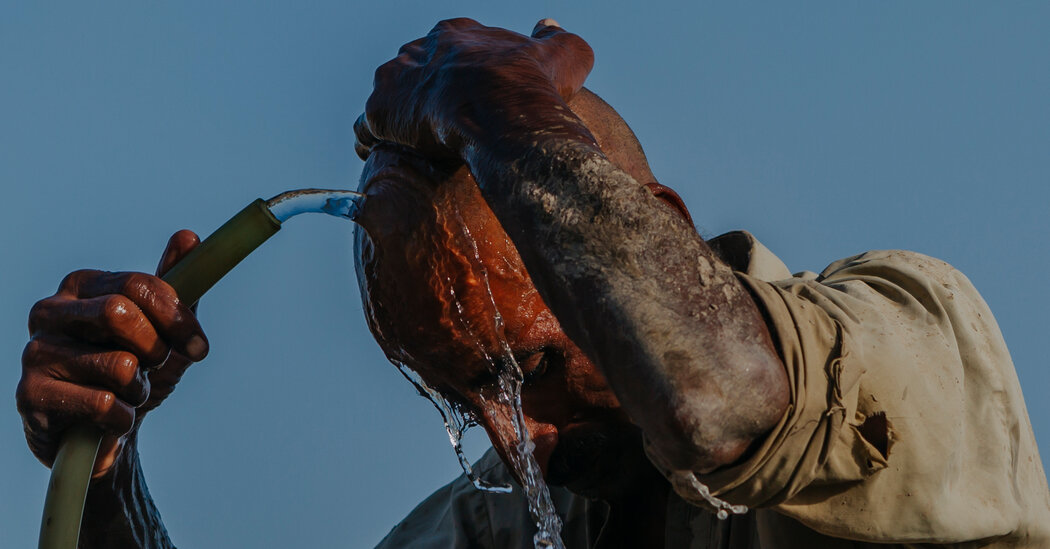
Pakistan ranks among the countries most vulnerable to climate change, and few districts here have experienced as many climate extremes as Dadu.
The temperature in the district, in southern Pakistan, reached 124.7 degrees Fahrenheit, or 51.5 Celsius, on May 28, the highest in the country this year.
“It feels as if the sun has come down closer to the earth,” said Abdul Khaliq, 48, a farmer.
By midday, farmers abandon fields, brick-kiln workers gather in the shade, and vendors pack away stalls. Children jump into ponds, while herders lead buffaloes into the water for relief.
It isn’t just the record heat. The people of Dadu have endured drought, erratic rainfall, water scarcity, sandstorms and the growing threat of destructive floods from glacial lakes in its northern mountains.
Geography makes Dadu unusually vulnerable. Located between the Indus River and the Kirthar mountain range, it faces hazards from both sides. Heavy monsoon rains can swell rivers in the mountains, while the Indus and its canal network threaten low-lying areas. But the monsoons have become more unpredictable, and large parts of the district are prone to drought.
For most of his life in Dadu, Mr. Khaliq divided his year by the seasons — when to plant, when to harvest and when the rains would come. Now, he says, those cycles are gone.
“We used to know what each season would bring,” he said. “Now, every season comes with a warning.”
Recently, blinding sandstorms have swept across Dadu, a sign of the monsoon’s onset and the possibility of floods. While monsoon rains have long been variable, experts have linked the severity of devastating floods in 2022 to climate change.
I first met Mr. Khaliq after that catastrophe. At one point, he was chest-deep in water, trying to save his family and livestock. Much of Dadu had been submerged. Villages became islands, accessible only by boat. Families struggled to find dry land even to bury their dead.
The 2022 disaster caused about $30 billion in damage across Pakistan, and Mr. Khaliq’s family is still recovering, as are many neighbors.
“Each flood made us incur severe debts and forced us to start over,” said Mr. Khaliq, a father of 10.
In the cluster of mud dwellings his extended family shares, watermarks remain visible on the walls, while parts of the property lie in ruins. When those waters receded, they left behind salt deposits that crippled soil fertility. Mr. Khaliq said he harvested almost nothing for two growing seasons.
“It can take two generations for a family to escape poverty, yet floods can destroy decades of progress within days,” Musadik Malik, Pakistan’s climate change minister, said last month at the World Urban Forum, a United Nations-sponsored conference.
Aside from floods, people in Dadu endure long dry spells and droughts.
“The weather has now become our biggest fear,” Mr. Khaliq said. “Without enough rain, our harvests fail. But too much rain destroys everything we have.”
With harvests unpredictable and rising fuel prices increasing the cost of irrigation, transportation and farm equipment, some farmers in Dadu who once grew cotton, rice and onions might now rely on a single wheat crop. Many of the men seek seasonal work in Karachi and other cities.
In Mr. Khaliq’s family, the women and children spend long hours twisting wild plant fibers into rope. This labor-intensive craft earns them all a combined $3 a day.
During cooler mornings, they work outdoors using a hand-operated machine. As temperatures rise, they move into shaded corridors to work under a small solar-powered fan. It runs only after the battery has absorbed enough sunlight to generate electricity.
In dozens of Dadu’s villages, power was never fully restored after the 2022 floods damaged infrastructure. Blackouts can last 14 to 18 hours a day.
“When there is no electricity, the solar panels give us some relief,” Mr. Khaliq said.
But most families in Dadu cannot afford batteries large enough to run fans. Mr. Khaliq bought his system on a $4 monthly installment plan, using savings from selling milk from his two buffaloes.
Recent sandstorms have brought a new worry. “The panels are on the roof, and whenever strong winds come, I fear they could be damaged,” he said. “If anything happens to it, I don’t know how I would afford to replace it.”
Water, too, has become increasingly scarce. In several villages in Dadu, drinking water systems damaged during floods in 2010 were never fully restored, so people here have to buy drinking water and ice.
“Climate change has become a stress test for survival,” said Mashooque Birhmani, head of the Sujag Sansar Organization, a local nonprofit. “It exposes the fragility of everything: governance, agriculture, electricity, water, health and people’s ability to earn a living.”
Looking ahead, Mr. Khaliq said his biggest concern was for his children.
“I don’t know whether my children will still be able to make a living from this land in Dadu,” he said, “or whether they will have to leave and find a future somewhere else.”

