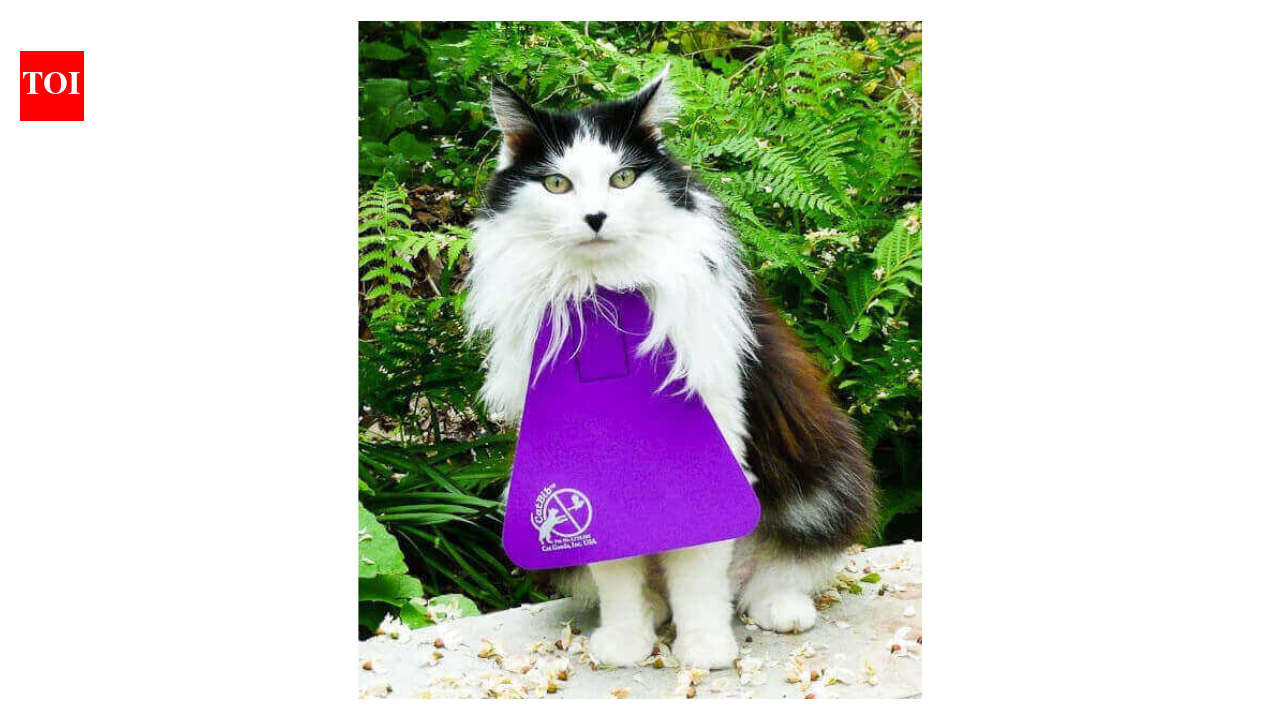
Domestic cats can be effective hunters, and devices designed to reduce their success have increasingly been used as a way to limit predation on wildlife while allowing cats to remain outdoors. One such device is the CatBib, a neoprene bib attached to a cat’s collar and designed to interfere with the pouncing movement used during hunting.Now, researchers have used accelerometers and GPS tracking to examine whether wearing the bib substantially changes how cats move and behave. The study, ‘Conservation gains at minor movement costs: Evaluating a cat-borne predation deterrent,’ published in Applied Animal Behaviour Science, found that cats wearing the device showed about 15% less overall activity. Yet the researchers found no significant change in the distances the cats roamed, suggesting the bib did not simply prevent them from moving around outdoors.
Researchers tracked cats with and without the anti-hunting bib
The study was led by Oakleigh Wilson with Nicole Galea, David Schoeman, Jasmin Annett and Christofer Clemente. The researchers monitored nine free-roaming domestic cats using high-frequency accelerometers, with each cat tracked for eight days, four days wearing the CatBib and four days without it.They also used GPS tracking on seven cats for two days each, with one day spent wearing the bib and one without it. Altogether, the accelerometers produced 1,052 hours of continuous monitoring data. The CatBib used in the experiment was a neoprene bib hanging from the cat’s collar. The device is intended to disrupt the mechanics of pouncing rather than prevent cats from roaming.The researchers wanted to test whether concerns that the bib might restrict normal movement could be detected objectively rather than relying only on owners’ observations.
Image: Canva
Wearing the bib reduced overall activity by about 15%
The accelerometer measurements showed that cats were, on average, 15% less active when wearing the CatBib. The researchers recorded lower overall activity, alongside more time spent inactive and less locomotion.The change was particularly noticeable in how often cats moved. Locomotion events decreased significantly, with the study reporting an approximately 19% reduction in locomotion frequency. Individual periods of locomotion were also shorter when the bib was being worn.At the same time, the researchers did not find a significant reduction in the occurrence of high-energy activity. The study also found that responses varied between individual cats. Differences appeared to be associated with personality rather than body size or sex.The authors therefore described the behavioural effect as relatively small rather than evidence of a major restriction on cats’ normal activity.
GPS showed no change in how far the cats roamed
The reduction in activity did not translate into a measurable reduction in the cats’ overall roaming distances. GPS tracking found no significant change in how far the animals travelled when wearing the bib.That distinction matters because a cat can spend less time moving or move less frequently without necessarily having its outdoor range restricted. The researchers found evidence for changes in activity patterns, but not for a reduction in overall roaming distance.Their findings also suggest that the lower activity was not necessarily caused by the bib physically preventing cats from walking or travelling. The authors noted that the effect could instead be related to the unfamiliarity or annoyance of wearing the device.The study found that cats responded differently to the bib, with more active individuals appearing to experience a greater change in activity.
The study did not test every hunting behaviour
Although the research provides detailed measurements of movement, it does not answer every question about how CatBibs affect cats.The researchers specifically noted that they did not directly measure hunting behaviours such as pouncing and swatting. Because the device is designed to interfere with pouncing, these behaviours would require more targeted investigation.The study also found no significant reduction in high-energy activity and no evidence that the bib altered the cats’ overall roaming distances. Its conclusion was that CatBibs produced a small decrease in daily activity, while showing limited evidence of broader behavioural effects.The findings come from a relatively small sample, nine cats for accelerometer monitoring and seven for GPS tracking, so the authors called for further research into hunting-specific behaviours.
What the findings mean for cats and wildlife
The research adds quantitative evidence to an ongoing question surrounding cat-borne predation deterrents, whether reducing hunting success comes at the cost of substantially restricting cats’ normal behaviour.The researchers found a measurable 15% reduction in activity and less frequent locomotion, but they did not detect a corresponding change in roaming distance. They described the overall behavioural impact as limited, while acknowledging that individual cats responded differently.The study also places the findings in the wider conservation context. Domestic cats can prey on native birds, mammals and reptiles, and devices such as CatBibs are intended to reduce successful hunting without completely preventing outdoor access.The authors concluded that CatBibs slightly reduce cat activity, but found no evidence of an inhibition of locomotion or general activity budgets large enough to indicate a major movement restriction. They also stressed that further work focusing specifically on hunting behaviours would help establish the full effect of the device.