
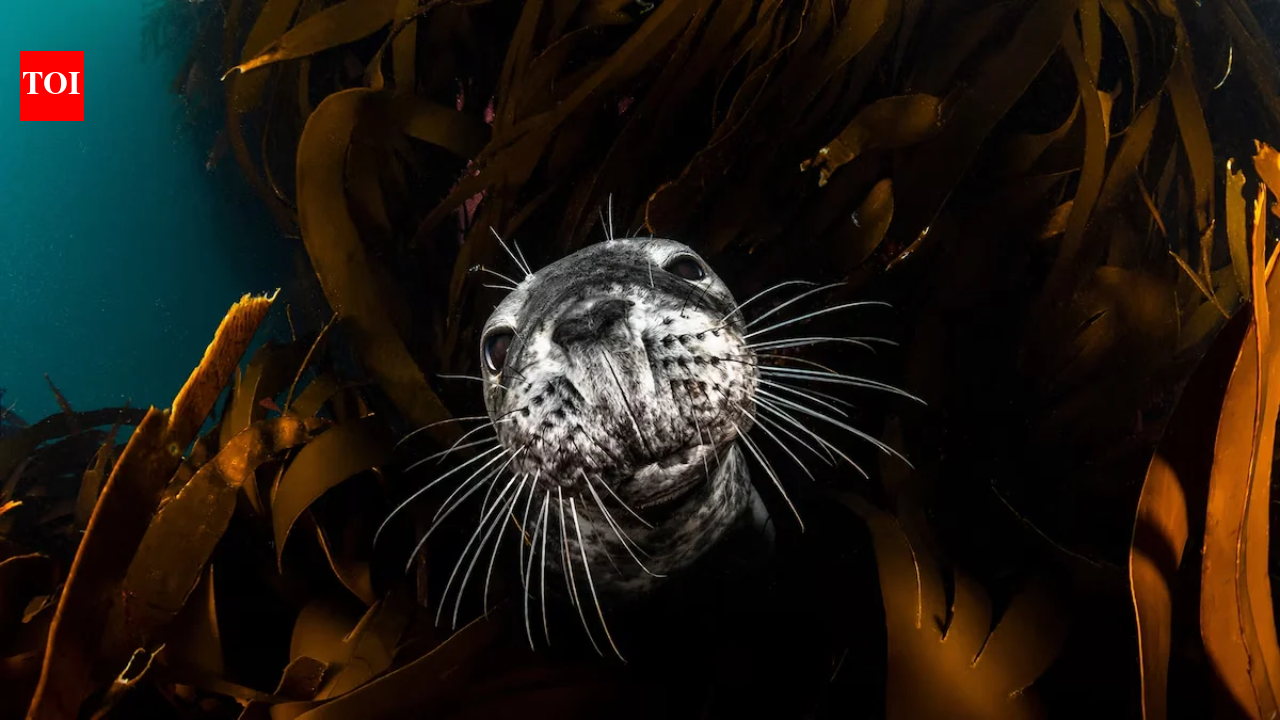
Grey seals at a popular German beach were more likely to stay farther from designated swimming areas when exposed to underwater sound signals, according to a study testing a new way to reduce encounters between marine wildlife and people. Researchers trialled an acoustic deterrent at Helgoland Dune, home to Germany’s largest grey seal colony, to see whether sound could influence where the animals moved without blocking access to their natural habitat. The analysis of more than 22,000 recorded seal positions found that the animals were 3.57 times more likely to occupy farther distance categories when the system was active.
Grey seals at Helgoland Dune create challenges for swimmers and tourists
Helgoland Dune, a small island off Germany’s North Sea coast, is home to the country’s largest colony of grey seals. The area is also a popular destination for visitors, many of whom come to enjoy its beaches and coastal waters.Seals use the surrounding waters as part of their natural habitat, while swimmers expect to use the same area for recreation. Encounters are not necessarily dangerous, but close contact between large marine mammals and people can create risks, particularly when animals enter designated swimming areas.Earlier physical incidents in the shared waters prompted concerns about how these interactions could be managed. Simply keeping seals away from the island was not an option, given the importance of the surrounding environment to the colony. The researchers instead looked at whether the animals could be encouraged to maintain a greater distance from swimmers without being prevented from accessing nearby waters.
Scientists tested an underwater acoustic deterrent
According to the Scientific Reports research titled, ‘Acoustic deterrence as a mitigation tool for seal-human conflicts in the Helgoland Dune swimming zone’ examined an acoustic deterrent system designed to influence seal behaviour through short bursts of sound. It used a technology known as Targeted Acoustic Startle Technology (TAST), which is intended to produce a startle response rather than cause lasting physical harm.During two field trials, the equipment transmitted pulsed underwater signals lasting two seconds. The signals covered frequencies between 700 and 1,500 hertz and were emitted at a source level of 180 decibels relative to one micropascal.A camera system recorded the seals’ movements in relation to the swimming area while the acoustic equipment was operating. This allowed the researchers to compare how far the animals stayed from the relevant zone during periods when the signals were being emitted.
Seals were 3.57 times more likely to remain farther away
The analysis covered 22,086 recorded seal positions. The team used a statistical method called a cumulative link mixed model to examine how the animals’ distances from the swimming zone changed during sound emission.The results indicated a clear difference in where seals were recorded. During periods when the acoustic signals were active, they were 3.57 times more likely to occupy one of the two farther distance categories rather than the closest category.The researchers divided the observations into three distance groups: less than 10 metres, between 10 and 25 metres, and more than 25 metres. The statistical result therefore suggested that seals were more likely to be found at least 10 metres away during signal emission than in the area closest to the swimming zone.The reported odds ratio came with a confidence interval of 2.38 to 5.37, while the statistical test produced a p-value below 0.001. These figures indicate that the observed association was unlikely to be explained by random variation alone.
Study highlights differences in individual grey seal behaviour
The results also revealed considerable differences between individual animals. According to the study, individual variability accounted for 94% of the behavioural differences recorded in the analysis, based on the intraclass correlation coefficient.This suggests that seals did not all respond to the acoustic signals in the same way. While the overall pattern showed a greater likelihood of animals occupying the farther distance categories, their individual behaviour remained an important part of the findings.The study did not establish that the sound system would produce identical results across different seal colonies, seasons or coastal environments. Its findings relate specifically to the conditions observed during the two trials at Helgoland Dune.
Underwater sound system aims to protect swimmers without restricting seal habitat
The researchers presented the acoustic system as a non-invasive option for reducing conflicts between seals and people in recreational coastal areas. Its intended purpose is to discourage animals from approaching a particular zone rather than exclude them from the wider environment.This is relevant to places where wildlife conservation and tourism operate side by side. Physical barriers can interfere with animal movements, while measures that prevent access to entire sections of coastal habitat may create difficulties for wildlife management. An acoustic approach could offer a more targeted way of influencing where animals spend time.The team described the work as the first empirical evidence of this type of acoustic deterrent being effective in a recreational setting. The system’s ability to alter the distribution of seal positions, while leaving access to surrounding waters intact, was central to that assessment.


