
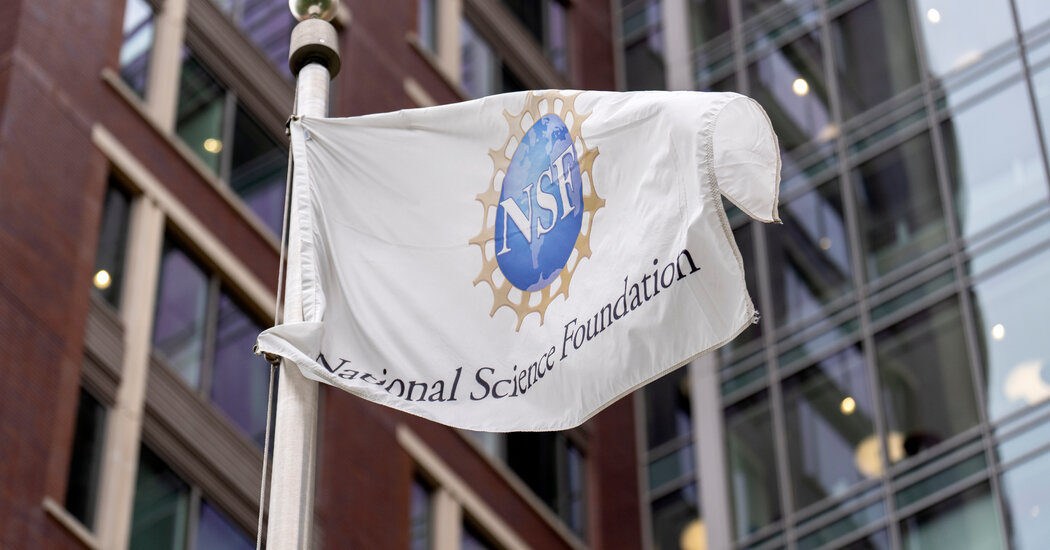
More than 2,500 scientists said in a letter to Congress on Monday that President Trump’s dismissal of the National Science Foundation’s oversight board was an “alarming attack” on research funding that could put the United States at a disadvantage with rivals, especially China.
“We stand with the National Science Board, and call on Congress, as an equal branch of government, to rapidly and firmly support science by calling for the reinstatement of terminated National Science Board members,” the signatories wrote.
In a separate letter last month, more than a dozen former leaders of the foundation urged the White House and Congress to quickly fill the leadership vacuum President Trump created at the agency. Established in 1950, the agency has been responsible for annually distributing about $9 billion in research grants in recent years. That money funds much of the public science research in the United States, from artificial intelligence to astronomy.
The former board members have been trying to call attention to what they say is a growing research funding gap with China. Last week, the N.S.F. published the board’s 2026 report on the state of U.S. science and engineering, which the board had finalized before its dismissal. In the report, the board warned China had overtaken the United States in research and development expenditures.
That gap is likely to grow as science funding under the Trump administration is at a low point.
As of May 1, the agency has committed 10 percent of its congressionally appropriated funds, roughly half of what the foundation had awarded by this point in previous fiscal years, according to Grant Witness, which tracks scientific grants.
A White House spokesman justified the decision to fire the board by pointing to a 2021 Supreme Court decision about the governance structure at another government agency. The spokesman added that the N.S.F. was delivering on Mr. Trump’s pledge to cement America’s technological and innovative dominance.
Former agency board members, however, voiced concerns about the foundation’s ability to fulfill its mission. The dismissal of the board and the yearlong vacancy of the role of foundation director has left the agency “in a very precarious position,” said Yolanda Gil, a computer science professor at the University of Southern California and former board member.
Four people formerly on the board date the deterioration of its relationship with the administration to April 2025, when the N.S.F. canceled hundreds of active research grants without consulting any board members. Shortly thereafter, the foundation’s director, Sethuraman Panchanathan, announced his resignation; another board member, Alondra Nelson, resigned a few weeks later.
Ms. Nelson, a social science professor at the Institute for Advanced Study, said that she had seen the writing on the wall. “It was so clear that our work was going to be compromised,” she said.
Another former board member said the administration had left scientists in the dark on its plans. “It almost didn’t matter what question we asked, the answer would almost come back exactly the same, and it would always be along the lines of, ‘that’s an active conversation with the administration,’” said Keivan Stassun, a physics and astronomy professor at Vanderbilt University. “A lot of euphemism, but no actual answers.”
With limits on its ability to conduct oversight, the board turned to its responsibility of advising Congress on science policy.
Last May, the White House released a budget request for the 2026 fiscal year that proposed slashing N.S.F.’s funding by more than half, but board members advised Congress to maintain similar funding levels as in previous years.
Divided into small groups, board members told lawmakers of both parties about the importance of funding science research, raised the specter of China’s growing scientific output and discussed how new technology could help modernize the N.S.F.
In the end, Congress appropriated $8.75 billion to the research funding agency, a modest cut from the $9.1 billion in fiscal year 2025.
Last month, Mr. Trump released his budget plan for the 2027 fiscal year, again calling for significant N.S.F. cuts. This time, the White House requested about $4.9 billion for the agency, a more than 40 percent cut.
In the proposal, the administration also said it wanted the N.S.F. to fund a $900 million project to build an ice-breaking vessel. Arctic cutters are a priority for this administration, and last October Mr. Trump signed a memorandum directing the Coast Guard to build four Arctic Security Cutters in Finland. As of February, the Coast Guard awarded contracts for 11 ships. It is unclear if there is any connection between the Coast Guard’s vessels and the one Mr. Trump has proposed that the N.S.F. fund.
For the former board members, who were nominally responsible for approving major N.S.F. programs like the Arctic vessel venture, the proposal came as a surprise.
“It just sort of appeared in the president’s budget request,” said Mr. Stassun, who led the board’s subcommittee on funding larger facilities and projects. “It had not gone through any of the normal processes,” he added.
But before board members could discuss the shipbuilding proposal or begin advising Congress on funding levels for the N.S.F., they were dismissed.

