
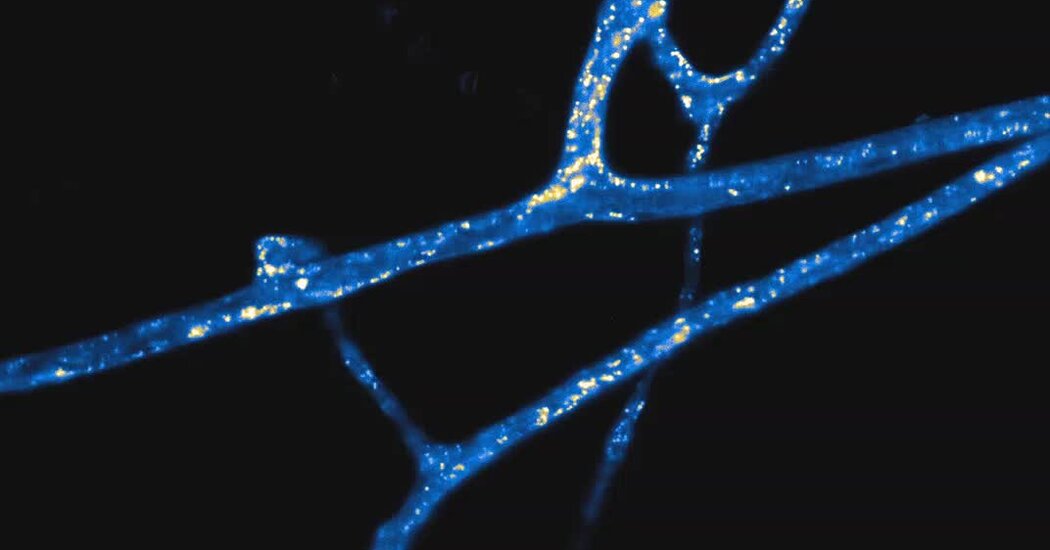
A hidden circulatory system pulses just beneath the planet’s surface. There, embedded in the soil, are dense networks of microorganisms known as arbuscular mycorrhizal fungi. These fungi attach themselves to the roots of plants, sending long, thin filaments out through the soil. These ferry water and nutrients to plants and whisk away carbon, helping to keep vast quantities of it out of the atmosphere.
Laid end to end, these filaments would extend for 68 quadrillion miles — roughly 730 million times the distance between Earth and the sun, scientists reported in a new paper. Collectively, the filaments contain approximately 300 megatons of carbon, or four to six times as much as the carbon contained by all the human beings on the planet, according to the study, which was published in Science on Thursday.
An international team of scientists conducted the research, using a combination of advanced techniques, including machine learning and a high-resolution imaging robot, to measure, predict and map the size of these fungal networks in ecosystems across the globe.
The study revealed particularly dense fungal networks beneath the world’s grasslands, adding to the evidence that these ecosystems, which tend to receive less conservation protection than forests, serve as significant carbon sinks for the planet.
“People just aren’t paying attention to these ecosystems,” said Toby Kiers, an evolutionary biologist at Vrije University Amsterdam and an author of the new paper. “What we want to do with these data is really shine a light on some of these hidden patterns underground.”
More than 70 percent of Earth’s terrestrial plant species rely on arbuscular mycorrhizal fungi, which — in addition to transporting nutrients and storing carbon — also help stabilize the soil and protect plants from environmental stress.
Although it has become clear that these networks are both critical and vast, Dr. Kiers said, “we don’t know where networks are very healthy and where they’re threatened.”
In the new study, she and her colleagues set out to “build a better picture” of this underground infrastructure, she said. They began by compiling data from hundreds of previously published papers, which had collectively analyzed more than 16,000 soil samples from around the world. The authors of these papers had already calculated the density of the fungal filaments, known technically as hyphae, in these samples. (Density was defined as the number of meters of hyphae per cubic centimeter of soil.)
The scientists used this data — alongside information about the environmental conditions where the samples were collected — to train a machine learning model. The model then predicted the fungal density at locations around the globe, including those that had not previously been sampled.
The researchers also photographed lab-grown fungal samples with a high-tech imaging robot, developed by Thomas Shimizu, a biophysicist at the AMOLF Institute in Amsterdam and an author of the new paper, and his team. The robot took high-resolution images of the hyphae, allowing the scientists to determine the filaments’ width.
Together, this data on the global density of the fungi and the width of its branching hyphae allowed the researchers to estimate the total length and mass of these underground fungal networks.
“We’re excited about the number — about a billion times the Earth to the Sun — because it just gives some sort of sense of the magnitude, the scale of what we’re looking at,” Dr. Kiers said. “But to me, what’s more exciting is not just giving it a length but actually putting it on a map and being able to see these patterns.”
Grasslands had higher densities of arbuscular mycorrhizal fungi than any other ecosystems. Particular hot spots included the Florida Everglades, the Sudd wetland in South Sudan and the Tibetan steppe.
The findings were not a total surprise, and previous research has suggested that grasslands are especially rich in arbuscular mycorrhizal fungi.
But the new study highlights the importance of these ecosystems at the global scale, said Liz Koziol, a mycorrhizal fungi ecologist at the University of Kansas who was not involved in the research. “Comparing all these data sets all across the globe, that’s an incredible amount of work,” Dr. Koziol said. “It’s just amazing to look at the global heat map.”
The researchers also found that the density of these networks was roughly 50 percent lower in soil used for growing crops than in non-croplands, though more research is needed to link farming practices to mycorrhizal health, Dr. Kiers said.
Indeed, the researchers acknowledge that the findings come with considerable uncertainty and that there are some regions and ecosystems, like drylands, that are especially understudied.
But Dr. Kiers said she hoped that the team’s findings would help inform conservation and land management policies that protect not only the life aboveground but also the vast fungal networks below it.
“Because I think once they’re gone,” she said, “they’re very hard to bring back.”

